Wild Bounty Showdown is the six reel title
Wild Bounty Showdown is a PG SOFT slot with a six reel board, gold framed symbol transformations and a free spin multiplier that doubles after qualifying winning stages. The character Cass and western setting make it recognisable, but the complete title is the best way to identify it. Wild Bandito is another PG SOFT product with a related visual theme and a different rule structure. Keep both titles distinct in search, catalogue tiles and support records. Recognising a hat or a gold background alone cannot establish which game was running.
The central reading task is to connect three events: a qualifying symbol result, the cascade that follows it and the multiplier state used by the next stage. Gold framed symbols on the middle pair of reels add another state change. The explanations below use assumed credits to show how those relationships work mathematically. They do not recreate a particular recorded spin, predict a feature result or establish a host's account conditions. Confirm the exact title and loaded information panel before applying the description to a live game screen.
Six reel heights explain 3600 ways
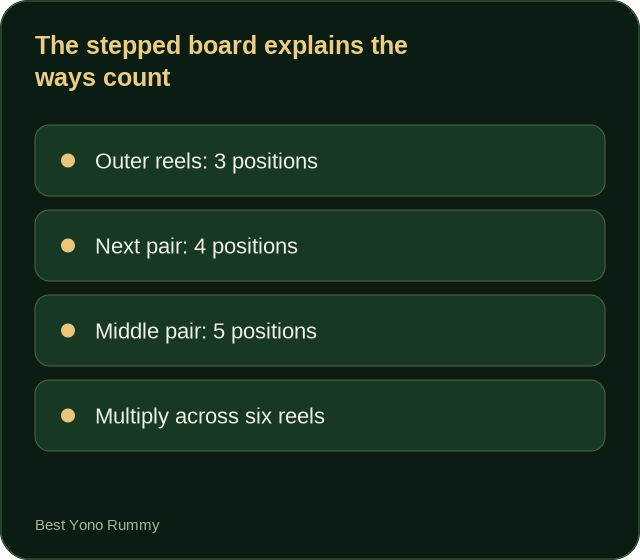
The published board has three positions on reels one and six, four on reels two and five, and five on reels three and four. Multiplying three by four by five by five by four by three gives three thousand six hundred possible position combinations across all six reels. This explains the headline ways structure. It does not mean every combination pays on each outcome. Actual symbol distribution, qualifying succession and paytable values still determine the payment. A ways number describes the evaluation space, while a win describes a specific result within it.
For an illustrative count, suppose a qualifying symbol occupies one position on the first reel, two on the second and one on the third. Those positions create two combinations over that qualifying length. Matching copies elsewhere should not be added as unrelated payments without applying the game's succession rule. The board's taller middle reels give it a distinctive outline, which is useful for product identification. A cover or screenshot that crops away the outer reels can conceal that shape. A complete board image is therefore more informative than a close up of Cass alone when explaining the layout.
Paying stages and the cascade sequence
A qualifying stage resolves before new symbols cascade into the board. Further qualifying outcomes can continue the same initial spin. The initial paid action and the subsequent stages should be recorded separately: one starts the round, while the others develop its award. The sequence can contain ordinary symbol payments, framed transformations and changes to the multiplier. Reading those in order is more reliable than looking only at the last board, which may no longer contain the symbols responsible for the earliest payment.
Assume incremental unmultiplied awards of one, two and three credits in a simplified example. Their total is six. If the screen presents running totals of one, three and six, the final six already includes the earlier stages. Adding all three running displays would overstate the return. The same award can appear first beside the reels and later in a feature summary without becoming two payments. A useful record chooses either individual incremental awards or the completed spin total and keeps that method consistent. A long sequence also does not guarantee a large result, since the value of each qualifying stage still matters.
Gold frames on the central pair of reels
The official rules place gold framed regular symbols on reels three and four, excluding Wilds and scatters. When a framed symbol participates in a winning stage, it transforms into a Wild after the cascade. Participation is the key condition. A gold border visible elsewhere in the screenshot does not by itself establish a transformation or an independent award. First mark the qualifying symbol relationship, then follow the relevant framed positions into the next board state. This explains why the later board can contain a Wild where a regular symbol appeared earlier.
An original sequence diagram can show three views: the ordinary framed symbol, its involvement in a qualifying result and the resulting Wild. Those views explain a causal chain within the rules without imitating an actual operator screenshot. A cropped final Wild can show its presence but cannot establish which earlier combination caused it. The reel restriction also matters: this is a rule for the middle pair of the six reel board, not a statement that every regular symbol on every reel is framed. Preserve the reel numbers in an explanatory image so that the feature remains understandable on a phone.
Wilds do not replace scatter conditions
The published information says a Wild substitutes for regular symbols while excluding scatters. This separates the normal matching role from the free spin trigger. A Wild can affect an eligible regular symbol combination without becoming another scatter for entry counting. Both symbol categories may be visually prominent, but their functions remain distinct. When a board contains a mixture of Wilds, framed symbols and scatters, identify each category before deciding which rule to apply. A general count of special looking symbols is not a valid substitute for their individual conditions.
For an illustrative board with two scatters and a Wild, the Wild should not simply be counted as a third scatter. Whether a regular symbol result pays is a separate question that requires the relevant matching relationship. An annotated screenshot can use one colour for the normal qualifying sequence and another for the scatter count. That separation makes a busy board readable without changing its rules. It is also useful when comparing titles: a different game's bonus symbol substitution should never be assumed to apply here merely because both products belong to the same studio or use similar artwork.
Entering free spins and the eight times start
Three scatters trigger the published free spin feature. Each free spin begins with an eight times win multiplier. That starting value is a rule about feature state, rather than an eight credit payment or a guarantee of eight times the stake on every round. A qualifying award still needs to occur. The remaining spin counter records available rounds, while the multiplier describes the factor relevant to an eligible result. Reading the two labels separately prevents the large starting number from being mistaken for money already credited.
Take an illustrative eligible base award of two credits at the eight times starting level. The resulting amount is sixteen credits. A feature round without a qualifying award does not become sixteen credits just because the starting multiplier is visible. The example demonstrates a calculation after qualification; it does not specify the frequency of such outcomes. The wording that each free spin starts at eight also matters when reading transitions between rounds. Do not assume that the largest multiplier reached in one cascade automatically becomes the starting level of the next independent free spin.
Doubling after winning cascade stages
During the feature, a qualifying winning stage causes the multiplier to double after the award is paid and new symbols cascade. Starting from eight, illustrative successive levels are sixteen, thirty two and sixty four. This is geometric growth, different from adding a fixed one or two. The timing matters as much as the arithmetic. A multiplier displayed after a stage has resolved may describe the next stage, so it should not automatically be applied backwards to the preceding payment when reconstructing a replay.
For a simple example, suppose a two credit eligible award is paid at eight times, producing sixteen credits. After the qualifying increase, an assumed one credit award at sixteen times would also produce sixteen. The equal monetary amounts come from different combinations of base value and multiplier. This shows why the largest multiplier icon is not a complete explanation of the round. A smaller base award at a larger factor can match a larger base award at a smaller factor. The numbers illustrate timing and scaling without forecasting that either stage will occur.

A multiplier ceiling is not the session result
The official information presents a multiplier ceiling and a separate maximum win limit. Those are different concepts, so this page does not infer the final payment from the largest multiplier displayed on the splash screen. A multiplier operates within the award calculation. A maximum win limit bounds the game's payout under its rules. Neither is a prediction of an ordinary feature or a typical session. The loaded information panel should be checked for the precise configuration rather than borrowing a value from an image of another release.
Even without quoting any ceiling, the distinction is easy to demonstrate. An assumed one credit base award at a hundred times produces one hundred credits; an assumed ten credit base award at ten times also produces one hundred. The multiplier alone cannot identify the larger return. Session profit requires another calculation using total stakes and settled returns. If forty credits have been spent and thirty are returned, the result is minus ten regardless of a dramatic multiplier reached along the way. The multiplier is a mechanism, while the session result is an accounting outcome.
Comparing the western themed games accurately
Wild Bounty Showdown differs from Wild Bandito in board size, framed reel positions and feature progression. Wild Bandito has five reels and a one at a time feature multiplier increase. Wild Bounty Showdown has six reels, gold frames on the central pair and doubling from an eight times free spin start. Those are meaningful product differences that should remain visible in the catalogue. Sharing a western theme is useful for browsing, but it is insufficient for directing a launch action or copying a rule explanation between the two pages.
Pinata Wins supplies another comparison because its framed symbols collect multiplier values under a different condition. The same gold outline does not establish the same arithmetic. A visitor can choose a product by understanding what changes after a winning stage: a symbol transformation, a multiplier increase or a collected value. This is a clearer basis for comparison than ranking games by colour intensity or an unmeasured claim of popularity in India. Exact titles and studio attribution also make a support record useful, while a generic reference to the bandit game can leave the actual release uncertain.
Mobile reading and a complete account record
On mobile, preserve the full stepped reel outline, multiplier label and lower stake controls. Ordinary animation speed can help when learning the order of award, cascade and doubling. A speed option affects presentation rather than changing the qualification rule. If browser controls obscure part of the game, adjust the viewing state before placing a stake. For an interrupted round, retain the full title, approximate time, selected stake and any available round identifier. Those details are more useful than a cropped image of a large multiplier without the board or stage context.
Keep monetary records in one unit. A credit amount should not be assumed to equal rupees until the loaded configuration establishes the conversion. Completed returns belong in the return total once, even if shown in several summary screens. The host's wallet, payment methods, verification requirements and withdrawal conditions are separate from PG SOFT's game mechanics. This page does not establish availability for every person in India or a relationship with every Yono named app. It explains a specific published game and uses assumed arithmetic to make its sequence readable before any decision about a host account or live launch.
Questions about Wild Bounty Showdown
Where do gold framed symbols appear?
The published rules place gold framed regular symbols on reels three and four. A qualifying framed symbol involved in a winning stage transforms into a Wild after the cascade.
Does a Wild count as a scatter?
The published substitution rule excludes scatters. A Wild can help the regular symbol evaluation, but it should not be counted as a replacement scatter for the free spin entry condition.
Does the largest multiplier carry into every next free spin?
The published description states that each free spin starts at eight times. Qualifying winning stages double the multiplier within the sequence, so the previous peak should not be assumed to become every later starting level.
Source notes
Listing reference: game artwork and catalogue.