Treasures of Aztec and the transforming board
Treasures of Aztec is a PG SOFT slot built around changing ways, cascading results and framed symbols that can move through a transformation sequence. Its explorer and temple setting identify the theme, while the silver and gold frames explain an important part of the board's state. The complete title and studio should remain visible on the catalogue tile and loading screen. A generic temple cover cannot establish that a product uses these exact rules, particularly when a lobby contains several ancient treasure themed games from different suppliers.
The most useful reading order is to identify the current qualifying symbol result, follow the cascade, observe any frame transformation and then read the multiplier used for the next award. Normal play and free spins increase that multiplier differently. The examples below use assumed credits and simplified boards to make the sequence understandable. They are original arithmetic illustrations, not recorded game results or forecasts. The loaded information panel remains the reference for the precise configuration, especially when comparing a current game with an older video or a short clip that omits the opening state.
A ways display that changes with the board
The game's changing board can display different ways counts as symbol arrangements develop. The official information illustrates six reels and a maximum layout reaching thirty two thousand four hundred ways. A current ways display is a description of the board's position combinations, not a guarantee that all those combinations pay. The important practical task is to read the qualifying symbol succession and its paytable value. A large ways number can appear alongside a small payment or no qualifying payment at all without implying that the display is wrong.
For a purely illustrative count, two matching positions on one reel, three on the next and two on the next create twelve combinations over that qualifying sequence. The multiplication describes combinations of positions, not twelve separate guaranteed cash amounts before qualification. If a required reel lacks the matching relationship, later copies cannot simply be added to bridge the gap. This is why a complete board is more informative than a cropped ways label. The label gives structural context; the actual symbols explain whether the current result qualifies and what length of match the paytable evaluates.
Cascades preserve the connection between stages
After a winning stage resolves, symbols cascade and the next board can create another result within the same spin. The initial paid action and the later stages should not be treated as unrelated new bets. Instead, record one starting stake and follow the awards generated by its sequence. The frame transformations are especially important here because the later board can contain a different symbol state in a position involved in the earlier win. A final screenshot alone may omit the event that explains why a Wild appeared.
Suppose hypothetical incremental awards are two, four and one credits. Their total is seven. A running display of two, then six, then seven is an accumulated record, so adding all three displays would overstate the amount returned. A final celebration can show the same seven again without creating another award. This bookkeeping point becomes useful when a sequence also has changing multiplier labels. Read the award at the factor relevant to its own stage, rather than applying the final multiplier backwards to every earlier amount. The sequence order is part of the explanation, not merely an animation between independent images.
Silver frames are the first transformation state
The published Wilds on the Way rule concerns certain larger regular symbols on reels two through five. A silver framed symbol involved in a win becomes a randomly selected regular symbol with a gold frame after the cascade. Wilds and scatters are excluded from the regular symbol selection described by that rule. The frame therefore records a specific transformation state rather than acting as an independent money value. A silver border by itself does not establish that a symbol has already become a Wild or that it will pay again on the next board.
An explanatory sequence can mark one silver framed position, highlight the qualifying win and then show its new gold framed regular symbol. The symbol inside the frame can change, so following only the picture of the object can lose the continuity. The position and border state together make the transition clear. A frame on a symbol not involved in the qualifying win should not be assumed to undergo the same change merely because its colour matches. This conditional reading prevents a decorative feature description from being mistaken for an unconditional promise that every framed symbol develops on every spin.
Gold frames can lead to Wilds
A gold framed symbol involved in a subsequent qualifying win transforms into a Wild after the cascade. This makes the silver to gold to Wild sequence a useful way to explain the design, while preserving the requirement for participation in qualifying wins. The intermediate gold state is not equivalent to an already completed Wild transformation. Each stage needs its own event. The resulting Wild then follows the game's substitution rule, which excludes scatters. A Wild created through this route does not automatically supply another scatter towards feature entry.
For an illustrative three frame diagram, label the first image silver regular symbol, the second gold regular symbol and the third Wild. Place a qualifying win condition between the images rather than an unconditional arrow suggesting the change always happens. This is a more accurate illustration than showing three colours with no explanation of what connects them. It also helps on mobile because the outlines may be small. A person can understand the state sequence before trying to follow several framed positions at once in a real cascade. The diagram explains the rule without pretending to show a tested operator result.

Normal spin multipliers increase one at a time
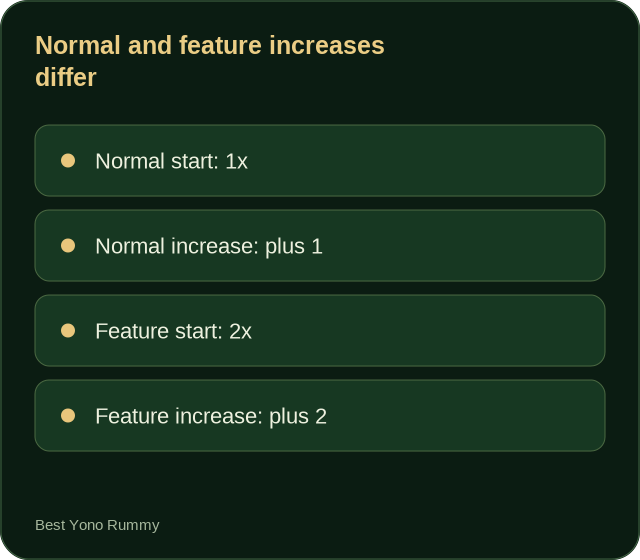
At the start of a normal spin, the published multiplier is one times. After a winning stage is paid and new symbols cascade, the multiplier increases by one. The increase is additive and follows the preceding award. It should not be confused with doubling or applied backwards to earlier stages after a later value appears. A simple record can list the stage number, current factor and resulting award in separate columns. That makes the timing readable even when several symbols transform between the stages.
Assume an eligible two credit award at one times, followed by an assumed three credit award at two times. The amounts are two and six credits, giving eight in total. If the multiplier later rises to three, that does not turn the first two credit award into six retroactively. The example demonstrates sequencing without claiming that these two outcomes occur together. The current multiplier is a state used for the relevant calculation. A later, larger label is not a replacement for every factor that appeared earlier in the round. This distinction is central to reading a complete cascade accurately.
Four scatters enter the free spin feature
The published entry condition is four scatters for ten free spins, with each additional scatter adding two more. The feature begins at a two times multiplier and can retrigger. These are separate facts from the regular ways evaluation. Count scatters under the feature condition rather than treating them as regular matching symbols or combining them across unrelated normal spins. The starting number of free spins describes rounds available at entry. It does not guarantee a particular number of transformations, a final multiplier or a feature payment.
An illustrative ten spin feature can finish with a larger or smaller award than an independent twelve spin feature. Both are consistent with their starting counts because the symbols and qualifying results within those rounds can differ. The remaining spin counter also differs from the multiplier display: one counts rounds, while the other scales eligible awards. A retrigger changes the available rounds under its rule; a frame transformation changes a symbol state. Keeping these events separate helps explain a busy feature without reducing every animation to an undefined bonus or assuming that every favourable looking event adds money directly.
Free spin multipliers increase by two
During free spins, the published multiplier increases by two after a winning stage is paid and new symbols cascade. This differs from the normal spin increase of one. Starting from the feature's two times level, illustrative successive values are four, six and eight. The sequence is additive, rather than two, four, eight and sixteen through repeated doubling. That distinction matters when reconstructing a payment from a video. Use the state relevant to the award and preserve the order in which the multiplier increased.
For a simplified example, an eligible two credit award at four times becomes eight credits. A later eligible one credit award at six times becomes six. The larger factor has produced the smaller monetary award because its underlying base value is lower. This shows why a multiplier label alone cannot describe the total result. It also prevents confusion with Wild Bounty Showdown, whose feature publishes doubling. Two PG SOFT games can both show cascading symbols and growing multipliers while changing those multipliers under different arithmetic rules. The exact title determines which progression should be used.
Comparing frame mechanics across the catalogue
Treasures of Aztec uses a silver frame stage before the gold frame can become a Wild after another qualifying event. Pinata Wins and Wild Bounty Showdown use their own gold framed symbol conditions, so their descriptions should not be copied word for word into this product page. The useful comparison is the sequence of states and the event required between them. A visitor can then distinguish a two step frame development from a different collected multiplier or Wild transformation mechanism, even when the artwork uses the same colours.
Sugar Rush 1000 provides a contrast with position based multiplier development. A persistent multiplier cell is a different object from a regular symbol moving from silver to gold to Wild. Both can make later stages relevant to earlier state changes, but they do so through different rules. This comparison does not establish which game is more profitable. It explains what to watch. A catalogue organised around those mechanisms offers a practical choice, while a list of large numerical ceilings alone does not explain how a person should read the board or identify the correct game.
Mobile controls and the completed calculation
On a phone, keep the reel area, changing ways display, multiplier and lower stake controls visible together. Normal speed can make the frame sequence easier to follow while learning. If the browser covers a control, resolve the viewing state before starting. An interrupted round should be documented with the full title, time, stake and any available round reference. A cropped Wild portrait cannot establish the preceding transformation sequence or the final settlement. The host's completed round history and wallet record provide different information from an unfinished animation.
Use one unit for the session record. Fifteen paid spins at two credits cost thirty credits; settled returns of twenty seven produce a loss of three. A six times multiplier displayed during a feature is not another six credits to add to that return. Confirm any credit to currency conversion in the loaded configuration before treating a figure as rupees. Registration, deposits, verification, withdrawals and individual eligibility in India belong to the host's current terms. This page explains the specific PG SOFT game and its published transformation rules, without claiming those separate account facts or promising that an illustrated sequence will recur.
Questions about Treasures of Aztec
Does a silver frame immediately become a Wild?
A qualifying silver framed symbol first becomes a gold framed regular symbol after the cascade. A gold framed symbol involved in a later qualifying win can then transform into a Wild.
How do normal and free spin multiplier increases differ?
The published normal spin multiplier starts at one and rises by one after a winning cascade stage. The free spin feature starts at two and increases by two under its stated winning stage condition.
Can Wilds replace scatters in Treasures of Aztec?
The published substitution rule excludes scatters. A Wild can participate in normal symbol evaluation, but it should not be counted as an extra scatter for the four scatter feature entry condition.
Source notes
Listing reference: game artwork and catalogue.