Ganesha Gold and the PG SOFT identity
Ganesha Gold is a PG SOFT slot with five reels, three rows and a free spin feature that collects Wild symbols to increase a multiplier. The exact title and studio distinguish it from other games using an elephant character or a gold theme. A familiar cultural image in a cover is not enough to identify the rules. Look for Ganesha Gold in the loading screen and PG SOFT in the supplier information. This is particularly useful in a large catalogue where several unrelated titles can share a similar palette, character silhouette or promise of fortune in their names.
The game's structure is easier to understand by separating three questions. First, does the board contain a qualifying sequence of matching symbols? Second, do scatters trigger a feature? Third, has the feature collected enough Wilds to change its multiplier? These questions use different symbols and counters. Combining them into one general idea of a lucky screen makes the result harder to read. The calculations below use assumed credits to explain the relationships. They do not claim that a cultural theme changes the outcome, or that the illustrated amounts have been observed in an actual session.
What 243 ways means on five reels
Ganesha Gold uses a ways structure rather than a list of fixed drawn paylines. Matching symbols must continue through the required consecutive reels from the leftmost reel. The three positions on each of five reels create the familiar two hundred and forty three possible position combinations when all reels are considered. That number describes the board structure, not a count of guaranteed winning outcomes on every spin. A qualifying symbol must still appear in the appropriate succession, and the paytable establishes how long that succession must be for its payment.
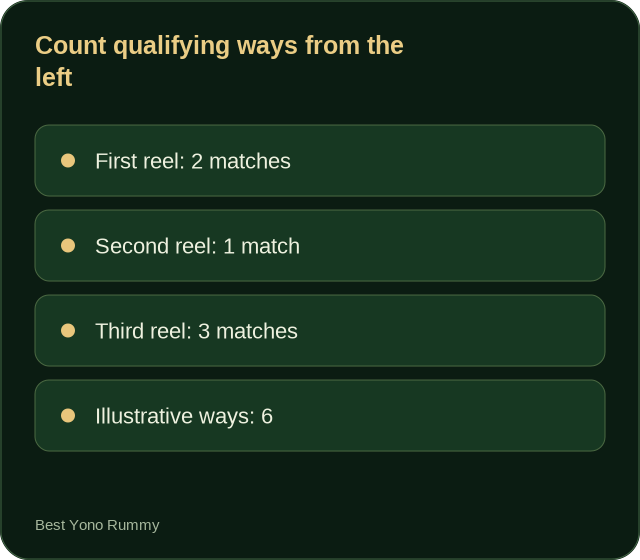
Suppose a hypothetical symbol appears in two positions on the first reel, one on the second and three on the third. For a qualifying three reel match, those counts create six combinations: two times one times three. If that same symbol is absent from the second reel, matching symbols on the first and third do not bridge the gap by themselves. This is the practical difference between counting ways and counting matching symbols anywhere. The total number of copies visible on the screen is not the only question. Their distribution across consecutive reels determines whether the required route exists.
Turning symbol combinations into an amount
After identifying qualifying ways, apply the relevant symbol payment at the selected stake. The ways count and the symbol value perform separate jobs. One describes how many valid combinations exist, while the other supplies the value associated with the qualifying length and symbol type. Higher value artwork does not remove the need for a valid sequence. Likewise, several low value symbols can create more than one way without becoming a new premium symbol. Reading the current paytable is more reliable than assigning amounts from memory or borrowing another PG SOFT game's illustrated values.
For a purely mathematical example, assume a qualifying combination pays two credits per way and there are six ways. The combined amount is twelve credits before any applicable feature multiplier. These assumed values show multiplication without reproducing a particular paytable entry. If another outcome has only one qualifying way but pays fifteen credits for that symbol, it can exceed the first result despite having fewer ways. This is why the largest ways number in a screenshot is not a complete description of the award. Both the qualifying count and the symbol's value are needed to explain the final figure.
Wilds substitute within specific reels
The published rules place Wild symbols on reels two, three and four. They substitute for regular symbols but do not substitute for scatters. A Wild therefore has a matching role within a sequence and a separate collection role during free spins. It cannot automatically repair every missing feature condition. For example, a Wild standing beside two scatters should not simply be counted as a third scatter. The two symbol categories have distinct jobs, even if both are visually prominent and associated with favourable animations.
An illustrative board can show why the position restriction matters. Matching regular symbols on the first and third reels may be linked by a Wild on the second when the game's normal substitution conditions apply. That is a sequence through consecutive reels. A Wild on the third reel cannot create the required leftmost start if the first reel does not contain the relevant matching symbol. It is useful to annotate the qualifying route from left to right before counting its combinations. This makes the Wild's effect specific and visible rather than treating it as a generic payment icon that pays independently wherever it appears.
Three scatter counts and their starting awards
The published free spin entry awards are twelve spins for three scatters, fifteen for four and twenty for five. These counts are evaluated under the feature rule, rather than the ordinary ways calculation. The extra starting rounds change the initial number of opportunities, but they do not specify how much will be won. A feature with more starting spins can still produce less than another feature with fewer. Keep the starting award and the final result separate when comparing two completed features or trying to understand a recorded example.
The difference also explains why combining scatters from unrelated paid spins is unhelpful. Two scatters on one outcome and one on another are not automatically a three scatter trigger. Read the feature notification attached to the actual qualifying board. Once the feature begins, the remaining spin counter becomes the useful record of rounds still to resolve. A payment animation does not necessarily add spins, and an increase in the multiplier does not necessarily change that counter. Keeping those labels separate turns a busy screen into a sequence of specific, understandable events.
Wild collection increases the feature multiplier
Free spins begin with a two times win multiplier. The feature collects Wild symbols, and each group of three collected Wilds raises the multiplier by two, up to the published twenty times ceiling. The collection counter and active multiplier are therefore linked, but they are not the same number. A counter may show progress towards another increase while the current multiplier continues to apply. The key moment is completion of the required group. Merely seeing one Wild does not mean that the multiplier has jumped to its largest possible value.
An illustrative progression is two, four, six and eight times after successive qualifying increases. This is an additive increase of two, rather than repeated doubling. Four becomes six, not eight, at the next increase. The distinction is easy to miss when a feature celebration makes every increase look equally dramatic. If an assumed eligible award is three credits, a four times multiplier produces twelve; a six times multiplier produces eighteen. Those calculations explain the value of a state already reached. They do not predict how many Wilds will arrive before the remaining spins are used.
Separate the Wild counter from money received
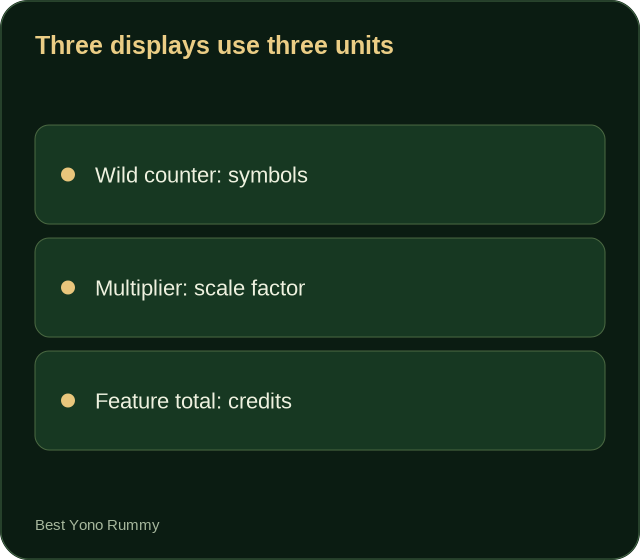
A collected Wild advances feature progression; it is not itself a fixed amount of cash. The actual payment still depends on the qualifying reel result and active multiplier. This is why the collection counter can change without the same number of credits appearing in the balance. Read the counter as a record of symbols, the multiplier as a scale factor and the feature total as a record of awards. All three are useful, but adding their displayed numbers together would combine incompatible units and produce a meaningless result.
For example, imagine a screen showing two Wilds collected towards the next increase, an active six times multiplier and a feature total of thirty credits. That does not mean thirty eight credits are available by adding two and six to thirty. The first number counts symbols, the second scales eligible awards and only the third is a monetary total in this illustration. A simple diagram with three labelled boxes can communicate this distinction better than a large unlabelled win screenshot. It also explains why a nearly complete collection group is still a state to resolve, rather than an amount already owed.
Reading the visual theme without changing the rules
The character, coins, lamps and decorative setting help make Ganesha Gold recognisable within the catalogue. The regular symbols and letter symbols also have different paytable roles, so the illustration should leave their outlines clear. On a small phone screen, an image that preserves the centre reels and feature counter is more informative than an extreme close up of the character alone. The theme provides continuity between the tile and the loaded game; the rule labels establish what actually happened in a round.
The title's use of Ganesha does not establish religious endorsement, a special outcome pattern for Indian players or a relationship with a bank or government service. Those would be different claims requiring different evidence. The useful product information is concrete: the exact PG SOFT title, its ways structure, where Wilds appear and how the free spin collection changes the multiplier. A person arriving through an English or Hinglish search can use that information without being promised luck based on the theme. The same care applies to support screenshots, which should identify the game and round rather than rely solely on a recognisable character.
Comparing Ganesha Gold with other multiplier games
Ganesha Gold increases its feature multiplier by collecting groups of Wilds. Lucky Neko uses Cat symbols, while Wild Bandito changes its feature multiplier after winning cascade stages. These are different conditions even when all three show an increasing number near the reels. A catalogue that labels each simply as a multiplier slot misses the decision a person actually needs to make: which event changes the state? This page keeps the Wild collection condition central so that the game can be compared on its sequence rather than its colour or largest advertised number.
It also differs from Sugar Rush 1000's position map. A collected Wild counter is not a persistent multiplier attached to a square of the board. A rule from one mechanism should not be transferred to the other because both contain golden highlights. Choose the title whose process is easiest to follow, then verify the loaded paytable and stake. There is no inference here that one mechanism produces better personal returns. A small set of appealing outcomes cannot establish that, and a multiplier ceiling cannot describe how often particular qualifying events occur.
A clear mobile and session record
Before starting on a phone, make sure the stake selector, information menu, spin control and Wild collection display can be read without browser overlays. Use the selected unit consistently. Twenty paid spins at two credits cost forty credits; if settled returns total thirty one, the net result is minus nine credits. A large multiplier reached during a feature does not replace that calculation. The completed payment total is what belongs in the returns column, and a running feature total should not be added again to its own final summary.
If a round is interrupted, preserve the exact title, approximate time, stake and any available round reference. The host wallet and the game presentation are separate components, so an incomplete animation alone is not enough to reconstruct settlement. Deposit, withdrawal, verification and local eligibility details must come from the host's current information. This product page explains the published Ganesha Gold mechanics and uses hypothetical numbers to make them readable. It does not claim that the game is available through every Yono named app, nor that the same account conditions apply wherever its cover appears.
Questions about Ganesha Gold
Where can Ganesha Gold Wilds appear?
The published rules place Wild symbols on reels two, three and four. They substitute for regular symbols but exclude scatters, so they cannot be counted as replacement scatter symbols for feature entry.
How does its free spin multiplier rise?
The feature begins at two times. Collecting each group of three Wild symbols increases the multiplier by two, up to the published twenty times ceiling; the progression is not repeated doubling.
Does 243 ways mean 243 payments on every spin?
It describes the five reel, three row ways structure. An actual payment still requires the appropriate matching symbols in succession from the leftmost reel, with the current paytable determining their value.
Source notes
Listing reference: game artwork and catalogue.