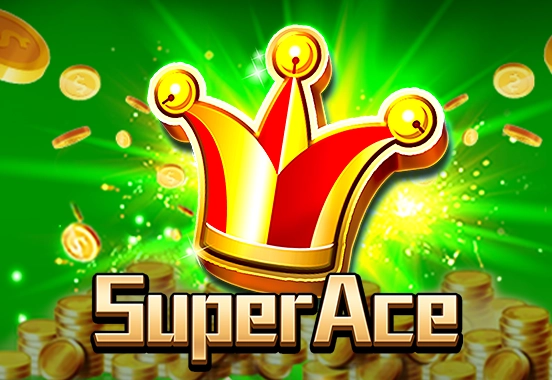
Super Ace is a slot with card symbols
Super Ace is a JILI Games slot whose card artwork sits inside a reel game with cascading results and multipliers. It is not a rummy table where a player draws cards, builds sets and declares a hand. That distinction is especially useful in a Yono related catalogue, where slot titles and card games can appear beside one another. The word Ace and familiar card ranks identify the visual theme; the loaded slot rules determine the result. The complete title and studio should therefore remain visible on the product tile and loading screen.
The official game description identifies one thousand and twenty four ways, multiplier development through consecutive winning eliminations and a Golden Card transformation into a Golden Joker. These elements form the reading sequence for this page. Begin with the qualifying symbol result, follow its elimination, observe the transformed symbol and then read the applicable multiplier. The arithmetic below uses invented credits for clarity. It does not demonstrate a strategy for selecting cards, predict another spin or establish that a particular Yono named application contains the official JILI product.
What the 1024 ways label describes
The ways label describes a reel evaluation structure, not a hand ranking from poker or a scoring system from rummy. Matching symbols need to meet the succession conditions stated by the loaded paytable. A board containing several Aces does not establish a payment merely because Ace is a high card in another game. Their positions and the relevant qualifying length matter. Open the information panel to see the game's exact symbol values and matching conditions rather than importing rules from a familiar card table.
For an illustrative ways count, assume two matching positions on one qualifying reel, two on the next and one on the next. That creates four combinations over the relevant sequence. The arithmetic is two times two times one. It explains how multiple positions can participate without assigning an invented Super Ace paytable amount to a particular rank. A high total ways number does not mean every combination pays on every spin. It is the evaluation space within which an actual symbol arrangement must qualify. This distinction makes the board easier to read than treating every visible card as a separate cash award.
Eliminations connect the boards in one spin
Super Ace's official description connects successive winning eliminations with its multiplier mechanic. After a qualifying result, the board can change and continue the same spin. A single initial action can therefore produce several displayed stages. These stages are part of the paid round's resolution rather than independent new stakes every time symbols move. The visual continuity matters because a symbol that disappears or transforms in one stage can explain the appearance of a special symbol in the next.
Suppose a hypothetical sequence produces incremental base awards of one, two and four credits. The unmultiplied sum is seven. A running display of one, three and seven already accumulates those awards, so adding all three displays would double count earlier stages. The final summary may present the same total again. Choose either incremental awards or the completed total when keeping a record. A long elimination sequence does not by itself establish a larger payment than a short one; the symbol values and multiplier application determine the actual result. The number of animation stages is only one part of the visible story.
Golden Cards are a specific symbol state
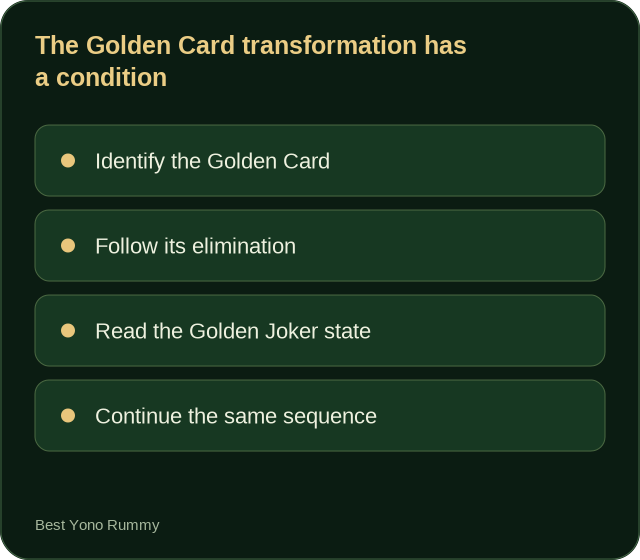
The Golden Card is a named feature in Super Ace, rather than a generic description of any yellow card in the artwork. Its role is connected to elimination. The official description says that a Golden Joker appears after a Golden Card is eliminated. To understand the transition, follow the symbol through the qualifying sequence instead of inspecting only the final special symbol. A gold border in a static cover is not enough to establish that the condition occurred in a particular round.
An original explanatory image can show the regular Golden Card state, mark the elimination event and then show the Golden Joker state. The arrow between them should carry the condition rather than implying that every Golden Card changes simply because time passes. The surrounding qualifying symbols are useful context because they explain why an elimination happened. A close up of the Joker can identify its appearance, but not the earlier board that produced it. Keeping the full sequence readable is more informative than adding decorative gold effects to an otherwise unlabelled screenshot.
The Golden Joker is not a rummy hand card
The Golden Joker belongs to Super Ace's slot rules. It should not be interpreted using a rummy convention about printed jokers, wild ranks or the composition of a valid declaration. There is no player decision to move the displayed Golden Joker into a chosen set on these reels. The game evaluates its symbol role under the loaded paytable. This is an important product distinction for an audience browsing both Yono Rummy pages and slot pages within the same hub. Shared card imagery does not mean shared controls or shared scoring.
For a practical comparison, a rummy player may choose which card to discard after a draw. A Super Ace spin resolves a reel outcome and its programmed sequence. Tapping a particular card picture is not a documented method for choosing the next result. A clear product page should keep those interfaces separate rather than describing the slot as a card skill table. The exact Joker substitution details should be read in the loaded information screen. The verified transformation identity is enough to explain what to watch without inventing additional powers, payment values or manual choices for the special symbol.
Multipliers develop through consecutive wins
The official description links accumulated multipliers to consecutive winning eliminations. This means the current sequence matters. Read the applicable multiplier at each stage together with the eligible award, rather than assuming that the largest number seen later applied to every earlier stage. A multiplier is a scale factor, not an amount of money. A growing factor can affect a later qualifying award, but its presence alone does not establish that an award has occurred. The game display should make the active stage and accumulated result distinguishable.
For a simplified example, an eligible two credit award at a three times factor becomes six credits. An assumed later one credit award at five times becomes five. The stage with the larger multiplier has produced the smaller amount because its base award is lower. This illustrates why the multiplier alone cannot identify the largest payment. The example does not specify Super Ace's exact stage schedule; the loaded rules provide that schedule. It demonstrates the arithmetic after a factor is known, without guessing a progression from another JILI title or treating a visually similar card slot as the same release.
Free game multipliers differ from normal play
JILI's published description states that the free game's multipliers are double those of the main game. This is a comparison between two game states, rather than a statement that every free spin result doubles the entire account balance. The actual monetary effect still depends on a qualifying base award and the relevant multiplier stage. The free game entry and its precise spin count should be read in the loaded rules. This page does not manufacture a trigger threshold from a similarly named title or an unofficial video.
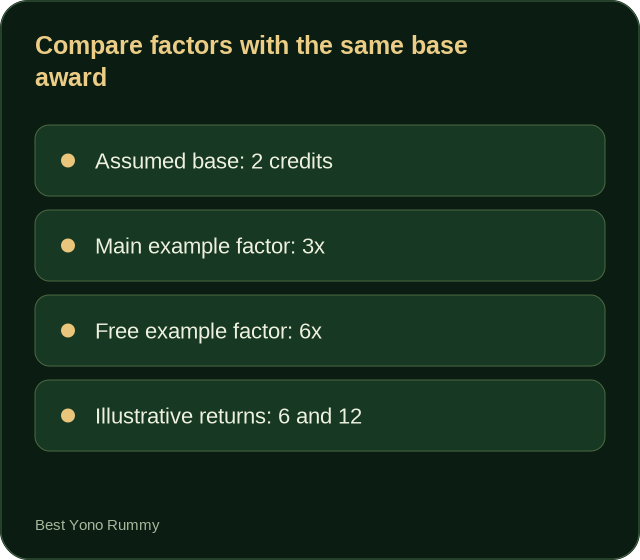
An illustrative comparison can hold the base award constant. If a hypothetical main game factor is three and its corresponding free game factor is six, an eligible two credit award would become six in the first calculation and twelve in the second. This isolates the published doubling relationship without claiming that the two outcomes occur with the same frequency or even in the same session. If the base awards differ, the final comparison can differ too. A doubled factor is a rule about scaling an eligible award, not a guarantee that a free feature recovers all earlier stakes.
Three quantities to keep separate
The stake, current multiplier and completed return are different quantities. The stake is the selected cost of starting a paid round. The multiplier scales an eligible award within that round. The completed return is the amount produced by the settled sequence. Mixing those labels is a common source of confusing calculations in any multiplier slot. In Super Ace, the card art can add another distraction because a person may attach outside meanings to the ranks. Use the displayed unit and the game's own labels rather than a mental card scoring system.
Imagine a screen with a two credit stake, a five times factor and an accumulated return of eight credits. Adding two and five to eight would not describe another payment. If an eligible base award of one credit is subsequently multiplied by five, that produces a five credit award to include once in the completed total. This simple separation can be illustrated with three labelled boxes. It also helps when a celebration and the balance show the same award at different times. A repeated display is not evidence of a duplicate payment, and a factor is not a second currency amount.
Comparing Super Ace with other catalogue games
Super Ace can be compared with Ganesha Gold by asking what changes the multiplier. Super Ace's published description focuses on consecutive winning eliminations and doubled free game factors. Ganesha Gold increases a feature multiplier through groups of collected Wilds. Their themes and triggers differ even though both can display growing numbers. A catalogue that only says multiplier slot would conceal the useful distinction. The product page should describe the event that changes the state so that a visitor can choose a sequence they understand.
Fortune Gems editions provide another contrast with their compact gem boards, fixed lines and edition specific features. The Golden Card to Golden Joker transformation belongs to Super Ace and should not be copied into a Fortune Gems page merely because both are in a JILI catalogue. A larger ways count also does not establish better personal returns than a five line game. It describes a different evaluation structure. Keep exact names, studios and loaded rules together, and avoid ranking titles by a few dramatic clips or an unmeasured statement that one is the most popular in India.
Mobile controls and the completed session
On mobile, make sure the full reel area, active multiplier, stake selector and information menu remain visible. Normal speed can be helpful while learning how an elimination leads to a Golden Joker and another stage. A speed option changes the presentation pace rather than turning card tapping into an outcome choice. If a connection interrupts a round, retain the exact title, time, stake and any host round reference. Those details are more useful than a cropped picture of a Golden Joker without the preceding sequence or final settlement.
For a session example, twenty paid spins at two credits cost forty credits. Completed returns of thirty two leave a loss of eight, regardless of a memorable multiplier or card animation. Confirm any credit conversion before treating those amounts as rupees. Registration, deposits, verification, withdrawals and local eligibility are facts about the host service and its current terms. The JILI product page does not establish them for every application using Yono in its name. This page explains Super Ace's verified identity and core sequence, with assumed arithmetic that helps read results without promising a particular future award.
Questions about Super Ace
Is Super Ace a rummy game?
Super Ace is a JILI Games slot with card themed symbols, ways evaluation and winning eliminations. Its Ace and Joker artwork does not create a rummy table with drawing, discarding or declaring hands.
What produces the Golden Joker?
The official description links the Golden Joker appearance to elimination of a Golden Card. Follow that transformation sequence rather than treating every gold coloured card in a cover as an already qualified special symbol.
How do free game multipliers differ?
JILI describes the free game multipliers as double the main game multipliers. That compares scaling factors; an eligible award is still needed, and it does not mean doubling the entire account balance.
Source notes
Listing reference: game artwork and catalogue.