Fortune Gems 3 and its official catalogue identity
Fortune Gems 3 is a compact gem slot listed in the official JILI Games catalogue and also documented by TaDa Gaming. The verified product identity is more precise than assigning every similarly named gem game to one imagined Yono developer. The complete title matters: the third edition is separate from Fortune Gems 2 and Fortune Gems 500. The catalogue pages identify a three by three main board, five fixed paylines and symbol splitting. The loaded title and supplier information should be checked before applying a rule description to a live screen.
The detailed TaDa product description also separates a fourth multiplier reel from the main symbol board. That produces a useful reading order: establish a qualifying line, consider its split reward and then follow the separate multiplier calculation. This page uses hypothetical credits to explain those operations without reproducing a particular operator's result. The official sources differ in some numerical presentation, so a regional product page should not be treated as proof that every host uses one identical configuration. The current loaded information screen is the relevant reference for the actual version being presented.
The three by three board and five lines
The main board has three reels with three positions each. Five fixed paylines evaluate matching symbols in the required patterns from left to right. The right side reel has a different role and should not be treated as another ordinary gem column extending those lines. A small board can still produce several things to read because line qualification, split state and the multiplier are separate layers. Start with the main grid before allowing a large number on the right to distract from whether a qualifying result exists.
Imagine three matching symbols across the main reels in a hypothetical horizontal pattern. Their positions can satisfy one of the specified lines when they meet the actual paytable condition. Three identical symbols scattered in other positions are not automatically the same result. The line diagram establishes which patterns count. Five fixed lines do not mean five awards are guaranteed on every spin, and nine main positions do not represent nine independent currency payments. These numbers describe the evaluation structure. The actual symbol, pattern, stake and applicable special features determine the amount awarded by a completed result.
The separate multiplier reel
TaDa's detailed description identifies six values on the fourth reel: one, two, three, five, ten and fifteen times. The central position supplies the relevant multiplier for the main board payout. This distinguishes a selected value from numbers merely visible above or below it during the animation. Read the settled central position rather than the largest number seen while the reel was moving. The multiplier is a factor in the calculation, not a separate cash amount or another matching gem needed to complete a main board line.
For an illustrative calculation, assume a qualifying main board amount of two credits and a central five times multiplier. The result is ten credits before considering any other applicable rule. The five should not be added as five extra credits to the two. If a different example has one credit at ten times, it also produces ten. These examples show why the multiplier alone does not identify the higher award. The underlying amount matters too. They also show why a dramatic multiplier animation is not a complete record of the spin: the main board and settled selected value are both needed.
Split symbols add another reward factor
Symbol splitting is the defining published feature of Fortune Gems 3. The detailed TaDa information describes split rewards of two or three times for the relevant line. This is a feature of the symbol evaluation, not a player's choice to cut a card or manually divide the stake. The split state can change the amount associated with an otherwise qualifying line. It should therefore be read after identifying that line and before interpreting the final combined award. A split symbol that does not belong to a qualifying result cannot be assumed to create the same payment.
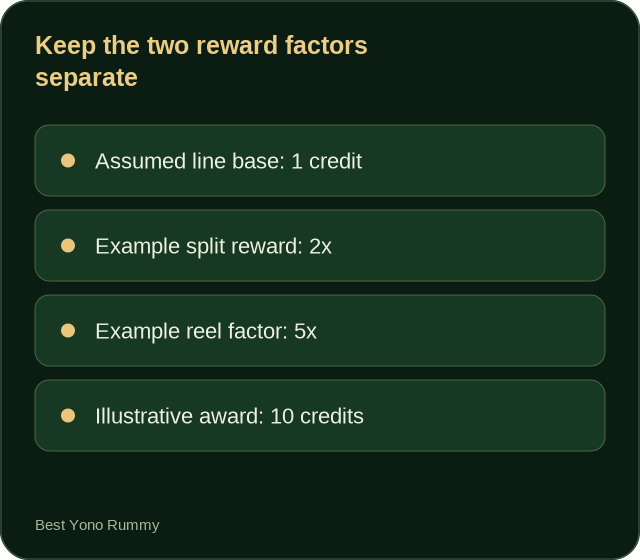
For a simple illustration, an assumed one credit eligible line amount receiving a two times split reward becomes two credits at that stage. A three times split reward would make the same assumed base amount three. These are arithmetic comparisons after qualification, not predictions of which split will appear. The exact handling of more than one relevant split symbol belongs to the loaded rules. This page does not invent an aggregation rule from a single promotional screenshot. A useful explanatory image can use one qualifying split reward at a time so the relationship remains clear without overstating what the source establishes.
Combining a split example with the reel factor
The line reward and fourth reel multiplier are different components of the calculation. Keeping them separate makes the final amount readable. First identify an eligible underlying line amount, then the applicable split treatment and then the settled multiplier value. This is a mathematical explanation of known components, rather than a claim that every possible board uses an identical shortcut. The loaded game's result sequence and rules establish which factors apply to a particular outcome. A final summary alone can hide how the underlying amount was built.
Assume, for illustration, an eligible base amount of one credit, one applicable two times split reward and a five times fourth reel factor. The simplified calculation is one times two times five, giving ten credits. It is not one plus two plus five. The two and five are factors, while the final ten is a credit amount. If the interface presents the intermediate two and final ten, those values should not both be added as independent settled payments. The example is deliberately simple so that it explains units and sequence without claiming an unverified multi split rule or assigning a particular gem value.
Garuda Wilds and a full matching board
The detailed TaDa description identifies Garuda as the Wild, substituting for paying symbols. The official JILI information also calls attention to a full board Garuda outcome. These are related but distinct ideas: substitution can affect an eligible line, while a full board condition concerns the entire main grid. A nearly complete screen should not be described as satisfying a complete condition. The actual loaded rules define its special treatment and limits. A decorative cover filled with the character is artwork, not evidence that the outcome occurred in a paid round.
An explanatory comparison can put a board with one unmatched position beside a fully matching board. Label the first incomplete and the second full board condition, without attaching an invented payout. This makes the boundary clear even before a reader knows the individual symbol values. The same care applies to Wild substitution: a Wild belongs to the game's evaluation rules and should not be interpreted as a free choice to select the next symbol. Garuda's cultural identity supplies the theme, while the programmed qualification rules supply the calculation. No religious endorsement or country specific outcome advantage follows from the character.
Extra Bet changes the cost as well as the setting
The detailed TaDa product description presents an Extra Bet option with an additional charge equal to half the base wager, intended to change access to higher multiplier symbols. The cost is an essential part of that setting. Turning on an optional feature should not be described only through its attractive outcomes while ignoring the amount charged for each spin. The actual control and price should be read in the loaded version because a host can present a particular configuration or make different options available.
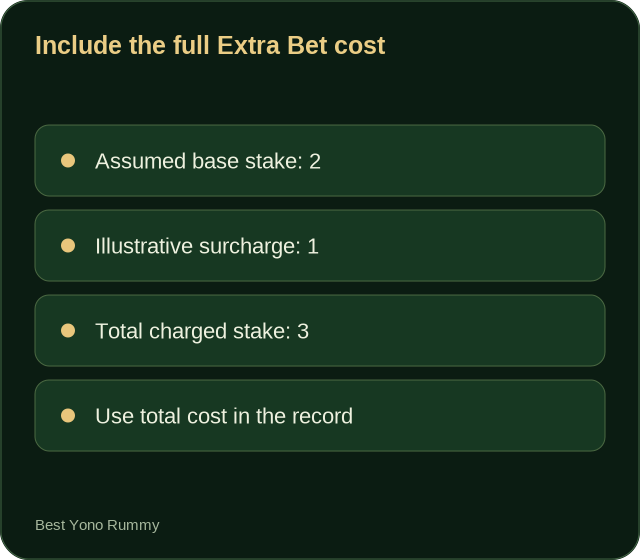
For a hypothetical base stake of two credits, a half stake surcharge adds one, making the total cost three credits per paid spin while the option is active. Ten such spins would cost thirty rather than twenty. If all settled returns were twenty four, the session would be six credits down under the higher cost, even though the same return would exceed a twenty credit cost. This arithmetic does not compare expected returns or recommend a setting. It demonstrates why the full charged amount must be included before evaluating a completed session or comparing screenshots from two different modes.
This edition does not borrow the Lucky Wheel
The detailed TaDa description explicitly distinguishes Fortune Gems 3 as a game without a bonus game or free spin feature. Its product identity focuses on the line, split and multiplier relationship. Fortune Gems 2's scatter linked Lucky Wheel should therefore not be copied into this edition's description, and Fortune Gems 500's Ex NUDGE collection sequence should not be assumed to exist here. Family resemblance is useful for browsing, while the exact edition is necessary for accurate rules. A larger title number is not a setting that enables every earlier and later feature together.
The distinction also separates internal game features from account promotions. A host may advertise promotional spins or another offer, but that would not change the verified description of Fortune Gems 3's own feature structure. Such an offer needs the host's current terms and eligibility information. A product page can remain specific and useful without inventing a free spin counter. It can show the compact board, relevant split symbol state, settled fourth reel value and total charged stake. Those are the actual elements a visitor needs to identify and understand before comparing this edition with another gem game.
Comparing the compact board with larger slots
Fortune Gems 3 differs from Super Ace, which uses a ways structure, winning eliminations and Golden Card to Golden Joker transformation. A small fixed line board asks the reader to trace a limited set of patterns, while a ways game asks a different succession question. The number of visible positions does not establish which game is more profitable for a particular person. It describes how the outcome is organised. Choose between the structures by understanding the evaluation and special state changes rather than assuming a larger board supplies more guaranteed payments.
Sugar Rush 1000 offers another contrast because its multipliers belong to developed board cells. The separate fourth reel in Fortune Gems 3 is a different kind of object from a persistent position map. Likewise, a split reward attached to a qualifying line is not the same as a Cat driven multiplier in Lucky Neko. These comparisons keep the catalogue informative without reducing every title to a claim of large potential awards. Exact names and studio source links make it possible to inspect the right rules, while generic gem imagery alone cannot establish the product or its configuration.
Mobile reading and completed returns
On a phone, keep all three main reels, the central selected multiplier position and the stake controls visible. Ordinary animation speed can help when learning how split symbols affect a qualifying line. A moving reel can briefly show values that are not its final selection, so read the settled state. For an interrupted round, retain the full title, time, charged stake and any available round reference. A cropped fifteen times symbol cannot establish whether the main board qualified or what amount the host wallet ultimately settled.
Use the total charged stake and completed returns in one unit. Credit amounts are not automatically rupees until the loaded configuration establishes their value. Count a final award once, even when intermediate and summary screens repeat it. Registration, deposits, withdrawal methods, verification and local eligibility belong to the host's current service terms, rather than the JILI or TaDa catalogue descriptions. This page identifies the published product and explains its specific line, split and multiplier components with assumed examples. It does not certify those separate account facts, guarantee regional availability or suggest that manually tapping a symbol can choose the next result.
Questions about Fortune Gems 3
Is the fourth reel another ordinary gem reel?
The detailed TaDa description separates the three by three main grid from a fourth multiplier reel. Its central settled value supplies a factor for the relevant main board award rather than extending an ordinary gem line.
Does Fortune Gems 3 have the second edition’s Lucky Wheel?
The detailed official product description presents Fortune Gems 3 without bonus games or free spins. Its split symbol mechanism should not be replaced by the Lucky Wheel description from Fortune Gems 2.
What does the split feature change?
The detailed source describes two or three times split rewards for the relevant line. Read the loaded rules for any complex combination instead of guessing how several split symbols aggregate from a screenshot.
Source notes
Listing reference: game artwork and catalogue.