
Indian Rummy Rules
Learn the common 13-card Indian rummy format, build sequences and sets, follow a draw and discard, and check a complete declaration with original examples.
What the thirteen-card format asks you to do
Indian rummy commonly asks a player to arrange thirteen cards into valid sequences and sets. A turn normally involves drawing a card and discarding one, while the objective concerns the completed hand rather than a single attractive group. The reference rules linked below describe a declaration with at least two sequences, including a pure sequence. This page explains that common framework with original practice hands. A table's own instructions remain the reference for its exact variant, scoring and declaration procedure.
Begin by looking at the whole hand before deciding which group seems strongest. A player can have a convincing run and still leave several unrelated cards outside it. Write the proposed groups on separate lines and count their cards. The total should return to thirteen, with every physical card used once. This simple inventory catches an error that a quick visual inspection often misses: the same useful card has been imagined in two groups. An exercise below demonstrates why a complete arrangement matters more than remembering a slogan about sequences.
Read a pure sequence by rank and suit
A pure sequence contains consecutive ranks of one suit without a substituted card filling a missing position. Four, five and six of hearts make an easy example. The numbers increase one step at a time, and all three suit symbols match. Changing the six of hearts to a six of diamonds breaks that particular sequence, even though the ranks still look consecutive. Read both the rank and the suit when checking a hand aloud.
For a second example, place eight, nine and ten of clubs together. The ten is one card with a two-character rank, which can be easy to overlook in a narrow mobile layout. A screenshot that hides the suit of the nine leaves the identity of the group unresolved. These examples explain a pure run without assigning any particular app's scoring or button behaviour. If a designated wild rank appears as its natural card in a sequence, consult the actual rules for that table rather than extending a rule about substituted jokers by guesswork.
Recognise what makes a set different
A set groups equal ranks in different suits. Three kings in hearts, clubs and diamonds illustrate the pattern. Their ranks match while their suits distinguish them. The same cards do not form a sequence because kings do not progress through consecutive ranks. A useful check is to say the rule you are applying before touching the cards: either ranks progress within one suit, or one rank is collected across suits.
Multiple-deck games can contain more than one physical copy of a card. Two kings of hearts may therefore both be present without being an identical object. That does not make their repeated suit suitable for every proposed set. The exact table rules govern allowed sets and joker substitutions. In a practice exercise, label physical copies separately when necessary, then check the group itself. Counting two cards as different physical objects answers an inventory question. It does not automatically satisfy the combination rule that the declaration must meet.
Check aces at the ends of a run
An ace needs to be read according to the particular rummy variant. Common Indian-rummy instructions permit it beside the two in a low sequence or after the king in a high sequence, while a run that wraps from king through ace to two is a different proposition. Keep the published rule beside your example. The word ace alone does not explain whether a remembered group is valid.
Compare an ace, two, three and four of spades with a queen, king and ace of spades. Each example keeps a clear end point. Now write king, ace and two on a third line. The third line is exactly where an informal phrase such as 'ace can be high or low' can become misleading if interpreted as permission to wrap around. In a mobile exercise, reading the ranks in order is more reliable than assuming that a row containing an ace must be a run. Treat a rule exception as a question for the table instructions.
Build one complete thirteen-card declaration
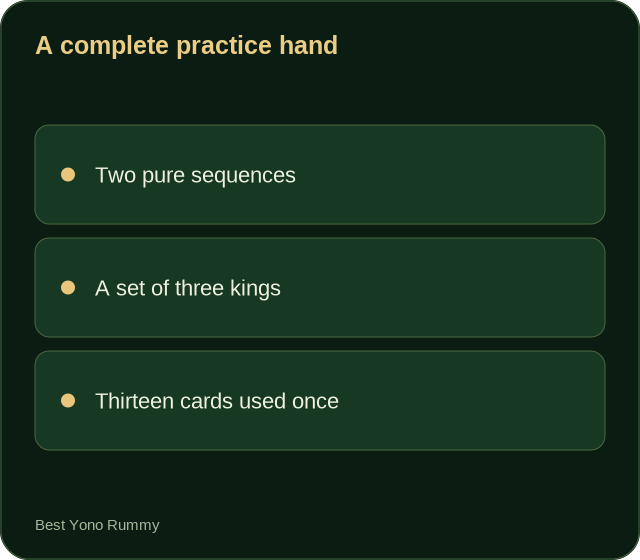
Consider a practice hand with four, five and six of hearts; eight, nine and ten of clubs; three kings in different suits; and ace, two, three and four of spades. The group sizes are three, three, three and four, adding to thirteen. The hearts and clubs provide straightforward pure sequences, the kings provide a set, and the spades provide another sequence under the low-ace convention described above.
The exercise is useful because you can audit it in two directions. Start with the groups and check their validity. Then start with the inventory and make sure every card appears exactly once. If both checks work under the selected rules, the proposed arrangement is coherent. This is an original explanatory hand, not a screenshot from an application or evidence that any listed platform uses the same interface. You can use the same written inventory with a physical deck, a notebook or a learning screen without creating a player account.
Find a fault without losing the rest of the hand
Replace the five of hearts in the previous hand with a queen of diamonds. The hearts group now contains four and six with a gap between them. The other three groups still look attractive, but they do not repair that missing card by themselves. This is why a declaration must be checked as a whole. A valid set somewhere else in the hand does not turn a broken run into a pure sequence.
Now try a different change: keep the five of hearts, but imagine using the king of clubs both in the king set and in another proposed group. The error is no longer a gap in rank. It is double use of a physical card. Naming the type of error helps you understand the correction. An explanation that says only 'wrong hand' conceals this useful distinction. When working through an exercise, point to the exact position or duplicated card before rearranging everything, so the reason for the mistake remains visible.
Follow a draw and discard as separate actions
A draw adds a card temporarily, and a discard returns the hand to the required size. The available draw sources and the timing of a declaration depend on the chosen table rules. Read their labels before taking an action. A face-up discard pile, a covered stock and a declaration control have different purposes even when a compact mobile layout places them close together.
For a paper exercise, begin with thirteen written cards and add one candidate on a separate line. Consider possible arrangements while keeping the candidate identifiable. Then cross out the card you would discard and recount the remaining inventory. The exercise shows what a turn changes without claiming to optimise a money-game result. It also explains why a screenshot containing fourteen cards can depict a legitimate intermediate state rather than an automatically invalid hand. To interpret the image, you need to know whether it was captured before the discard or after a completed action.
Understand a joker by its assigned role
A joker can serve as a substitute where the selected rules permit it, but the position it fills should be stated explicitly. In a practice sequence containing nine and jack of one suit, a substitute placed between them is being treated as the missing ten. Saying that aloud makes the proposed run understandable. It also makes clear why the group should not casually be described as a pure sequence.
Avoid treating every card with an unusual picture as having the same role. A printed joker, a rank designated as wild and a decorative card back identify different things. The table information should explain which applies. When writing an exercise, mark a substitute with the rank and suit it is intended to replace, then check the remaining declaration. This records the reasoning instead of relying on the visual position of the joker. The example explains substitution as a concept and does not assert the joker rules of an unverified app.
Read points and conditions from the selected rules
Points are a scoring unit whose meaning depends on the format being played. A practice score, an unmatched-card total and an account balance are different records. A written exercise can use points without assigning them a monetary value. Before comparing two scores, confirm that both refer to the same variant and the same stage of a hand. A number shown after a declaration is not enough to reconstruct the rule that produced it.
An error explanation should name the combination problem before discussing its possible score. If a run has a missing rank, identify that gap. If a set repeats an unsupported suit combination, identify the cards. The exact penalty, if any, belongs to the table's published scoring and declaration rules. This directory does not replace those with a guessed value or turn a card example into an earnings claim. For a learner, separating validity from scoring makes the material easier to revisit when moving between different practice formats.
Use the app catalogue for an app-name question
A card rule and an application identity answer different questions. Someone who remembers arranging thirteen cards may be looking for Indian-rummy rules, regardless of the phone app involved. Someone who remembers an icon labelled Joy Rummy or Rummy 91 is asking about a named catalogue entry. Use the complete app name for the second question. Familiar card combinations alone do not identify an Android publisher or a package.
The rummy collection on the home page keeps named profiles together, while the wider app catalogue also includes mixed-game platforms and other game types. Their Download controls open local information pages. The common app-offer control is a separate destination and does not prove that a particular named APK is available there. You can read these rules, compare a practice hand and browse the directory without using that offer. This gives a learner a clear route from a card question to an app-name question while keeping the two records distinct.
Review a hand in a repeatable order
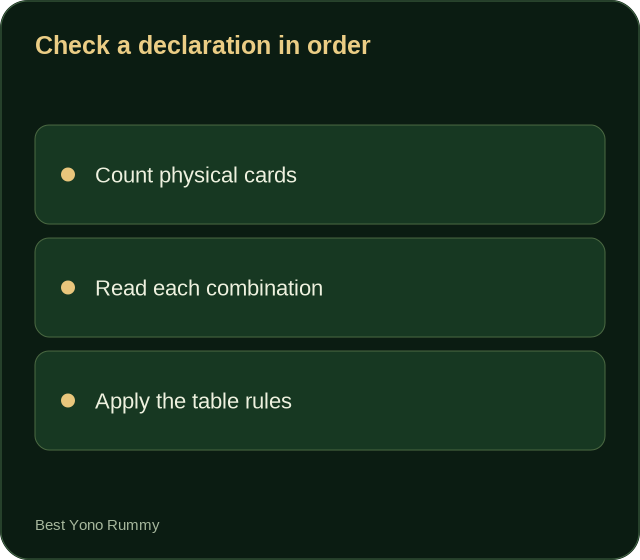
A repeatable review starts with the inventory, then checks each group and finally checks the declaration requirements. Count the physical cards, read the ranks and suits, identify which groups are sequences or sets, and note any substitution. After that, check the required number of sequences and the pure-sequence condition in the selected rules. This order makes a disagreement about one card easier to isolate.
Keep a small written note of the exact example rather than a general judgement about it. 'Four and six of hearts with no five' preserves the issue. 'I thought the hand was almost complete' does not. If two people are using different rule references, record that difference before comparing their answers. A shared practice hand can then remain useful even when the interface, app name or scoring format changes. The linked rules reference and the examples on this page are available independently of any installation or third-party account.
Questions about Indian Rummy Rules
What is a pure sequence in Indian rummy?
It is a run of consecutive ranks in one suit without a substitute filling a missing card. Four, five and six of hearts are a straightforward example. Check the selected rules for treatment of designated wild cards.
Can one physical card belong to two groups?
A complete declaration needs an inventory in which every physical card is used once. Imagining the same king in a set and another group creates an inventory error even when the groups look plausible separately.
Does learning these rules require an app download?
The worked hands can be read with a physical deck or notebook. The catalogue profiles and this rules page are available without an account or an app installation.