
About Best Yono Rummy
Discover how Best Yono Rummy organises Indian app names, rummy profiles and studio games, how catalogue search works and where your saved entries are kept.
What Best Yono Rummy does
Best Yono Rummy is an English-language directory of gaming apps and individual games for readers in India. A name is usually the starting point. Someone remembers that an icon said Rummy, Spin or 777 and wants to find the complete title again. Someone else knows a game title and wants to find the studio that made it. The directory has different places for those two tasks, so a person looking for a studio game does not have to guess which app may contain it.
The site's own activities are browsing, comparing names, reading source information and saving entries. Best Yono Rummy holds no player balances and supplies no casino account, deposit facility or withdrawal service. The name of an app on a card identifies its subject. It does not make us that app's publisher or official partner. If you come with a problem inside a particular service, first find the service's own attributable contact information. The directory cannot see what happened in another company's account.
Pick a starting place
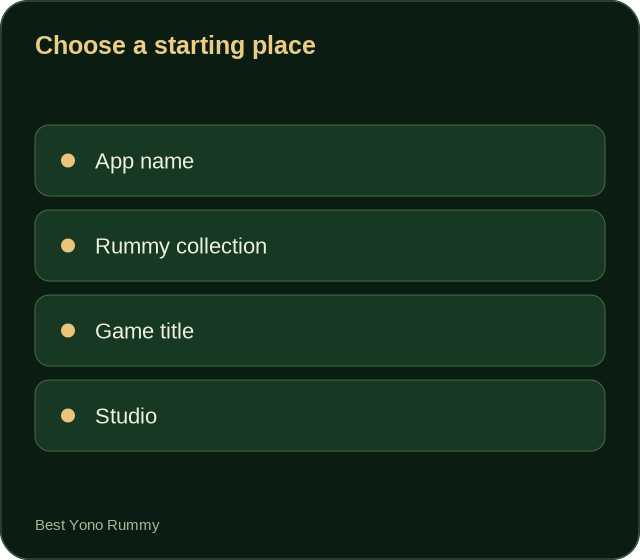
The rummy collection on the home page is useful when you remember the kind of app more clearly than its exact title. All apps is the wider index, covering other names and families as well. Individual slots have a section of their own. The Studios section offers a production credit as the starting clue and leads towards game pages. Choosing a narrower entrance first reduces the amount of irrelevant material you have to compare.
Imagine a friend saying “it had Ace in the name”. If they mean a studio game, the game catalogue and its studio information are more helpful than a list of rummy app names. If they remember an app whose second word was Rummy, start in the rummy collection and compare the opening words of its cards. Neither starting point is permanent. Following the breadcrumb or the header navigation gives you a simple way to widen the search when the first clue proves incomplete.
Search for the part you remember
The catalogue search compares the words you type with the searchable information on cards in the selected collection. Begin with a distinctive part of the remembered name. Joy narrows a search faster than the common word rummy. The digits 777 may return several plausible entries, so add a known prefix such as My or Spin when you have one. Capitals generally make little difference to a catalogue search, but the letters themselves can matter greatly.
A search emptying the grid often means the text and an active category no longer match the same entry. Clear the category or shorten the query and read the result count again. A result count tells you how many cards in the current collection match the current conditions. It does not estimate how many players use a product or how many copies have been downloaded. Try a simple name that you know is present before interpreting a zero-result page as evidence that an app has disappeared elsewhere.
For a second search exercise, start with Ind Bingo and then try a broader word such as Bingo. The broader query can help when the distinctive prefix escaped your memory. When the shorter one returns several plausible records, compare their full headings before adding another word. Adding a term is useful only when it is a clue you actually remember. A wrong extra word can hide the result you need more effectively than a broad starting query.
Use categories as a browsing aid
Rummy apps, numbered app names, spin names and slot apps are useful ways to organise a crowded catalogue. A category describes how the entry can be found on this site. It is not a claim that every app in the group shares a developer, game library or sign-in system. My 777 and Spin 777 benefit from being close together for comparison precisely because a small difference in the prefix changes the identity being discussed.
Within a collection, follow the full label to the detail page before comparing information from two entries. It is easy to carry a figure or game name down from the previous card on a narrow phone. Reading the next page's heading first prevents that mix-up. If a grid initially shows only part of a longer list, the control to show more reveals additional matching entries. Changing the filter recalculates which cards belong to the displayed selection.
Tell an app from an individual game
An app profile describes a name used for software or a gaming destination. An individual game page describes a named title and, where established, its studio. Yono Slots is an example of the first kind of record. Sweet Bonanza is an example of the second, with a studio reference to Pragmatic Play. Recording both in the same directory helps with discovery, but the two records answer different questions. Seeing them online together does not establish that Sweet Bonanza is currently available inside Yono Slots.
This distinction is especially helpful when a remembered feature is the only clue. A player might remember cascading symbols or a particular character yet have forgotten the name of the lobby. Begin with titles and studio descriptions that fit the remembered scene. If the clue is a full app label, begin with the app instead. When you have identified both, keep their titles on separate lines in a note. You can then investigate the relationship with an appropriate provider source without accidentally assuming one.
What you can learn from an entry
A detail page can explain the spelling of the name, distinguish nearby products and identify where a specific observation came from. Some pages contain a small worked example, such as a paper rummy hand or a diagram of a reel route. Those examples supply enough information for a reader to reproduce an idea independently. They do not purport to be screenshots of a named app or evidence that an external operator uses those exact rules.
Take three cards printed as four, five and six of hearts. A reader can check whether their ranks are consecutive and the suit is consistent without opening software. That is a self-contained fact about the example. A statement that a product offers a particular rummy format would need an attributable product reference. A statement about money in a player's account would need access to a secure service record that we do not hold. Keeping these kinds of evidence distinct makes a profile considerably more useful than an unexplained row of badges.
Save a shortlist on this browser
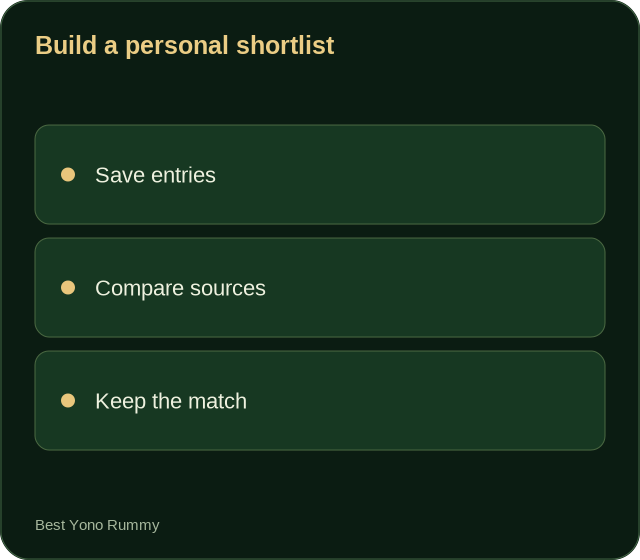
The save control keeps selected directory entries in local browser storage. Open Saved to see the collection created in that browser. This is handy when several names have the same suffix and you want to compare them later. Save two plausible records, revisit their source links and remove the one whose spelling or description does not fit. An entry can be saved before you have resolved every question about the product.
Saving a profile has no effect on an installed app or an account with another service. A browser bookmark is another way to return, with a different scope: it stores a web address in the browser's own bookmark collection. If you clear this site's browser data, use another browser or move to another device, your local saved entries may differ. Share the public profile address when you want another person to see a record. A link lets them open the same page without exposing your browsing shortlist.
A useful way to test the saved collection is to select two different app titles and inspect the names in the list. Remove the first and confirm that the second remains. The displayed count has gone from two to one, while the public profiles themselves remain available to other readers. This small exercise distinguishes a personal change to a browser collection from a change to the underlying catalogue or to the software described by either record.
Read dates and quoted amounts carefully
A date on a source record explains when an observation was made. A date associated with an addition to the catalogue records a different event. Neither date automatically identifies a software launch or a current promotion. Where a third-party directory supplied a monetary figure, the source, time and type of figure matter together. A listed minimum is a condition attributed to that source. A headline maximum is an upper bound within the wording quoted. The two cannot be combined into a guaranteed balance.
Consider a card whose source listed a bonus and another whose available material contained no bonus amount. The honest comparison keeps the confirmed label in the first row and leaves the second as Not listed. Entering zero would assert a fact not in evidence. Copying the first amount across both rows would do more harm still. A reader who needs current service terms should check the exact named product and its accountable source. This directory does not process or verify deposits, withdrawals, identity checks or entitlements.
Know where a button leads
Navigation inside the directory opens the selected collection, detail page or reference section. Where a profile has an external offer action, it takes the reader to a separately configured destination. Several cards can share that destination. The product name and terms shown there need to be read separately from the name on the originating catalogue card. An external offer button cannot confirm that the destination supplies a particular APK, honours a historical amount or operates the account someone is trying to access.
Source links serve another purpose again. A game studio link can support a game's title or authorship; an official document can establish the wording of a rule; a third-party directory can record what that directory displayed on its observation date. Following a reference is useful when you want to check the basis of a claim. Its presence does not mean the source commissioned this site, endorses every other entry or offers installation to all visitors in India.
For a straightforward return visit you can stay entirely within the directory. The header opens the main categories, the breadcrumb identifies the current branch, and Saved brings back profiles selected in this browser. These are useful routes even for a reader who has no interest in visiting an external commercial destination.
A practical way to compare two names
Begin with the question you want to settle. If it is spelling, compare the full headings. If it is authorship, locate publisher or studio attribution. If it is a game rule, locate the individual title and the condition being tested. A comparison becomes confusing when facts that answer different questions are put in a single unlabeled column. A simple note with name, kind of record, source and date goes a long way even when a confident final attribution remains unavailable.
For example, a reader can open Yoyo Slots and Yono Slots, note the differing third letter and save both public pages. That resolves the spelling question. It does not resolve ownership or establish shared balances. Another reader comparing Super Ace and an app named Yono 777 would record the first as a studio title and the second as an app name before looking for any relationship. The most valuable outcome is often a narrower question with a clear source to consult. The directory exists to make that next step easier to find.
Questions about About Best Yono Rummy
Is Best Yono Rummy a casino account provider?
Best Yono Rummy is an independent app and game directory. It offers search, source information and local saved entries, and holds no player balances or casino accounts.
Where are my saved app profiles kept?
Saved profiles are kept in this site's local browser storage. The list can differ on another device or browser and may disappear when site data is cleared.
Why do some app cards and game cards share similar artwork?
A visual theme can appear across unrelated records. Compare the full app name, individual game title and cited studio before drawing conclusions about ownership or availability.