Pinata Wins and the festival board
Pinata Wins is a PG SOFT slot with five reels, three rows and twenty paylines. Its festival artwork frames a more specific mechanism: qualifying gold framed symbols can become Wilds, and multiplier values can be collected during the collapsing sequence. The exact title is written Pinata Wins in the official catalogue. That title and PG SOFT attribution should remain visible even when a lobby cover uses decorative lettering. A person arriving through a short search should be able to distinguish this game from unrelated piñata themed products without relying on the background colours alone.
The useful way to read the game is in layers. Begin with the line result, follow the collapse, observe which framed symbols qualify for transformation and then read any collected multiplier. The free spin feature changes the persistence of those multiplier values. The character and confetti make the sequence lively, but the labelled counters establish what has happened. This page uses invented credit figures to explain the calculations. It does not present a recorded test, a prediction, or a claim that a particular account provider offers the game to every visitor in India.
Twenty paylines are specific patterns
The published layout uses twenty paylines, rather than an unrestricted count of matching symbols anywhere. A matching symbol needs to participate in an eligible line pattern according to the loaded paytable. This means that a cluster of similar objects can look promising without forming the required line. Conversely, a qualifying pattern can bend across the rows instead of appearing as a simple horizontal row. Open the line diagram when learning the game so that the visual shape and the payment rule can be matched directly.
An illustrative example can use three matching symbols in consecutive columns. Whether they produce a payment depends on their positions and the applicable line rules, not just on their count. Moving one into another row can change the relevant pattern. The example deliberately does not assign a paytable value because that value belongs to the actual symbol and configured stake. The twenty line label describes the set of evaluated patterns; it does not mean twenty awards will be paid every time. That distinction is particularly useful when switching from a pays anywhere game such as Gates of Olympus.
Collapsing results and one paid round
Pinata Wins uses collapsing reels. After a winning stage is paid, the board changes and fresh symbols can create another result within the same spin. This creates a sequence of related states rather than a single static picture. The original stake starts the paid round; the following collapse stages belong to its resolution. Watching the sequence in ordinary speed helps explain which symbols were involved in a payment before they disappeared or transformed. A fast montage can hide that relationship and make the final board look disconnected from the earlier award.
For a hypothetical sequence with incremental awards of one, three and two credits, the unmultiplied sum is six. A running display might show one, then four, then six. Those running figures should not be added as separate payments because the later values already contain the earlier ones. The final spin award and the feature total may then appear on different screens. Keep track of which display is being shown rather than assuming every celebration creates a fresh award. The length of the collapse sequence does not, by itself, reveal its monetary value.
Which gold framed symbols can transform
The published rules allow regular gold framed symbols on reels two, three and four, excluding Wilds and scatters from that category. A gold framed symbol that participated in a win transforms into a Wild after the symbols cascade. Participation matters. A gold frame visible somewhere on the board is not sufficient evidence that the transformation condition has been met. To understand the next stage, first identify the previous winning line and then follow the framed positions that belonged to it. This preserves the connection between a payment and the later Wild.
Imagine a framed regular symbol on the middle reel that is part of a qualifying line. After that stage resolves, its Wild transformation can affect the subsequent board under the normal substitution rules. Another framed symbol elsewhere that did not participate in the win should not be assumed to undergo the same change merely because the artwork matches. A useful explanatory diagram therefore shows a before state, marks the qualifying line and then shows the transformed position. A screenshot of the Wild alone establishes its presence, but not the chain of events that produced it.

Collecting multipliers from winning frames
The official description places multiplier values between two and one hundred times on gold framed symbols. Values are collected when the relevant framed symbols have participated in a win, after the next symbols cascade. At the end of a spin, the total spin win is multiplied by the collected total. This makes the collection moment distinct from the initial appearance of the number. Read the collected display rather than adding every visible value on the board as if it had automatically qualified. A multiplier outside a winning relationship has not established the same event.
Assume, for illustration, that a spin has an eligible total of three credits and a collected multiplier total of six. Applying six produces eighteen credits. The six is a factor, not another six credit payment to add to eighteen. If the interface first shows the three credit base total and later the eighteen credit result, it is presenting the calculation in stages. This simple example uses one already established collected total, avoiding any invented rule about a complex screen. When more than one value appears, follow the game's actual collected total and loaded rules for the relevant sequence.
The difference between visible and collected values
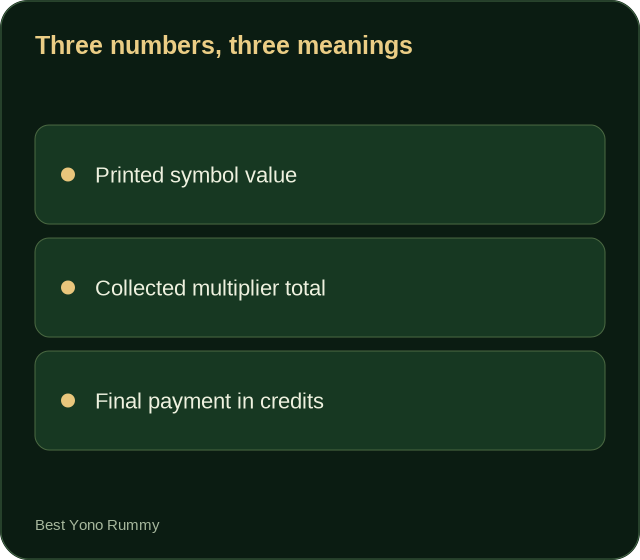
Pinata Wins is easier to read when three quantities stay separate: the value printed on a framed symbol, the multiplier total collected under the rule and the spin payment after multiplication. Each number answers a different question. A prominently displayed value may attract attention even before it has qualified for collection. The collected total documents the feature state used by the calculation. The final award is the monetary result. Adding all three numbers together would mix a symbol label, a scale factor and a payment.
For an illustrative record, note a visible four times framed value, a collected six times total and an eligible two credit spin award. The resulting payment depends on the collected total, giving twelve in this simplified calculation. It is not twelve plus four plus six. The purpose of separating the labels is not to reconstruct every possible board from memory. It is to make clear which figures can be entered into a session record as settled returns. A useful game illustration should retain those labels so that a reader can follow the same distinction on a mobile screen.
Free spins and persistent collected multipliers
Three scatters trigger fifteen free spins in the published game description. During that feature, collected multipliers remain above the reels until the feature ends. This persistence is a substantive change from reading an isolated ordinary spin. A multiplier collected early can be relevant to later feature calculations, so the running feature state becomes important. The remaining spins counter still serves a separate purpose: it describes how many rounds are available, rather than the value of the accumulated multiplier or the amount already paid.
Consider an illustrative feature in which the collected multiplier display has reached eight while five spins remain. The eight does not mean eight spins are available, and the five does not mean five credits have been paid. If a later eligible award is two credits and the applicable multiplier is eight, the simplified resulting amount is sixteen. A nonpaying outcome does not become an award solely because a multiplier total exists. Keep the feature opening and ending in a record, since those boundaries explain when the persistence begins and when it stops.
Comparing Pinata Wins with Wild Bandito
Pinata Wins and Wild Bandito both use gold framed imagery, but their multiplier conditions should not be merged. Pinata Wins collects values from qualifying framed symbols. Wild Bandito's published free spin mechanism increases its multiplier after winning cascade stages and applies a special framed treatment to the middle reel. The shared gold colour does not make those rules identical. A catalogue can help by describing the specific event that changes the state, rather than assigning both games the same generic description about growing multipliers.
Sugar Rush 1000 provides another useful contrast. Its multipliers are associated with positions developed by repeated qualifying explosions. A multiplier collected above the Pinata Wins reels is a different object from a persistent board cell. Reading the wrong mechanism into a screenshot can produce an entirely incorrect explanation of a payment. Choose between games by understanding these distinctions and the style of presentation. No conclusion about personal profitability follows from the fact that a game has more frames, more positions or a larger printed maximum. The loaded rules and actual settled outcomes remain the relevant records.
Making the mobile sequence readable
On a phone, check that the line result, upper collected total and lower stake controls can be seen without browser bars covering them. The small values on framed symbols may need more attention than the large character artwork. Ordinary animation speed can make the transformation and collection order easier to follow while learning the game. A speed control changes how quickly the result is presented, rather than changing which symbols qualify. The information menu should remain accessible without a forced application installation simply because the visitor uses a mobile browser.
If a sequence is interrupted, preserve the exact game title, time, stake and any available round reference. A cropped image of a multiplier does not establish the final settlement. The host's round history and wallet information are the appropriate records for a completed account result. Reopening a pending game should be understood as recovery of its recorded state, rather than a method for creating a duplicate award. The precise recovery process varies by host, so avoid assuming that every account uses the same steps based only on the presence of the same game cover.
Stakes, returns and the catalogue destination
Use a consistent unit when comparing the stake with the completed return. If ten paid spins cost three credits each, their total cost is thirty credits. If all related settled returns add to twenty two, the session is eight credits down. A six times multiplier shown during one feature is not another six credits to add to the returns. Likewise, a final summary should not be counted again after its component awards have already been recorded. The arithmetic concerns settled payments, rather than the brightness or duration of the celebration.
Before using a live launch action, confirm Pinata Wins, PG SOFT and the selected stake in the loaded game. Credit values should not be assumed to be rupees until the actual configuration establishes the unit. Registration, deposits, verification, withdrawal methods and local eligibility belong to the host's current service information. The product page explains the published game structure and supplies clear illustrative calculations. It does not establish those separate account facts or imply that a similarly named Yono application contains the same title. Exact naming, specific source links and a readable feature explanation make the catalogue destination useful without inventing an operator relationship.
Questions about Pinata Wins
Does every gold frame become a Wild?
The published transformation concerns a gold framed symbol involved in the previous winning stage. Its participation in the win matters; a gold frame elsewhere on the board is not sufficient by itself.
When are multiplier values collected?
The rules collect multiplier values from relevant gold framed symbols involved in the previous win after the cascade. The collected total then multiplies the spin total at the end of the spin.
What remains during Pinata Wins free spins?
Collected multipliers remain above the reels until the free spin feature ends. This persistent total describes the feature state, while the remaining spin counter separately records rounds still available.
Source notes
Listing reference: game artwork and catalogue.