Wild Bounty Showdown
PG Soft

Discover PG Soft titles with distinctive visual worlds, including Wild Bounty Showdown, Ganesha Gold and Treasures of Aztec.
Explore the studio’s titles in this directory.
PG Soft
PG Soft
PG Soft
PG Soft
PG Soft
PG Soft
Try a different name, or clear the filters to explore the whole collection.
PG Soft, short for Pocket Games Soft, is the studio behind six titles in this directory: Wild Bounty Showdown, Ganesha Gold, Lucky Neko, Treasures of Aztec, Wild Bandito and Pinata Wins. Their visual worlds are easy to distinguish when the title screen is visible. A more interesting comparison begins once the artwork is cropped away. The games use different reel shapes, framed symbols and feature counters. Those details can help identify a title and explain why two similar-looking animations have different consequences.
Use this page at the studio level. It groups the six game entries and points to PG Soft's own supporting material for particular releases. A studio information sheet can identify the game, illustrate its symbols and describe a rule. It cannot establish whether a separate app offers that game in a particular region. Keep the game title with the source when comparing features. A gold border, a wild icon or a rising multiplier occurs in more than one of the titles below.
PG Soft describes Wild Bounty Showdown as a six-reel game with heights of three, four, five, five, four and three positions. The two outer reels are shorter than the two in the centre. That stepped outline gives a reader a structural recognition clue even when the game title is missing from a small picture. The same studio document identifies gold-framed symbols and a rising multiplier. The shape, action and title together give a stronger identification than a Western theme on its own.
Draw six columns on paper and give them the stated heights. Counting the visible positions gives twenty-four. Cover the two outer columns as a cropped screenshot might and the remainder appears to be an entirely different four-reel display. That simple exercise illustrates why an observed crop is weak evidence for the total number of reels. Count from the original composition where possible. The twenty-four positions are visible places for symbols; their count does not describe twenty-four winning lines or a probability of winning.

The Treasures of Aztec information sheet describes framed symbols changing state during cascades. A silver-framed symbol involved in a win can become a different symbol with a gold frame for a later stage under the conditions the studio sets out. That relationship matters because the frame and the symbol inside it are different pieces of information. Two screenshots of the same position can show both a changed drawing and a changed border without describing two independently initiated spins.
For a pencil exercise, draw a small diamond inside a silver square. On the next line draw a different shape inside a gold square at the corresponding coordinates. Add the words prior winning event between the two drawings. This is a model for reading the sequence of states rather than an illustration of actual game artwork. If you have only the second image, you can describe the gold-framed state. You cannot infer with certainty the exact symbol that occupied the earlier silver frame from the later picture alone.
The Lucky Neko studio document connects cat symbols with the win multiplier. For the described main-game rule, each cat symbol increases the multiplier by two before wins are paid. That gives the cat a role beyond being a recognisable character in the picture. Distinguish a decorative cat on a splash screen from a cat symbol occupying a qualifying position in the actual game. A theme character outside the reels does not fulfil a rule that explicitly refers to symbols appearing on them.
As a calculation exercise, start with a hypothetical displayed factor of three and apply two separate increments of two. The result would be seven under an additive rule. Multiplying three by two twice would instead give twelve. The point of the example is to read the operation in the source carefully. Before attaching any real credit result to either value, identify the applicable mode, the starting value and the qualifying win. A large seven pictured in a clip could be a multiplier, a credit amount or another label entirely.
For Ganesha Gold, PG Soft's information describes collecting wild symbols in free spins to increase the multiplier. The publisher illustrates a three-wild collection step. Here the key visual clue is a counter accumulating the qualifying wilds within a feature. This differs from treating every appearance of the featured character as a separate increase. The Ganesha-themed artwork identifies the title's visual world; the symbols and the feature rules establish which events actually contribute to the counter.
Imagine a feature display with two spaces marked as collected and one empty. A screenshot of that display records progress. A later frame showing another eligible wild can explain why the counter advances. The figure representing free spins remaining is a separate measure and can move in another direction. If somebody tells you that the number went from two to three, ask which number they saw. A filled counter, a multiplier level and a remaining-spin count all describe different parts of the same feature.
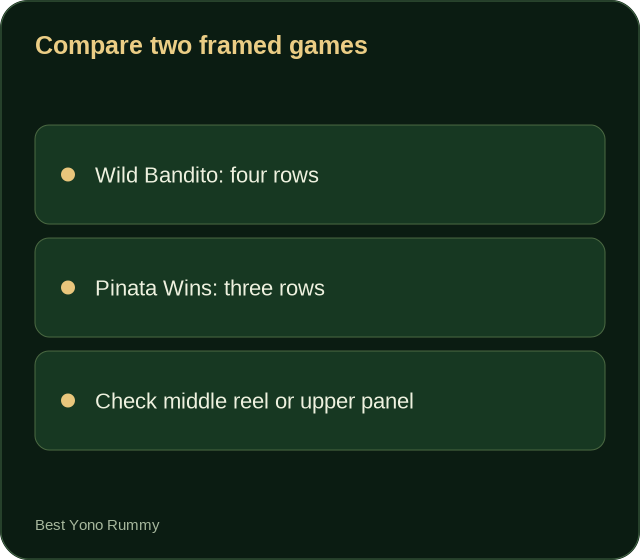
PG Soft identifies Wild Bandito as a five-reel, four-row game. Its feature description gives the middle reel a particular role for gold-framed symbols during free spins. Pinata Wins has a different configuration: five reels with three rows. The studio describes gold frames and multipliers and explains that collected multipliers can remain visible above the reels through the feature. Both titles use festive imagery and gold frames, so reel height and the location of the persistent information are useful discriminators.
In a complete rectangular view, the Wild Bandito layout just described has twenty visible positions and the Pinata Wins layout has fifteen. Those counts describe shape, not winning chances. Cover one row of the taller board and the visible fragment can look like the shorter one. If the picture shows a central highlight, look at what the rules say that highlight belongs to. A feature focused on the middle reel and a display storing collected multipliers above the reels use screen space differently, even when both employ the colour gold.
When reading any of the six titles, ask what the persistent object actually is. A frame can mark a symbol that changes after a qualifying event. A multiplier may be carried in a panel above a reel. A counter may advance when particular wilds are collected. The same visual technique of highlighting something does not give all three objects the same function. One sentence describing the object, event and resulting change is more useful than a list of colours from the screenshot.
For instance, “a cat symbol increased the displayed multiplier” and “a wild advanced the collection counter” are different explanations. The first points towards a mechanism described for Lucky Neko. The second fits the sort of feature described in Ganesha Gold. Neither alone proves the identity of an unlabeled clip because other games can use similar ideas. Add a second clue such as the title, studio mark, reel outline or feature heading. Taken together, two well-chosen observations are much more useful than several vague claims that the interface looked familiar.
A cascade can make a short clip look like several independent games. Start by locating the original arrangement, the qualifying event and the updated arrangement. If a result is displayed after more than one stage, determine whether it is a stage value or a running total. A teaching example showing four units after the first stage and a cumulative six after the second has added two more units. Summing four and six would count the first stage twice.
Now imagine that the second number is explicitly labelled multiplier instead. The arithmetic changes completely and you need a base value to know what it applies to. A game information sheet is useful because it usually illustrates the relationship with a screen and nearby text. Keep any quoted number attached to its edition and rule. Nothing in the title Treasures of Aztec, Wild Bounty Showdown or Wild Bandito by itself tells you when to add, multiply, reset or carry a value into the next feature state.
A mobile composition may keep the reels central and move controls or explanatory labels into compact panels. A studio illustration might show the same play area with additional framing or annotation. Compare the title, basic layout and feature labels before comparing minor decorative details. A phone's crop can hide the top of a multiplier display or one of the outer reels. A missing object at the edge of a screenshot is not proof it never appeared on the full interface.
If the purpose of the comparison is to identify a game for somebody else, preserve a version of the image containing its title and rules caption while removing private player information. Then pair it with the studio record naming the same release. For a broader comparison, save the studio page as well as the game profile. The studio grouping helps find the next related title, while the game-level record is where an edition-specific description should be checked. Neither supplies information about an unrelated account or an installation offer.
For a bird's-eye view of the six entries, start with the feature that seems most distinctive. The stepped six-reel outline suggests Wild Bounty Showdown. A cat symbol linked to a multiplier suggests Lucky Neko. A free-spins wild collection step suggests Ganesha Gold. A silver-to-gold framed transition suggests Treasures of Aztec. For the remaining pair, look at reel height and whether the relevant feature information occupies the middle reel or is stored above the play area. Then confirm the title against its source.
A reader asking which game is best may have a more concrete question underneath. They may want a game whose screen they can identify, a clear example of a cascade or a way to compare two feature counters. The comparison above can answer those questions without inventing a popularity ranking or forecasting an individual result. Save the exact title plus the one distinction that mattered to you. A future reader will know both which game you meant and why it belonged in the comparison.
Take an imaginary still image showing two stored multiplier markers above a three-row display. Write one hypothesis about its identity and one question the image cannot settle. Pinata Wins is a reasonable candidate from this particular collection, while the origin and timing of those markers still need evidence. A second image showing the actual game title would settle one question. A sequence of earlier frames or the studio's feature description would settle a different one. That separation is useful whenever a studio uses related visual ideas across several individual games.
A useful second exercise is to draw two empty five-reel boards on squared paper. Give the first board four rows and the second three. Circle the middle reel on both and leave room for a label above each rectangle. Now try placing the evidence from your still into each drawing. A corner cut off by a phone notification may leave both drawings plausible. A visible bottom edge and four complete positions on one reel will eliminate the three-row drawing, even if the art and title are obscured.
PG Soft describes five reels with four rows in Wild Bandito and five reels with three rows in Pinata Wins. Check the complete board and the title before relying on a cropped image.
No. The described Ganesha Gold free-spins counter collects wilds. Lucky Neko's studio information describes cat symbols adding to a multiplier in its main game.
Its six reels have a stepped outline with three, four, five, five, four and three visible positions. Pair that structural clue with the complete title and studio record.