Sugar Rush 1000 is a game of positions
Sugar Rush 1000 is a Pragmatic Play slot in which a seven by seven board develops through clusters, tumbles and multiplier positions. The sweets provide its visual identity, but location is the feature to understand. A symbol can disappear while the position beneath it remains relevant to later awards. This makes the board more than a fresh arrangement of candies on every stage. Watch both the matching symbols that qualify now and the marked cells that may affect another qualifying result later in the sequence.
The exact title matters because Sugar Rush 1000 is a separate release from the original Sugar Rush and other related games. A familiar pink background does not establish that the same multiplier ceiling or feature rules apply. The edition name should be visible in the loading screen and catalogue tile. This page uses the published Sugar Rush 1000 structure and hypothetical arithmetic to explain it. It does not assign features from a different sweet themed title to this game or infer an operator's available version from a cover image alone.
How a cluster becomes a win
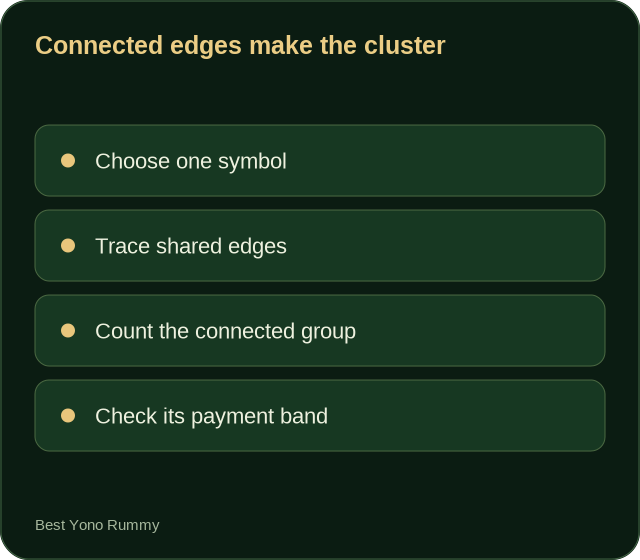
Normal winning clusters begin with five matching symbols joined horizontally or vertically. The required connection is different from merely counting five identical symbols anywhere on the board. Diagonal proximity alone does not create the same connection. When learning to read the screen, pick one symbol type and follow its shared edges. That reveals which positions form a continuous group. The paytable then determines the payment for the relevant cluster size and symbol type. Two equal sized clusters made from different symbols need not have the same value.
Imagine five matching sweets occupying consecutive cells along an L shape. They can form a single connected cluster even though they do not make a straight line. By contrast, five identical sweets separated by unrelated symbols may form no qualifying group. The distinction explains why a scattered pays anywhere count from Gates of Olympus cannot be used here. It also makes a simple annotated board useful: mark shared edges rather than drawing a line through isolated matches. The example explains qualification only, without assigning an invented paytable amount to that particular symbol or shape.
Tumbles and the life of a paid spin
When a winning cluster pays, its symbols disappear and fresh symbols move into the available spaces. The replacement board can create another qualifying cluster and continue the same paid spin. This is the tumble process. One spin action can therefore produce several visible stages, each with its own cluster arrangement. The stake is attached to the original paid action, not charged again for every falling set of sweets within that round. The game builds a total as the sequence resolves, then presents the completed award.
For example, take hypothetical unmultiplied awards of two, three and one credits across successive stages. Their total is six credits. If the interface shows a running two, then five, then six, those are cumulative displays of the same sequence. Adding all three running totals would double count earlier stages. Record the incremental awards or use the final sequence total. A longer animation does not automatically mean a higher return than a short one: three small awards can add to less than one larger cluster. The actual cluster values and affected multiplier cells explain the difference.
How marked cells create multipliers
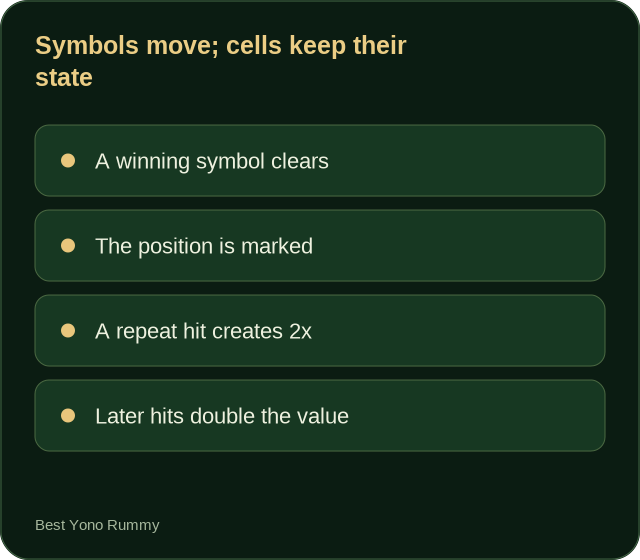
The published game marks a position after a paying symbol explodes there. A second explosion in that same position creates a two times multiplier. Further qualifying hits double that position's value, with a published ceiling of one thousand and twenty four times. The multiplier belongs to the cell, rather than permanently following one sweet around the board. This is why the marker can remain meaningful after the symbol that created it has disappeared. Watch the position and its displayed level together when a later cluster reaches that area.
An illustrative progression is two, four, eight and sixteen times after successive qualifying increases. Doubling a cell at eight produces sixteen, not ten. The sequence says how a cell changes when the required event occurs; it says nothing about how quickly that cell will be hit again. An almost developed area does not make another cluster inevitable. A useful board diagram can colour a single position through several tumble stages, showing that the same location is being revisited even though different symbols fall into it. This communicates the central mechanic more clearly than a picture of an isolated large multiplier.
Applying a cell value to a qualifying cluster
A multiplier position affects a winning combination that uses it under the loaded game's rules. The presence of a large value elsewhere on the board does not mean every cluster receives that value. First identify the qualifying cluster, then identify the multiplier positions it occupies. The order is important because a prominently displayed cell can distract from an unrelated cluster on the opposite side of the board. The information panel should be used for the exact treatment of a cluster touching several marked positions, rather than assuming an arithmetic rule from another slot.
For a deliberately simple example, suppose a qualifying award of two credits is affected by a single four times position. Applying that value gives eight credits. This example avoids combining several positions so that the basic relationship is clear. The original two credit amount is part of the eight, not another two to add afterwards. If a later animation shows the eight entering a running total, that is the same award moving to its summary display. Using one simple calculation before inspecting a dense board is a practical way to understand a feature without inventing extra payments.
Free spins preserve the developing board
Three or more scatters trigger at least ten free spins in the published description. During free spins, marked positions and their multiplier values remain in place until the feature ends. That persistence is the main reason to watch the board across several spins, rather than viewing every board as entirely independent artwork. A cell developed early in the feature can still matter later if a qualifying cluster occupies it. The remaining spins counter and the multiplier map therefore describe two different parts of the same feature state.
Consider an illustrative cell that reaches eight times during an early free spin. Its presence can be relevant to a later eligible cluster, but it is not eight credits already banked and it does not guarantee that another cluster will use it. The distinction between stored multiplier state and actual awarded money is essential. A feature can finish with visually impressive positions that were not all used in another paying cluster. The ending feature total is the record of paid outcomes; the brightest board area is a record of development. Both can be accurate while telling different stories about the feature.
Retriggers and the boundaries of persistence
Further qualifying scatter appearances can add spins during the feature. Added rounds extend the opportunity to use the existing feature board, but they are not a new multiplier rule. Watch the scatter notification and the remaining count to distinguish an extension from a large cluster celebration. The published persistence applies until the free spin feature ends. It should not be assumed to carry into unrelated normal spins or a different later feature. A new feature needs to be read from its own starting state and current information screen.
For an illustrative record, note the remaining spins before the retrigger, the number added by the game and the resulting count. Keep this count separate from the win total. An additional round is a round to resolve, rather than a fixed number of credits. If a recording skips the feature ending screen and begins another feature, do not treat the two multiplier maps as one continuous board. Complete timestamps or round history are more informative than a montage. This is a reading method for the visible state, not a method for forcing persistence beyond the boundaries stated by the game.
A useful comparison with other slot structures
Sugar Rush 1000 differs from Gates of Olympus because adjacency and position matter here. In Gates, the normal question is how many matching symbols appear anywhere. Here, the question begins with whether matching sweets share the required edges and continues with which cells they occupy. It also differs from Big Bass Bonanza, where a fisherman collects visible money symbols during the feature. These are substantial differences even though all three can produce animated multiplier displays. A well organised catalogue can describe them as cluster position play, pays anywhere play and collector play.
The comparison does not establish that a larger board or a higher multiplier ceiling makes one game better for earning money. Forty nine positions create a particular visual and mathematical structure, not forty nine guaranteed chances to receive a payment. Likewise, a developed multiplier map in a screenshot cannot reveal how much was staked before that image. Choose between titles by understanding their sequence and presentation, then read the exact loaded rules. A title with a related name should have its own product page when its mechanics differ, rather than sharing a generic paragraph about candies and large potential awards.
Controls, credits and a clear session record
On mobile, verify that the entire board, stake and spin control remain visible. Small multiplier labels can be harder to read than the large sweets, so ordinary animation speed may be useful while learning the map. A speed control changes presentation, not the requirement for a qualifying cluster. If the page is zoomed or the browser bars cover a control, fix the viewing state before placing a stake. The information menu should remain reachable without relying on an unlabelled cover image or an unrelated application download.
Keep the session calculation in a consistent unit. Thirty spins at two credits cost sixty credits; if all settled returns total forty eight, the net result is a loss of twelve. A feature containing a sixteen times cell does not change that arithmetic unless it produces an actual award included in the returns. If a host offers rupee display, confirm the game unit rather than assuming a lobby currency label applies inside every game. Deposit methods, account verification, withdrawals and local eligibility are properties of the host service, not facts established by Sugar Rush 1000's multiplier map. The catalogue explains the game, while those account details require their own current source.
A position map is different from a balance
A useful way to explain a developed board is to draw two separate records. One record marks the multiplier value of each relevant position. The other lists the amounts actually paid by qualifying clusters. A position may hold a large multiplier while the payment record remains unchanged because no eligible cluster used it on that round. The map records potential participation in a calculation; the payment record documents completed awards.
For an illustrative single cell, write four times in the map and leave the award column blank until a qualifying outcome uses it. If that outcome has an assumed base value of three credits and the relevant calculation applies four times, record twelve credits as the resulting award. Keep the four in its proper role as a multiplier label rather than entering another four credits into the payment column. This simple separation remains useful even when the actual board contains many marked positions and several stages of animation.
Questions about Sugar Rush 1000
Do five scattered matching sweets form a cluster?
The normal cluster rule requires at least five matching symbols connected horizontally or vertically. A total count of five isolated sweets is not the same as one connected qualifying group.
When does a marked cell become a multiplier?
The first qualifying explosion marks the position. A second explosion in that position creates a two times multiplier, and further qualifying hits double it up to the published ceiling.
What persists during Sugar Rush 1000 free spins?
Marked positions and their multipliers remain across the feature until it ends. They describe the developing board state and do not themselves constitute money already paid into the account.
Source notes
Listing reference: game artwork and catalogue.