Big Bass Bonanza and its fishing feature
Big Bass Bonanza is a Pragmatic Play slot built around a useful distinction: a fish can display a value without that value immediately becoming a prize. The fisherman is the collector to watch during free spins. This creates a different rhythm from a slot in which every highlighted symbol pays as soon as it appears. The lake, fishing equipment and character animations make the theme easy to recognise, but the important information is the relationship between the visible fish, the collector and the feature counter. Reading those elements together explains more than watching the size of a fish alone.
The original Big Bass Bonanza also needs its own identity within a large fishing series. Similar artwork, another fishing character or an added number in the title can indicate a separate release with different rules. This page concerns the original title, rather than assigning the mechanics of a later sequel to it. On a small screen, first check the full title in the loading screen and then open the information panel. That small identification step matters when two neighbouring lobby tiles show almost the same lake scene. The studio name is another useful check before comparing the feature behaviour described here.
Scatters and the opening number of free spins
The published rules distinguish three starting awards: three scatters provide ten free spins, four provide fifteen, and five provide twenty. The count is an entry condition, rather than a promise about the value of the resulting feature. Fifteen free spins give more initial opportunities than ten, but they do not specify how many fisherman collectors or valuable fish will appear. Treat the free spin counter as a count of rounds still available. A feature can contain several collecting moments, or relatively little collection, without contradicting the starting award shown on the screen.
For an illustrative comparison, imagine two independent features beginning with ten and fifteen spins. If the first collects thirty credits and the second collects twelve, the shorter feature has still paid more in that particular example. The opening count does not make the second result an error. It is equally unhelpful to combine scatters from separate paid spins on paper: the trigger is evaluated on the relevant outcome, not on a personal running total of past scatters. This makes the trigger message and the starting counter useful reference points when following a replay or checking a recorded session.
Money fish and the role of the collector
During the feature, fish marked with money values supply the amounts that the fisherman can collect. The collector is therefore more important than an isolated large number. A screen full of promising values is a description of the current reel state; the collection rule decides what actually contributes to the feature total. Keep separate the displayed value of an individual fish, the sum available on that screen and the amount credited by the collection animation. These are three related figures, but they describe different steps. Confusing them can make an ordinary collection appear to have paid incorrectly.
Suppose the visible collectible fish show two, five and eight credits. Their total is fifteen credits. If a qualifying fisherman collects those values at the ordinary feature level, fifteen is the starting collection amount in this simplified example. A fish showing eight is not eight times the entire session balance, and a fifteen credit collection is not automatically fifteen times the stake. Watch whether the interface presents currency, credits or a bet multiple. Using one unit consistently makes the arithmetic readable. The figures here illustrate addition only; they do not represent a predicted fish distribution or an observed result.

How fisherman retriggers change the feature
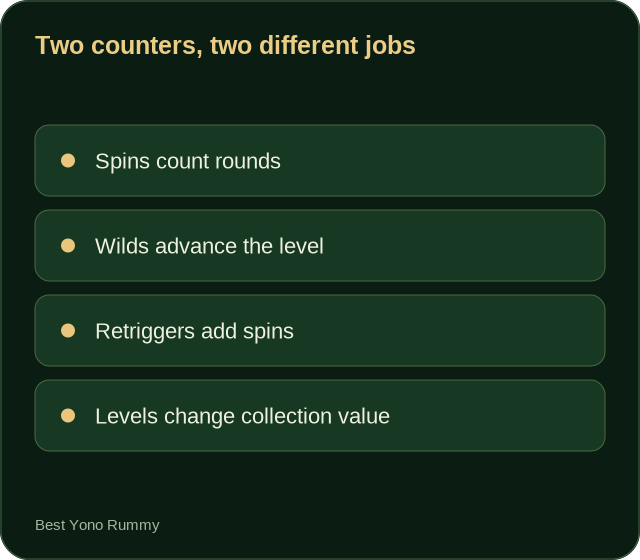
The fisherman also contributes to progression. Every fourth Wild retriggers ten extra spins, and the successive collection levels rise to two times, three times and then ten times. That makes the Wild counter a separate piece of information from the free spins counter. One records progress towards a level change, while the other records rounds remaining. A player following only the remaining spins can miss why a later collection pays differently from an earlier one. The retrigger notification is the point at which the added spins and the changed collection level should become clear.
Consider the same fifteen credit collection used above. At a two times collection level it becomes thirty; at three times it becomes forty five; at ten times it becomes one hundred and fifty. Those calculations explain the effect of a level after it has been reached. They do not imply that all levels will occur, or that a feature starting at ten spins will necessarily extend. The published progression also does not mean that the level values multiply together. Two, three and ten describe successive collection settings; treating them as two times three times ten would invent a different reward rule.
Reading a complete feature without double counting
A clear way to read Big Bass Bonanza is to follow one collection at a time. Start with the fish values on the relevant screen, note the active collection level, and then observe the amount added to the feature total. Only after that should the next spin enter the calculation. This sequence avoids counting a displayed fish once when it lands and again when it is collected. It also explains why an attractive screen can leave the running total unchanged when the required collection event has not occurred. The animation is a presentation of the rule, rather than an additional independent payment.
Imagine that a feature already shows forty credits collected. A later valid collection adds twenty credits, taking the feature total to sixty. The sixty includes the earlier forty; it is not a new sixty credit award to be added once more. At the feature finish, compare the final summary with the accumulated feature total, while remembering that any base game payment may be shown elsewhere. This is particularly helpful when a recording cuts between the reels, a celebration and the account display. Three screens showing the same amount can represent one award progressing through the interface.
Stake units and the difference between return and profit
The stake determines how the game's monetary figures are scaled, so a ten credit illustration should remain in credits until the actual unit is known. If one credit were equal to one rupee in a hypothetical setup, twenty credits would be twenty rupees. If the interface used another conversion, the same twenty credits would have a different cash value. A rupee symbol in a lobby banner does not establish the unit inside the game. Check the stake display and the information panel of the loaded version before comparing a video with a personal screen.
It also helps to distinguish a payment from a net result. Suppose ten paid spins cost two credits each, for a total cost of twenty, and all related returns add to fourteen. The net result is a loss of six credits despite the presence of winning animations. If the returns add to twenty eight, the net result is a gain of eight. The feature total alone does not include an unlimited number of earlier stakes. Keeping a short session calculation prevents a memorable fisherman collection from hiding the actual amount spent obtaining it. None of these examples estimates future results.
Comparing the fishing mechanic with other slots
Big Bass Bonanza suits a different kind of visual reading from Gates of Olympus or Sugar Rush 1000. In Gates, the important question is whether the required matching symbols form a paying result and how a multiplier affects it. In Sugar Rush, location matters because marked cells can develop their own multipliers. In Big Bass, the relationship between collectible fish and the fisherman is central. These differences are practical ways to organise a slot catalogue. Grouping all three together solely because they contain multipliers would hide the main action that a person needs to understand.
The comparison also stops rules from migrating between games. A multiplier that persists on a Sugar Rush position does not imply that a fish value stays available for the rest of a Big Bass feature. A multiplier appearing anywhere in Gates does not imply that the fishing collector works on any visible object. Use the individual game's information screen as the authority for its own state changes. A useful catalogue card can therefore give the exact title, studio and one distinguishing mechanic, while the longer product page explains the sequence. That approach offers a meaningful choice without pretending one mechanism is inherently more profitable.
Mobile controls and following the counters
On a phone, the most useful areas are the stake control, spin control, information menu and feature counters. Before starting, check that the browser has not cropped the lower controls or placed its own navigation over them. A full screen option can improve visibility, but the ability to read the stake is more important than making the fisherman appear larger. When a feature is running, let the collection animation finish before interpreting the account balance. A briefly changing display can otherwise look like a discrepancy when it is simply showing the stages of an award.
If a connection drops during a feature, record the time and any round identifier available in the host account rather than assuming the feature has disappeared. The supplier's game and the host's wallet are different components. A reload should be approached as recovery of a recorded round, not as a way to generate another copy of a favourable outcome. Big Bass Bonanza does not require a separate APK merely because it appears in a mobile catalogue. Use the launch route actually provided by the host, and avoid treating a similarly named application as proof that it contains this exact Pragmatic Play game.
Choosing the original title in the catalogue
The most useful reasons to select Big Bass Bonanza are its recognisable collector relationship, clear retrigger progression and compact fishing theme. These describe how it plays, rather than ranking it by a claimed Indian popularity figure that has not been measured here. The catalogue should preserve the original title and supplier attribution on both the tile and the destination page. A separate page for another Big Bass release should identify the change that makes it a distinct game, rather than repeating this text beneath a different cover. Exact naming makes comparisons and support questions easier.
Before moving from the product page into a live game, check the full title, displayed unit and currently available controls. Read the loaded rules for the precise configuration, especially if a platform presents more than one version. Any deposit, account verification, withdrawal method or promotion belongs to the host service and its stated terms; the fisherman feature does not establish those facts. This page explains the original game's published collection design and uses hypothetical arithmetic to make it understandable. It does not claim that a particular operator offers it to every person in India or that a visible feature guarantees a monetary outcome.
What a collector screenshot can establish
A useful feature screenshot includes the fish values, active collection level and counters in one frame. A cropped image of a high value fish establishes only that a value appeared. It does not establish that a fisherman collected it. If comparing two images, confirm that they come from the same round before combining their amounts. This is why a complete feature record is more informative than a dramatic isolated frame. The progression display also helps distinguish an ordinary collection from a later collection enhanced by a retrigger level.
Questions about Big Bass Bonanza
How do Big Bass Bonanza scatters change the starting feature?
The original published game awards ten free spins for three scatters, fifteen for four and twenty for five. These starting counts describe available rounds, rather than guaranteeing a particular collected total.
What does the fisherman collect in Big Bass Bonanza?
During free spins, the fisherman Wild collects visible money symbol values. The active collection level affects the resulting amount, so a fish value should be read together with the collector and level.
Are retrigger levels multiplied together?
The published progression changes collection levels to two times, three times and then ten times. These are successive settings; multiplying all three values together would describe a rule the original game does not publish.
Source notes
Listing reference: game artwork and catalogue.