Rummy 91 among numbered app names
Rummy 91 is a rummy-branded app name with the number at the end. Its catalogue entry is separate from JaiHo 91, Rummy 77 and Rummy 365. When somebody asks for the “91 rummy app”, check which word appeared beside 91 on their screen. Reversing the search words is an ordinary way to find a name again. Changing Rummy to JaiHo identifies a different record in this collection. A shared number is insufficient grounds for transferring an account history, a feature or an offer between the two.
The digits in Rummy 91 form part of the name. They provide no evidence that a game ends at 91 points, uses 91 cards or awards a prize of a particular size. If you want to know what the number in a scoring table means, look at the column heading and the rules for the particular game. The exercises below use invented scores on paper so you can practise reading a table independently of any claim about the Android app.
Identify the number beside the right label
Try reading a small app catalogue as if you were explaining it over the telephone. First say the heading of the entry. Then say the number sitting next to the heading. Finally identify any separate number printed under a date, offer or category. This simple order prevents “Rummy 91” on one card and an unrelated figure on the next card from becoming one imagined app name. A narrow phone layout can stack details that appeared side by side on a larger screen.
The same distinction matters in search results. A snippet can quote a table cell while the result title describes a whole list. Open the profile heading before saving it. If the name still cannot be read in full, a note such as “91, probably next to Rummy” honestly preserves the uncertainty. Later you can compare Rummy 91 and JaiHo 91 directly. An invented certainty would make that second check harder because you would no longer remember which part was your own inference.
Read one row of a score sheet
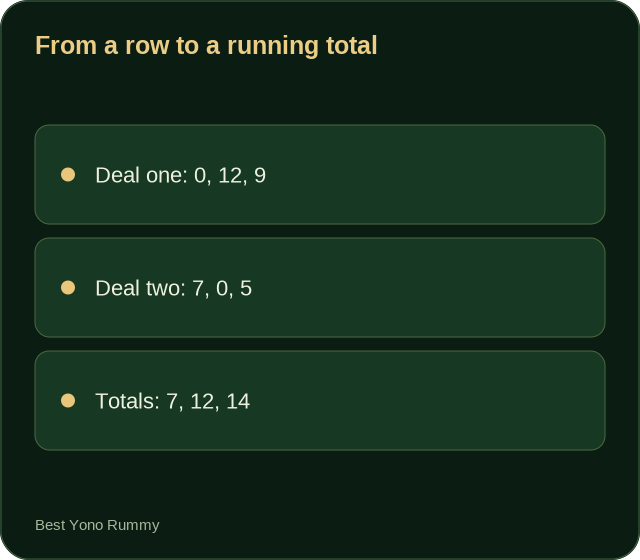
Imagine a free card session with three players named Asha, Dev and Leela. They agree to record penalty points in a notebook. On the first hand Asha writes zero, Dev writes twelve and Leela writes nine. The columns correspond to players and the row corresponds to one completed hand. For this example only, lower totals rank ahead. Cover the names and try to explain what the three values tell you. Without the names and the convention about penalties, the numbers alone do not tell you who did best.
Put the headings back. Asha has the lowest value after the first hand. Dev and Leela can still have the same number of cards as Asha; the penalty is a score under the agreed rules, unrelated to the physical count of thirteen. In a different scoring format, positive points might be credited to a winner instead. That is why reading a score panel begins with the scoring convention. An app listing containing the word Rummy gives no information about which convention an individual table applies.
Carry the totals into the next hand
In hand two, suppose Asha earns seven penalty points, Dev zero and Leela five. Write these values on a new row before adding them down the columns. Asha now has seven in total, Dev twelve and Leela fourteen. The ranking on hand two was Dev, Leela, Asha when considered in isolation. The order across both hands is Asha, Dev, Leela. Both statements are correct because the row result and the cumulative result measure different things.
It is easy to mistake a green zero for the best overall score when a mobile screen shows the most recent hand beside the session total. Put a finger over one column label at a time and read aloud what the remaining number measures. If the table does not make the distinction visible, keep the original screenshot and ask which scoring period the figure refers to. A calculated cumulative score can be checked on paper. A coloured badge or an animation does not supply the missing scoring rule.
A third result changes the order again
For the third hand, give Asha ten penalty points, Dev four and Leela zero. Adding to the previous totals produces seventeen for Asha, sixteen for Dev and fourteen for Leela. Leela now has the lowest cumulative value, although Asha led after two hands. These numbers demonstrate a changing score without assigning any rupee value to a point. The example remains a pencil-and-paper exercise whatever names the apps in a directory happen to use.
Ask a second reader to verify one column rather than all three at once. Leela's entries were nine, five and zero. That gives fourteen. It is possible to read the third row correctly and still transfer one number into the wrong player's column. If two people disagree about a final value, compare the three recorded entries first and then the addition. Separating transcription from arithmetic makes it easier to identify a mistake and avoids an argument about the game when the issue is simply a misplaced number.
Where points and deals differ
A score after a single deal settles one question. A table that carries totals between deals settles another. A pool format normally requires understanding its continuing threshold and any applicable drop rules. A fixed-deals format requires knowing how many deals have been scheduled. Point values can therefore have different consequences depending on the format. The word “91” in the app name does not choose a format for you, and this record does not confirm which ones an individual installation offers.
At a family table, agree on a simple practice format before dealing. For example, stop after three hands and compare the recorded penalty totals, without using money or real prizes. This private exercise has a clear end even if nobody reaches a particular threshold. If somebody suggests continuing for another hand, mark the change on the notebook page before the cards are dealt again. A final table makes more sense when the reader knows whether the length of the session was fixed or was extended during play.
Check the hand before debating the score
Suppose somebody claims to have finished with the four, five and six of diamonds as one sequence. That group is natural if all three cards really are diamonds. Suppose the second proposed group is the ten, jack and queen of hearts. That also forms a natural sequence. Turn to the other seven cards and account for them individually. Two good groups are encouraging, but a declaration deals with the whole hand. A player's score in the notebook cannot validate a group that was never checked.
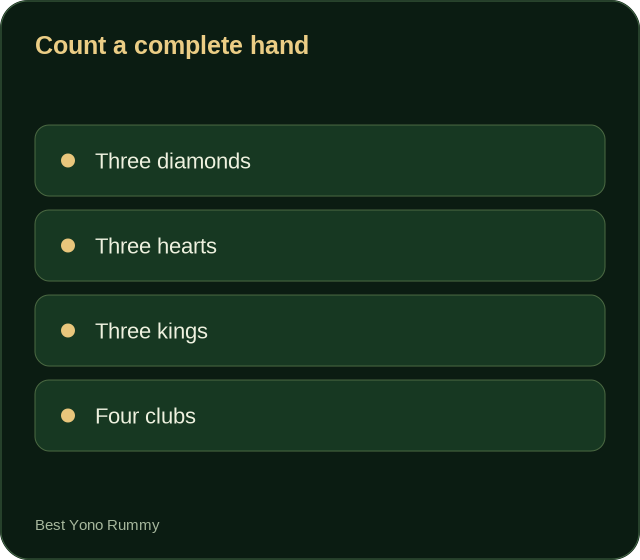
With an ordinary deck, add a set of three kings of different suits and a four-card run from two through five of clubs. Count three diamonds, three hearts, three kings and four clubs. Now there are thirteen separate cards in eligible groups under the common declaration rule. Remove one of the kings and replace it with a nine of spades. The notebook score has not yet changed, but the proposed hand has. This exercise shows why it is sensible to settle the card question first and enter points afterwards.
Tracking a hand seen on a phone
Take a note of what the screen displayed just before it changed. Was a score beside the player's name, above the cards, under an animated badge or in a separate history panel? A family member trying to describe a single moment may use the phrase “I got twelve” without remembering whether twelve was the round result or the running total. A note recording the panel name often resolves that ambiguity before anyone tries to reconstruct the entire session.
For a screenshot shared with a friend, include the explanatory heading and remove any private account or payment details. A second photograph of the game's rules may be more useful than several pictures of the same number. If a score is time-sensitive, preserve the stated time zone and sequence of hands. The catalogue can help you recover the Rummy 91 name. It cannot read an individual's game history. Good private notes are therefore more helpful for a particular scoring question than collecting several similar app names.
Rummy 91 on Android and in a directory
An Android device can show an installed app, a browser bookmark or a shortcut as an icon. Where you previously saw Rummy 91 matters. A title in a browser tab identifies a page. A package identifier and publisher record, when available, identify a piece of software more precisely. Look at the app information already on the device if that is what you are trying to identify. A catalogue profile by itself cannot authenticate a file copied from another phone.
The installation offer linked from this directory is shared across the app profiles. Its presence beside Rummy 91 does not verify an installer for this particular name. Check the actual product and terms on the destination if you choose to read it. Meanwhile the source reference on this profile records where the name appeared in another directory. For a reader interested in the game rather than an installation, the three-hand example and the worked declaration above are complete enough to try with paper and cards.
Make a score sheet another person can audit
Finish the practice session by writing the format, players and hand numbers across the top of a clean sheet. Put each hand result on one line and the cumulative total on a separate line below it. Mark the latter clearly so a reader cannot add both the row and its cumulative total together. With the example here, entering both the separate values and the running total as new points would double-count earlier hands and give a convincing but incorrect final table.
Give the sheet to someone who missed the session and ask two questions. Who had the lowest penalty on hand two, and who had the lowest total after hand three? Dev is the answer to the first question and Leela to the second. If the reader can reach those conclusions without an explanation from the dealer, the labels have done their job. Save the sheet as a scoring exercise and the Rummy 91 entry as an app reference. The number in the app's name will no longer be confused with either result.
Spot the error on a copied scorecard
For a last challenge, deliberately swap Dev's second-hand zero with Leela's five on a copied sheet. The sum of all penalties across all three players stays unchanged. Dev now appears five points worse off and Leela five better off. A check of the overall sum therefore misses the error. Checking individual columns against the original rows finds it straight away. Let the person solving the puzzle describe the error before showing them the correct sheet.
This is a useful distinction when a family group exchanges scores by message. A completely plausible total can conceal a mistake in who was assigned a particular hand. Keep the sequence of rows with the total, even if the participants only want to announce the final order. It takes a few more pencil marks, and it gives anyone with a genuine question the evidence needed to check it themselves.
Questions about Rummy 91
Who leads after the three sample hands?
Leela finishes with fourteen penalty points, Dev with sixteen and Asha with seventeen. Lower totals lead in this particular non-monetary notebook exercise.
How can the total look right when two scores were swapped?
Reassigning a penalty to another player preserves the overall sum. Check the individual columns against the original row to see who was actually assigned the points.
Does 91 specify the scoring threshold?
The digits are part of the recorded app name. A particular table’s written rules are needed to identify a pool threshold or the length of a session.
Source notes
Listing reference: app-name directory.