
Finding Rummy 365 by its whole name
Rummy 365 is a rummy-app name with three digits after the word Rummy. The entry belongs alongside numbered names such as Rummy 77 and Rummy 91, each with its own record. LetsPlayYono also lists Rummy 365 in an Android context. The number in the name is not evidence that an offer runs on every day of the year, that an account will work for a particular period or that the app contains a daily training programme.
A short practice journal can nevertheless be useful for a player who wants to remember what they learnt yesterday. The exercises below describe a personal notebook, independent of any feature of the app. They use one base hand over several short sessions and change one condition at a time. The point is to observe whether a learner can transfer an idea from one hand to another. There is no need to record a streak, earn rewards, make a payment or maintain an account to try them.
Choose a base hand worth revisiting
For the base hand, lay out the three through six of diamonds, the seven through nine of clubs, three kings in hearts, clubs and spades, and the nine through jack of hearts. Count four diamonds, three clubs, three kings and three hearts. There are thirteen cards and four complete groups under the familiar Indian rummy rule requiring two sequences, including a natural one. This particular example has three natural sequences and no substitute joker, so its initial validity is straightforward to inspect.
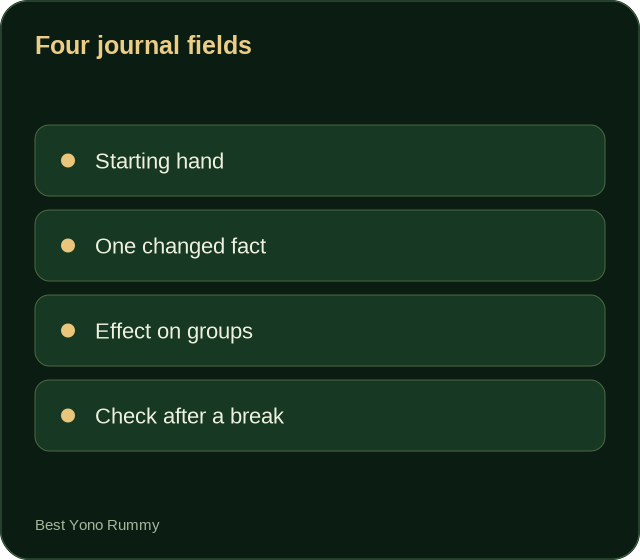
Draw four boxes on the first notebook page and write the groups into them. Include both rank and suit, especially for the nines, which occur in two different suits. Add a sentence stating the rule used. Somebody picking up the notebook next month can then tell whether you were checking a natural run, counting a score or evaluating a complete declaration. A photograph alone is often less informative because the camera records the cards but not the question that gave their arrangement meaning.
Session one focuses on recognising the arrangement
Put the hand away for a minute, then deal the same thirteen cards in a different physical order. Try reconstructing the four groups without checking the first page. When you finish, compare card identities rather than positions on the table. A run listed from high to low in the notebook can still represent the same consecutive ranks as one laid from low to high. The order in which you happened to discover two separate groups is also immaterial.
Write one specific observation about the attempt. Perhaps the kings stood out first, or the nine of hearts briefly looked as though it needed to join the nine of clubs. A note such as “the nines were a pair, but each belonged to a different run” captures an actual insight. A note saying only “good session” is less useful when you return. The exercise is deliberately repeatable. You can learn something from how you recognised the hand even though the cards themselves have stayed unchanged.
Session two changes a suit
Replace the four of diamonds with the four of hearts, leaving everything else as in the base hand. The long diamond run has lost an interior card. The hearts at nine, ten and jack remain complete, while the new four of hearts lies far from those ranks. Ask which of the original group descriptions stopped being true. The answer is more precise than saying the hand became worse. A same-rank replacement with the wrong suit destroyed a particular connection in the proposed run.
Give the notebook a column for the changed fact and another for its consequence. Under the first write that the four changed from diamonds to hearts. Under the second record that the three and five of diamonds now have a gap. A learner can then reconstruct the reasoning in either direction. Returning the four of diamonds repairs the original run. Returning only the number four in another suit cannot. This simple pair of statements is an excellent test of whether the reader is thinking about suits as well as ranks.
Session three changes a role
Restore the original hand, then remove the eight of clubs and place a printed joker in its position. In a practice rule that allows such a substitute, it can represent the eight between the seven and nine of clubs. The club sequence becomes impure. The other two natural runs remain available, the kings are untouched and all thirteen physical cards still have places. The change is different from the previous session: one group has changed classification while still functioning as a sequence.
Record both the actual card and the role it plays. If your note says only eight of clubs, tomorrow's reader might believe the club group remained natural. If it says only joker, the reader may have to guess which card it represented. Writing “printed joker used for the eight of clubs” preserves the relevant information in a short phrase. For a useful repeat test, cover that phrase and ask the learner to infer the missing rank from the two neighbouring cards before uncovering the answer.
Session four changes a grouping
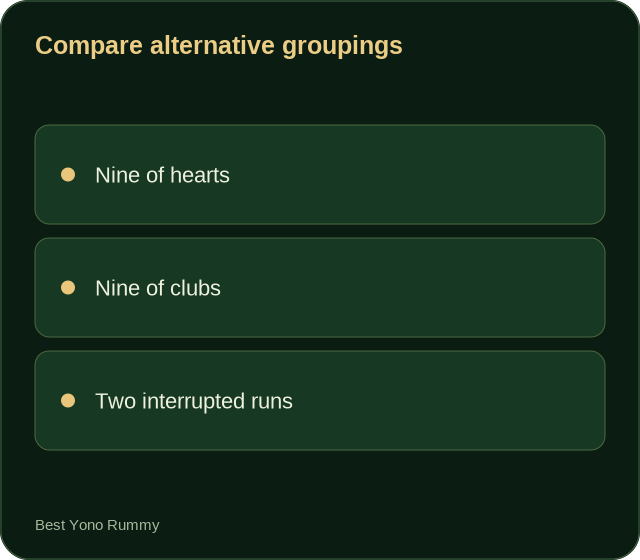
Return to the base hand again. Move the nine of hearts out of its run and place it beside the nine of clubs. The two nines look like the beginning of a set. That movement leaves the hearts ten and jack as an incomplete pair and also interrupts the club run if the club nine is moved into the proposed set. An attractive new possibility is not enough to complete a declaration. The reader must account for what has been taken out of the earlier groups.
Take a photograph of the rearranged hand only if you label it as a proposed change. Someone seeing it later might otherwise assume it was presented as the correct completed solution. The notebook can make the distinction with a single sentence: “I tried collecting the nines, then checked what remained.” A practice journal is particularly valuable when it preserves unsuccessful attempts alongside a working answer. They reveal which clues were genuinely tempting and give the next session a better starting question than repeating a memorised solution.
Add a timing note without turning speed into the goal
If you choose to note how long an exercise took, record what the time measures. Rebuilding a known hand from memory is a different task from solving a new thirteen-card layout. Reading out a hand to another learner can take longer while revealing a better understanding of why the combinations work. A rising or falling number on its own does not settle whether someone has learnt the rule. Use the explanation of the groups as the main evidence.
An easy comparison is to repeat the same task in two different ways. First reconstruct the base hand silently. Then explain each group to someone else while you form it. Write down which cards required an explanation and which did not. A reader who pauses over the role of the joker may understand the concept better by the end of the slower attempt. This journal belongs to the player. The three digits in Rummy 365 set no schedule, deadline, performance target or requirement to practise every day.
Read different dates as different events
An app release, an update on a handset and the addition of an entry to an app catalogue each has its own date. Rummy 365 appearing in a recently refreshed list does not establish that the software was released on the date of that refresh. An existing phone might also install an older release later. Keep the event with the date whenever you compare two records. Two accurate dates can appear to contradict each other when one describes publication and the other describes a later installation.
The same habit helps with a practice journal. A hand photographed on Tuesday might be written into the notebook on Wednesday and revisited on Saturday. If you want to compare progress, the date the exercise was attempted matters more than the time the photograph was forwarded. Record that difference explicitly. A file timestamp can change when a picture is copied, edited or sent to another phone. The date of that copy should not silently replace the date when the original card arrangement was seen.
Finding the app on an existing phone
If you are returning to a familiar Android device, check the full label of the app or shortcut before following a new search result. Rummy 365 and Rummy 77 both begin with Rummy and end with digits. An icon cropped down to the word Rummy could represent many products. A system information screen may show version and distribution information, while a browser shortcut can identify a webpage instead. Those two kinds of record are useful for different purposes.
The Install action beside this listing opens a shared offer destination used across the directory. It cannot verify a separate Rummy 365 Android package or confirm which publisher supplied a file you already have. Read the product name on the destination if you choose to inspect the offer. If your purpose was simply to revisit the four-session exercise, the notebook and a deck can do that without any installer. If your purpose was to identify a previously installed product, record the actual evidence supplied by the device.
Close the journal with one transfer exercise
Make a new hand that uses the same structural idea as the base hand but different suits and ranks. Try a four-card spade run, a three-card diamond run, a three-card club run and a set of three different-suit queens. Check the thirteen-card total and ensure you have not used the same physical card twice. Give the hand to somebody who did not practise the original layout. Ask them to identify what stayed the same between the two hands and what changed.
The strongest answer describes structure: three natural runs and a set account for all thirteen cards. An answer that mentions only the colours or the position of the longest row is less transferable. Keep one sentence about this result on the final page of the notebook. You now have a starting hand, a sequence of controlled changes and evidence that the underlying lesson can be recognised in a new example. Keep the Rummy 365 catalogue address separately for the simpler task of remembering the app's complete name.
Make the notebook useful after a break
Before putting the cards away, add one question for the next reader. It might ask which card changed suit in the second session or what value the printed joker represented in the third. Someone should be able to answer it from the written evidence without relying on the original player's memory. That final check reveals which details were recorded clearly and which should be added while the hand is still on the table.
A second useful question asks the reader to predict one change that would preserve the hand rather than break it. Exchanging the printed joker for the actual eight of clubs in the third session is one valid answer. Describing a successful repair demonstrates that the reader understands the missing role and can restore that particular group deliberately.
Questions about Rummy 365
Does the number 365 date the app or describe a daily reward?
The digits are part of the app name. They establish neither the date of a software release nor any continuing promotion or daily training schedule.
What changes when the eight of clubs is replaced with a printed joker?
The seven and nine of clubs can still form a sequence with the joker standing for the eight under the teaching rule. That club run becomes impure.
Why does starting a pair of nines break the notebook declaration?
The nine of hearts and nine of clubs were already completing different runs. Moving them together leaves gaps, and the resulting pair is not a complete set.
Source notes
Listing reference: app-name directory.