Finding Hi Rummy from a spoken name
Hi Rummy is an app-name entry in the rummy collection. The short word Hi is part of the title, even though it sounds like an ordinary greeting. Someone dictating the name might say “hi, rummy” and a keyboard may insert a comma. Search for the two words together and compare the complete heading with the message you remember. All Yono Spin records this particular spelling. A greeting somebody used while talking about another rummy game is a different clue.
Spoken names matter when a player asks a family member to help read a small phone screen. The listener may see the search result while the other person recalls the icon. Read the complete app name back before opening any destination. If the reply is “actually it was a card I wanted to identify”, switch to the task of reading the hand. A useful card description is possible without knowing the app name, and a good name match does not identify the rules for a particular table.
Say the rank and suit every time
A spoken card needs two pieces of information. “Seven” names a rank. “Seven of clubs” identifies a particular card in an ordinary single deck. That difference becomes important when a hand contains several sevens. Develop a consistent rhythm, such as speaking the rank first and the suit second. A listener can then write the rank and suit in separate columns without having to interpret a different sentence for each card. Choose the language that is easiest for both people.
For a first exercise, read the four of hearts, four of diamonds and four of clubs aloud. The listener writes down three cards, then reads them back in a different order. The group still has three cards of one rank in three suits. Now substitute a second four of hearts from another deck for the four of clubs. A listener who only wrote the ranks will miss the change. A listener who recorded both pieces can explain why the duplicate suit matters under the usual ordinary-set rule.
Learn the two red suits without relying on colour
Hearts and diamonds are both commonly printed red. A person who can distinguish red from black can still confuse the two symbols on a small screen. Describe the shape or say the suit name directly. A heart has lobes and a pointed lower end; a diamond is a four-sided lozenge. Those descriptions are helpful starting points, although individual decks can use stylised or four-colour suits. The printed symbol or written label is better evidence than the colour of a surrounding graphic.
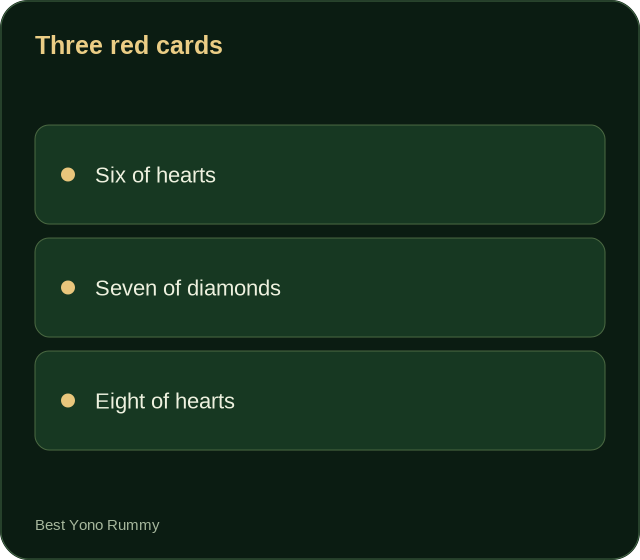
Lay out the six of hearts, seven of diamonds and eight of hearts. Read them once by colour alone, then again with full suit names. The first reading can make the group sound like a valid sequence. The second exposes the diamond in the middle. Replace it with the seven of hearts and repeat the full reading. The ranks have stayed exactly the same, yet the new group is a natural run. A learner who can explain the difference has acquired a skill more durable than memorising a particular picture.
Read black suits and court cards carefully
A club and a spade are often both black. At a glance their small lower stems can make them look more alike than they are. On a printed deck the club usually shows three rounded lobes, while the spade has a pointed top. If somebody is reading cards over a call, agree to say clubs or spades explicitly whenever the suit matters. “Black queen” still leaves two possible suits and may give the listener a complete-looking hand that never existed.
The letters for court cards can add a second ambiguity. J, Q and K stand for jack, queen and king on the familiar English-labelled deck used in these examples. Spell them out when a listener is new to the notation. A queen of clubs and a king of clubs can be neighbours in a run, while two queens of different suits might help form a set instead. The rank letter affects what kind of combination can be built. A decorative royal portrait tells you less than the rank printed in the corner.
Dictate a thirteen-card hand in four breaths
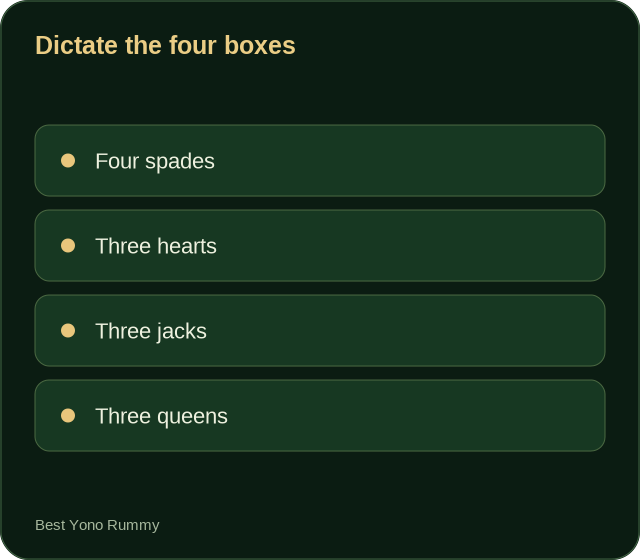
For a complete example, ask the listener to draw four boxes on paper. In the first box dictate the three, four, five and six of spades. In the second put the seven, eight and nine of hearts. In the third put the jacks of clubs, diamonds and spades. In the final box put the queens of hearts, diamonds and clubs. Ask the listener to count the cards back as four, three, three and three before discussing whether the arrangement works.
The first two boxes contain natural runs. The last two contain sets of one rank in different suits. If the listener heard the nine of hearts as the nine of diamonds, the second run fails even though its written ranks still rise in order. Find the mismatch by having the listener read back the middle box. There is no need to repeat the entire thirteen-card hand each time one detail is uncertain. Short groups make the process easier for both the person speaking and the person checking.
A pause can mean a group boundary
When there is no shared picture, timing can convey structure. Read a single proposed group, pause, then say the word next before the following group. This is especially valuable if one group ends with a nine and the next begins with another nine. Without a boundary the listener may assume the two nines were intended as part of the same set. A written slash or a line break gives the paper version the same organisation as the spoken version.
Try removing all boundaries and reading the example as thirteen consecutive card names. A confident listener may still reconstruct the same four groups, but they are now solving a different puzzle. In the first task they checked whether the declared arrangement was valid. In the second they had to discover an arrangement from scratch. Both exercises are worthwhile. Deciding which question you are asking prevents a disagreement in which the listener finds a good new arrangement while the speaker only wanted the original one checked.
Use an explicit name for the joker
A printed joker can be announced as “printed joker” before discussing the card it represents. In the second box of the dictated example, replace the eight of hearts with one. The speaker should say seven of hearts, printed joker, nine of hearts. The checker can then explain that the missing card is the eight of hearts and that the sequence becomes an impure run under a rule allowing that substitution. The other natural spade run remains available in the complete hand.
It is tempting to dictate the substituted rank instead, because the explanation sounds smoother. That shortcut hides important information. A listener who hears only “eight of hearts” may incorrectly classify the group as a natural run and later fail to understand why a natural-sequence requirement matters. Keep a physical placeholder or a small note showing both facts: one printed joker is actually held, and this is the rank and suit it is being used to represent in the proposed arrangement.
Distinguish a screen label from a card label
A mobile screenshot can contain many labels besides the cards. The app name might appear in a title bar, an opponent's chosen name may appear above a seat, and a large number could label the current round. Before dictating a screenshot to someone else, describe the region you are reading. An opening sentence such as “these are the cards in my lower row” avoids accidentally including a face-up discard from the centre or a decorative card in the background.
For a display that permits larger text or zoom, increasing the size may make a rank easier to identify. It can also move a neighbouring card outside the visible area. Count the cards after zooming and check the original uncropped screen if the number seems wrong. A screenshot containing twelve visible cards may simply exclude part of the row. In a question about a declaration, report the visibility limit instead of supplying a thirteenth card from memory. A careful incomplete description can still support a useful conversation.
What the directory's install action identifies
A caller who remembers Hi Rummy on Android could have seen a home-screen shortcut or an installed package. A browser shortcut opens a page; an installed application has additional system-managed identity information. If the phone is available, read the app information label and version together. If all that remains is a spoken recollection, save the catalogue name as a possible match and wait for stronger evidence before assigning a publisher or package to it.
Best Yono Rummy uses a shared installation offer across its listings. The Install control beside Hi Rummy opens that offer. It does not certify that the resulting destination supplies the Hi Rummy software you remember. Somebody helping over the phone should describe what the destination actually says, without asking for a private password, payment PIN or one-time code. If the immediate task is to learn card names, the spoken exercise can be completed using paper cards without opening any installation offer at all.
Finish with a listening test
Give the listener a choice of two possible descriptions for the first box in the complete hand. One says three, four, five and six of spades. The other says three, four and six of spades plus the five of clubs. The labels differ in one suit. The listener should be able to explain why only the first is a natural four-card run. Reverse the task and let the listener choose the changed card while the original speaker takes notes.
For a final exercise, describe the same completed hand to somebody who has never seen the Hi Rummy page. Ask them to name the two runs and count the three distinct suits in each set. If they can do so, the description stands on its own. If somebody later asks about the brand, the full name Hi Rummy and its saved profile can be supplied separately. Clear spoken game instructions and clear app identification depend on the same modest habit: preserve the exact detail the next person needs to identify.
Make a compact notation key
Write C for clubs, D for diamonds, H for hearts and S for spades in the margin of the exercise sheet. A note such as 9H can now stand for nine of hearts, while a vertical bar can separate proposed groups. Before using this shorthand with anyone else, ask them to decode three examples. A compact note is useful only if the sender and receiver give every symbol the same meaning. A clear key also makes last week's puzzle understandable when the original conversation has faded.
For the printed joker, choose a mark that cannot be mistaken for a jack. Writing the whole word joker beside a vacant rank is an easy convention. Read back the note once after finishing it. If the receiver hears both the actual joker and the missing eight of hearts, the shorthand has preserved both pieces of information.
Questions about Hi Rummy
What is missing from the description “the black queen”?
It could be the queen of clubs or the queen of spades. Name the suit as well as the rank so another person can reconstruct the hand.
How should I describe the joker in the dictated heart run?
Say printed joker when listing the actual cards, then explain that it represents the eight of hearts. This preserves the difference between a natural and an impure run.
Why put pauses between the four boxes?
Pauses convey the intended grouping. The listener can check the proposed declaration directly instead of first having to discover a possible arrangement from an ungrouped card list.
Source notes
Listing reference: app-name directory.