Love Rummy as a name and a phrase
Love Rummy is a named entry in the app directory. The same two words can also occur in an ordinary sentence about enjoying a card game. If someone says “I love rummy”, the speaker may be expressing a preference without identifying any app at all. If they point to an icon headed Love Rummy, you have a more precise clue. Look for the phrase as a complete heading and keep the surrounding context when saving a message for later.
The directory places this name alongside other rummy entries such as Hi Rummy and Joy Rummy. Those records make useful alternatives if the first word was lost in a cropped image. They do not establish a shared publisher, a shared login or a common set of tables. A person asking for a familiar activity can use the two-player puzzles below for free with ordinary cards. The puzzles illustrate how to discuss decisions with a partner and are independent of the features of any particular app.
Set a problem that both people can solve
One player sets out a hand and the other explains it. Agree first on what counts as an answer. In the first exercise the question will be whether a proposed group is a natural sequence. In the second, the question will be whether all thirteen cards can be placed in separate legal groups. Those are different levels of difficulty. A person who correctly spots one natural run has answered the first question even if they have not yet solved the whole hand.
To keep the exercise friendly, give the person solving it permission to ask for the rules in their own words. A player familiar with a local game might use “straight” where the other says “sequence”. A small example can reveal that both mean the same thing. Put the seven, eight and nine of clubs on the table and ask what single property each card shares with the others. A shared suit and consecutive ranks provide a common starting vocabulary before either player needs to argue about terminology.
Build a puzzle with one deliberate decoy
Lay out the seven of clubs, eight of clubs, nine of clubs and nine of spades. Ask the other person to choose three cards that form a natural sequence. The second nine is a useful decoy because it fits the rank order while having the wrong suit. Ask the solver to explain why one nine works and the other does not. Naming both the positive and negative cases shows more understanding than pointing to the three correct cards.
Now remove the nine of clubs and ask whether the task can still be completed from the three remaining cards. It cannot, under the stated rule. That answer is more instructive if the person is allowed to say no solution rather than being told every exercise must have one. In an actual hand the absence of an immediate group is ordinary. Recognising a genuinely incomplete arrangement is part of learning the game and prevents a player from trying to force a group simply because the cards have been placed beside one another.
Exchange roles with a set puzzle
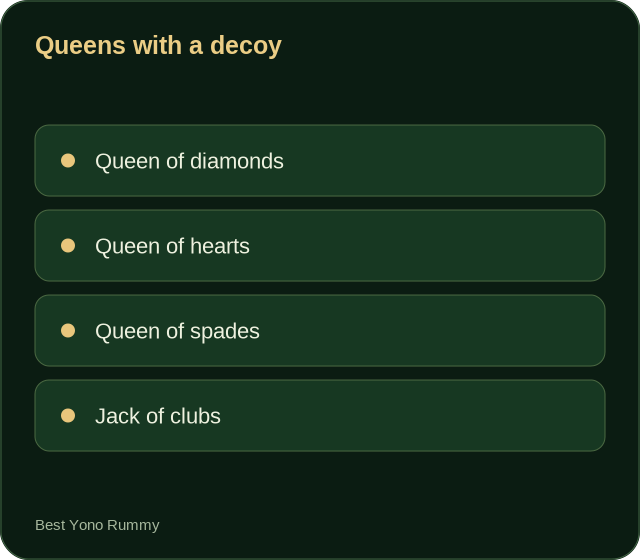
The person who just solved the run should choose four cards for the other player. Try the queen of diamonds, queen of hearts, queen of spades and jack of clubs. The task is to choose three cards of one rank in different suits. This time the decoy is identified by its rank. The three queens work regardless of their order on the table. The jack does not help, despite the fact that a jack can sit next to a queen in a run.
With a second deck, exchange the jack for a second queen of hearts. There are now several ways to select three physical cards labelled queen, but a group using both heart queens fails the distinct-suit rule used in this exercise. A player can still select hearts, diamonds and spades by leaving one duplicate aside. Discuss the difference between a valid choice existing and every possible choice being valid. It is an especially useful lesson before moving from a simple recognition puzzle to a full declaration.
A thirteen-card hand for two readers
Make a four-card run from the six through nine of diamonds. Add the two, three and four of clubs. Make a set of three kings in hearts, diamonds and spades. Finish with the nine, ten and jack of spades. Ask one player to verify the two diamond and club runs while the other checks the set of kings and the spade run. Finally count all the cards together. Four, three, three and three gives the required thirteen.
The hand includes two nines in different suits. One is at the top of the diamond run and the other begins the spade run. A listener who writes down only the ranks may wonder whether the same nine is being counted twice. Lay the two nines side by side momentarily to show that they are separate cards, then place each back in its group. The physical demonstration is quicker than a long explanation and helps train both players to preserve suit information when reconstructing a hand later.
See what a different starting point changes
Shuffle the thirteen puzzle cards and try arranging them again. This time one player should begin by looking for matching ranks and the other should start by searching for runs within suits. The first player is likely to notice the kings and the two nines. The second may find the long diamonds immediately. Both are reasonable ways into the puzzle, but the pair of nines is not yet a set. Discovering a promising pattern does not commit you to keeping it.
Compare the completed arrangements rather than counting how quickly each person spotted the first group. If both use thirteen cards once, contain the appropriate sequences and obey the same rules, the starting order has served its purpose. If one leaves a card outside, ask at which earlier step a useful card was committed to an incomplete group. That question makes a friendly discussion more constructive than telling someone they sorted the hand incorrectly before they have had a chance to explain their plan.
A joker puzzle with two possible completions
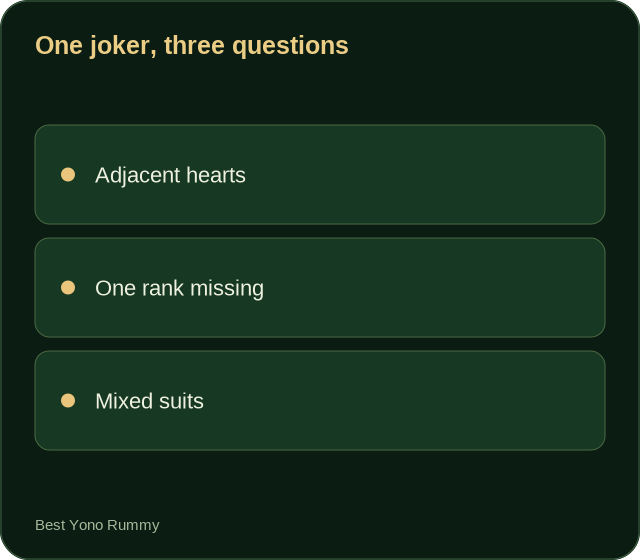
Place the eight and nine of hearts on the table with a printed joker. Under a rule allowing an impure three-card sequence, the joker might represent the seven of hearts below the eight or the ten of hearts above the nine. Both interpretations connect the same two natural cards in this isolated exercise. Have one person describe each arrangement. The interesting point is that the joker's role can depend on the proposed group when the natural cards leave two possible ends open.
Now use the eight and ten of hearts instead. A single printed joker can bridge the gap by representing the nine of hearts. The missing rank is more tightly determined. Change the ten of hearts to the ten of spades and the same explanation no longer works, because the natural cards belong to different suits. These three tiny changes offer a complete teaching sequence: two possible substitutions, one specific substitution and no valid substitution under the stated sequence rule. Keep the examples separate so neither partner has to guess which version is being discussed.
Discuss a rule without turning it into a dispute
If the two players give different answers, write down the condition each assumed. One may have allowed a high ace and the other only a low ace. One may have treated the example as an ordinary set and the other may be thinking of a local special combination. Change the condition explicitly, then try the same cards again. A hand can give a different result under a different rule without either player having misread the ranks or suits.
This approach is useful when sharing a digital example with relatives in another city. Include the variant, the selected cards and what you thought the question was asking. Cropping everything except the artwork leaves the reader with an attractive image and very little usable information. If the exercise came from this page, say that it was a tabletop example with agreed rules. A reader should never have to infer that Love Rummy software offers exactly the same mode or accepts the same special combinations.
Distinguish a remembered app from a new offer
If the original task was to identify software, return to the complete app label when the card discussion is over. An Android launcher can display a shortened name, while a browser shortcut may simply use the title supplied by a website. Compare any device information available to the owner with a publisher-controlled listing if one can be established. The name Love Rummy and the independent sources mentioning it are useful catalogue evidence, but cannot authenticate an installer somebody has copied or renamed.
The Install action opens a common installation offer used across this directory. Its position on the Love Rummy profile does not prove that the software on the destination is Love Rummy. Check the product name and terms there if that is your reason for opening it. For a two-player practice session no device permissions or account credentials are involved. A deck, a clear surface and one person willing to explain their choice are enough to reproduce the puzzles described here.
Keep one puzzle for the next game
At the end of the session let each player invent a three-card challenge for the other to solve next time. Give the challenge a name that captures its teaching point, such as two different nines or the joker with two jobs. Write down the exact cards and one sentence about the rule. When you meet again, let the other player find the answer before revealing the note. The point is to remember the distinction, not the order in which the cards happened to be dealt.
For a harder follow-up, put two challenges together in one row and ask whether their solutions compete for a physical card. If each group claims the same eight of hearts, both cannot be counted at once. If one uses the eight of diamonds and the other the eight of hearts, the groups can coexist. That final check turns a friendly three-card puzzle into the beginning of a genuine declaration exercise. Keep the Love Rummy bookmark to remember the product name, and keep the little card note to remember what the two of you discovered.
Help someone join halfway through
A third person walking up to the table sees an arrangement without hearing the original question. Give them the starting condition and exactly one clue, then ask them to restate the task. If they think they are judging a complete declaration while you are only comparing two possible jokers, clear that up before turning over another card. A brief introduction prevents a good answer to a different question from sounding like a mistake. It also makes the exercise easy to share across age groups and levels of experience.
When the new reader has answered, invite them to make one change for the original pair to diagnose. A useful change alters a single rank, suit or rule, leaving every other part of the puzzle easy to compare.
Questions about Love Rummy
Can the same joker represent two different ends of a run?
In the isolated exercise with the eight and nine of hearts, either a seven or a ten completes a three-card sequence. Choose one role for each proposed arrangement.
Why leave both nines in the full declaration?
They are different physical cards. The nine of diamonds ends the diamond run while the nine of spades begins the spade run, so no card is counted twice.
Does the phrase “I love rummy” identify an app?
It can simply express enjoyment of the game. Look for Love Rummy as a full heading or icon label before associating the phrase with the catalogue entry.
Source notes
Listing reference: app-name directory.