The app called Rummy 77
Rummy 77 is the directory entry formed by the word Rummy and two sevens. It has a different catalogue record from Yono 777, Spin 777 and Rummy 91. If a heading has been cropped down to “77”, you still need the adjoining word and the number of digits to distinguish those names. LetsPlayYono lists Rummy 77 in an Android context. That identifies one publicly documented app name rather than a complete inventory of the games or functions on any particular device.
The double seven makes a convenient starting point for a tabletop question. Two sevens form a pair. Under an ordinary Indian rummy set rule, the pair alone is not a complete three-card set. In the exercise below the digits serve as a memory aid for that distinction. They do not imply that Rummy 77 software awards a particular number of points for two sevens, requires seven runs or provides a special pair mode. Rules belong to the actual game and variant.
Build a pair and ask what it is missing
Take the seven of hearts and seven of clubs from an ordinary deck. The two cards have a shared rank and different suits. Under the exercise rule, one more seven of another suit would produce a three-card set. Either the seven of diamonds or the seven of spades can fill that role. Neither the six of hearts nor the eight of clubs completes the set, although both might be interesting neighbours in an entirely different sequence problem.
Put four candidate cards face down and turn them over one at a time. Ask the learner why each works or fails. A seven of spades matches the required rank and supplies a new suit. An eight of hearts has the wrong rank. A queen of diamonds has a different rank even though its suit is new to the group. Giving both checks makes the reasoning clearer than saying a card merely looks right. The next exercise will show why sharing the rank alone can also be insufficient.
The duplicate-suit trap in a two-deck example
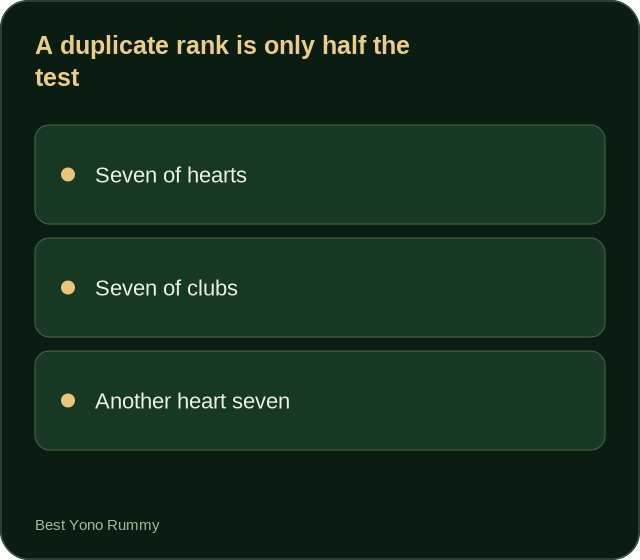
To examine duplicate cards, use two ordinary decks or write facsimiles on paper. Start with the seven of hearts and seven of clubs again, then add a second seven of hearts. All three cards display the numeral seven. The group still has only two distinct suits, so it fails the ordinary set rule chosen for this lesson. Label the two heart sevens A and B to make clear that they are two physical cards even though their printed ranks and suits match.
Now add the seven of diamonds to the three-card pile. You can choose hearts A, clubs and diamonds or hearts B, clubs and diamonds. Those are two different physical selections representing the same pattern of three suits. A selection containing both heart copies still fails. This is a useful intermediate problem because the question is no longer simply whether the pile has a solution. It asks whether a particular selection from the pile meets the rule. Keep the unused card visible outside the proposed set.
A fourth distinct suit gives choices
Set aside duplicate cards and use one seven in each of the four suits. Under a variant permitting a four-card ordinary set, all four can form one group. If your exercise asks for exactly three, you can choose a three-card subset in four ways by leaving out a different suit each time. List the omitted suit in each case: hearts, clubs, diamonds or spades. This shows why two people can offer different correct three-card answers to the same puzzle without disagreeing about the rules.
The choice becomes meaningful when the spare seven has another use in a full hand. If the six and eight of clubs are already together, leaving out the seven of clubs could allow a club sequence. Leaving out the seven of hearts would not help those two club cards. A decision that looks arbitrary when considering only the four sevens can be decisive once the rest of the hand is visible. That is one reason to inspect the complete layout before committing a flexible card to a set.
A full layout that needs a particular seven
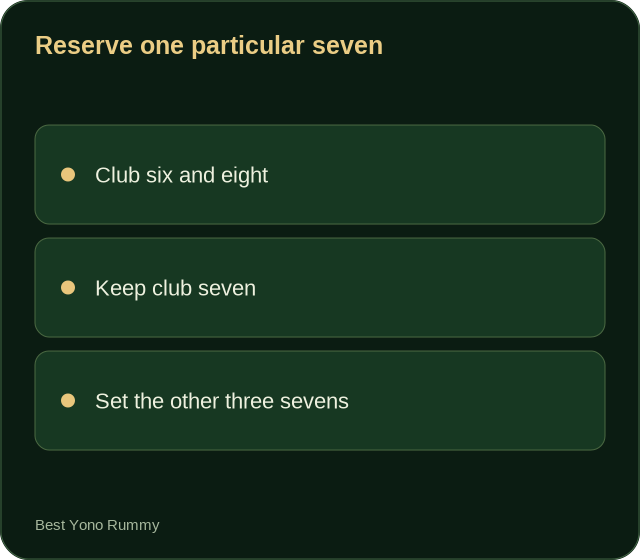
Place all four sevens on the table. Add the six and eight of clubs, the two through five of diamonds and the nine through jack of hearts. Count four sevens, two club neighbours, four diamonds and three hearts. There are thirteen cards. Arrange the clubs as six, seven and eight. Use the remaining sevens of hearts, diamonds and spades as a set. The diamonds and hearts make two more natural runs. All thirteen cards now have separate eligible places.
Try forming the set with the seven of clubs instead of the seven of diamonds. The set itself is perfectly good, but the club six and eight have lost their bridge. The spare seven of diamonds cannot replace the missing club because its suit differs. A reader checking only the three sevens might approve the proposed group while missing the problem elsewhere. A declaration asks a wider question. Every physical card must belong to a legal group and the required sequences must be present in the same arrangement.
Count the hand in more than one way
Verify the full example by group length. The club run contains three cards, the set contains three, the diamond run contains four and the heart run contains three. Three plus three plus four plus three gives thirteen. Now count by suit using the original physical inventory. Clubs contribute the six, seven and eight. Diamonds contribute the seven plus the four small consecutive diamonds. Hearts contribute the seven and the three high heart cards. Spades contribute only their seven. The totals are three, five, four and one.
Both methods reach thirteen. If they do not, the discrepancy reveals a card omitted or counted twice in the written description. Counting by suit is particularly useful when a group of identical ranks has been moved around repeatedly. Counting by group is more useful when checking that the declaration really consists of complete combinations. Use both as independent checks instead of repeating the same count more loudly if two readers disagree. The exercise is about making errors easy to locate, not about finishing quickly.
Introduce a joker after mastering the natural hand
Remove the seven of spades and insert a printed joker. Under a rule allowing a joker to fill the missing member of the ordinary set, the remaining heart and diamond sevens plus the joker can complete that group. The seven of clubs remains available for the club run. Write the proposed job of the joker clearly. Placing it in the set as the missing spade seven has a specific consequence for the rest of the hand.
A different rule might restrict the use of jokers in particular sets or require another treatment of the wild rank. That is a reason to identify the variant explicitly, not a reason to assume every app works like this paper exercise. If you teach the hand to somebody new, solve the entirely natural version first. Then introduce the joker and ask which parts of the explanation have changed. Three runs remain intact. The set now relies on a substitution. The physical count should still be thirteen.
Tell two sevens apart from three sevens on a phone
A numeric app name can be hard to recover from a small tile because the number might be clipped, repeated for decoration or printed on a separate game symbol. Search the complete label attached to the app icon or the heading on the profile. Rummy 77 means two digits in this catalogue. A row of three sevens inside reel artwork may belong to a slot motif and need not identify the app at all. Read the title independently of pictures used inside the game.
One practical clue is whether the word Rummy moves with the digits when the screen changes size. If the title wraps across two lines while the digits remain part of the same heading, they are likely being presented as the product name. If the digits appear only on a decorative tile elsewhere in the image, keep them as artwork rather than merging them into the title. A clear saved link can settle what the original crop left uncertain. An isolated pair of numerals usually cannot.
Distinguish a catalogue record from an Android package
Android can give different products similar display labels, and a browser shortcut can borrow a page title. To identify something already present on a phone, start with the system's app information when available and record its version and package identity. Compare those details with a publisher record appropriate to the particular software. A match on the visible label Rummy 77 is a starting point. It does not by itself authenticate a renamed file or tell you which version a third-party page describes.
The Install action used by Best Yono Rummy opens a shared installation offer across many listings. Its appearance on the Rummy 77 profile does not establish that a separate Rummy 77 APK is being distributed by the publisher. Read the exact destination details if you decide to examine that offer. To practise the four-sevens declaration or compare a pair with a set, the original deck and the card instructions here are all you need. There is no need for an account or a monetary stake.
Make a new puzzle from the same idea
Exchange every seven for a queen and rebuild the exercise around that rank. You can make a run using the jack, queen and king of one suit while the other three queens form a set. Add two natural runs in other positions and count the total cards before presenting the puzzle. Choose ranks carefully so you do not accidentally require a card already committed somewhere else. The exercise should contain thirteen physical cards and at least one complete arrangement under your stated rule.
Ask a second player to explain why one particular queen should be left out of the set. If they can point to its two suited neighbours and show what the other queens will do, they have transferred the lesson beyond the original double-seven motif. Keep their chosen example with the rules used. The Rummy 77 name is easy to remember because of its digits. The more valuable skill is being able to tell when a same-rank group is complete and when a card would serve the hand better somewhere else.
Write a useful answer key
An answer key should state both the chosen set and the card it leaves free. For the original hand, write hearts, diamonds and spades in the set, leaving clubs to join the six and eight. If a learner offers a different set, check the remaining cards with them before announcing a result. This gives credit for recognising a legal small group while explaining why the whole declaration still needs a different choice.
A second key can record the near miss: hearts, clubs and spades form an eligible set but leave a diamond seven with two club neighbours. Put the working and failing keys side by side. The contrast depends on just one suit, making it clear why a rank-only explanation could never distinguish the two arrangements.
Questions about Rummy 77
Does a pair of sevens count as a complete set?
The ordinary set rule used here requires at least three equal ranks in distinct suits. A pair of different-suit sevens still needs another eligible card.
Which seven stays out of the set in the complete example?
The seven of clubs completes the sequence with the six and eight of clubs. The heart, diamond and spade sevens can form their own set.
Is a three-seven reel picture enough to identify Rummy 77?
No. Three sevens might simply be decorative game artwork. Use the complete app heading and check that it contains the word Rummy and two digits.
Source notes
Listing reference: app-name directory.