Money Rummy is a name before it is a number
Money Rummy is a rummy-branded app name in the Indian directory. The opening word does not establish that every number shown beside the name is money. A score, a marketing example and a payment record can all contain digits but describe entirely different things. LetsPlayYono lists the name in an Android app context. The catalogue keeps it as an individual record rather than treating any page mentioning money and rummy as the same app.
A family member looking for Money Rummy may remember either the name or a figure on an old screenshot. Ask which detail matters. A search for an app name should preserve the full heading. A question about a card score needs the hand, scoring convention and result. A question about an actual debit needs the record issued by the payment provider. It is often possible to answer the first two with public information and an ordinary deck, while the third cannot be answered by any public catalogue page.
Begin with three clearly labelled units
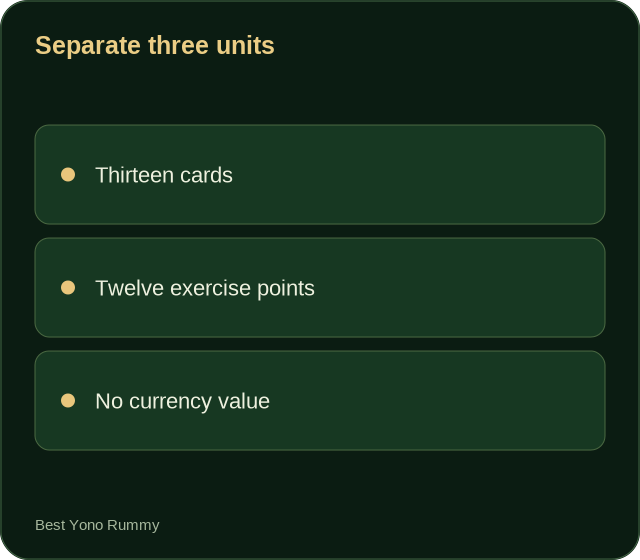
Take three slips of paper and write cards, points and rupees across them. Put the number thirteen under cards to describe the size of a common Indian rummy hand. Put twelve under points as a completely invented penalty in a family exercise. Put nothing under rupees. A hand can have thirteen cards and twelve penalty points while having no monetary value at all. That simple layout is useful when a product name includes the word Money and encourages somebody to infer an exchange rate.
Move the point value from twelve to eighteen after an imaginary correction. The count of physical cards remains thirteen, and the rupee field remains blank. A change in one of the three quantities need not change the others. If someone asks what eighteen points would be worth, the correct answer for this paper exercise is that no conversion has been defined. The absence of a conversion is an essential part of the example rather than a missing number to guess from the app name.
Choose a scoring convention on paper
For a small lesson about unmatched cards, define your own transparent scoring convention: number cards take their face value and court cards count ten for the purpose of the exercise. Leave out aces and jokers at first. This is a teaching convention for comparing arithmetic. An actual variant may apply different rules, caps, declaration conditions or penalties. Giving the rule before the examples lets every reader reproduce the sums without treating them as settings offered by the Money Rummy app.
Lay the three of hearts, five of diamonds and queen of clubs apart from any completed group. Under the written convention their values are three, five and ten, giving eighteen. Now exchange the queen for the nine of clubs. The new total is seventeen, even though there are still three physical cards. Mark the old sum and the new one on separate lines. The exercise isolates the effect of one changed card without any assumption about players, stakes, deposits or a live scoring table.
Why a valid group needs checking first
The value of a card in your teaching exercise depends on whether it is being counted among the unmatched cards. Put the six, seven and eight of clubs together as a natural run. Add a separate five of spades and nine of hearts. If the instruction is to add only the cards outside completed groups, the five and nine contribute fourteen while the club run stays together. Adding every visible numeral would answer an entirely different question.
Replace the seven of clubs with the seven of hearts. You now need to reassess the group before doing any arithmetic. The club six and eight no longer have a suitable middle card and the red seven belongs to a different suit. In a small exercise that counts all unmatched cards individually, a formerly complete group can therefore contribute several new terms to the sum. Write down the eligible combinations first and then list the cards you are actually counting. Arithmetic cannot correct an incorrect starting definition of unmatched.
Test the complete thirteen-card layout
Build a full example with the two through five of hearts, the eight through ten of clubs, three queens in diamonds, spades and hearts, and the five through seven of spades. There are four cards in the first group and three in each of the others. The three natural runs and one distinct-suit set account for the entire hand. Under the stated exercise that counts only unmatched cards, the unmatched total is zero. The number of cards held is still thirteen.
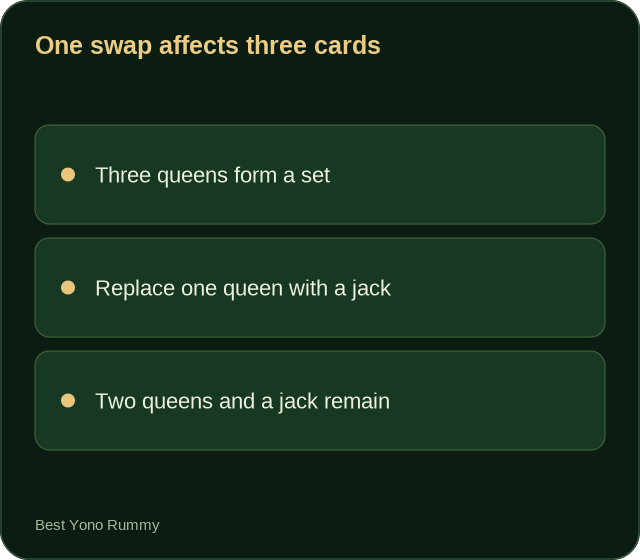
Next change the queen of spades into a jack of spades. The set of queens has lost a member. Two queens and a jack are left outside the original arrangement. Under the court-card convention they contribute thirty points if no alternative grouping is made. Notice how changing one card affects more than its own value. The new arrangement changes the status of two other cards as well. That is why a claim such as “I swapped one ten-point card for another” does not by itself settle the result.
Record corrections without losing the first answer
When teaching with a notebook, keep an initial answer even if it turns out to be wrong. Write the cards counted beside it and the reason for each inclusion. A correction can then identify whether the mistake was a number copied incorrectly, a court card assigned the wrong value or a valid set accidentally split. Those are different problems with different remedies. Erasing the original sum too quickly makes it harder for the learner to see why the corrected one makes sense.
Suppose the initial answer for the changed full hand was twenty. The list beside it shows only the two queens. The missing jack explains exactly why thirty is the answer under the exercise. If the list shows all three court cards but still totals twenty, the error is arithmetic instead. If the learner is still counting the queens as part of a complete set, return to the group definition. An adult or child can follow this reasoning without ever being told that a point represents a payment.
Interpret promotional figures as claims with context
A directory can record a figure attributed to a third-party listing and date the observation. That figure cannot establish an individual's balance or guarantee current terms. For a reader trying to understand an old image, preserve the heading beside the amount. Welcome offer, example credit and withdrawal request describe different events. An original source date is also useful because a screenshot can keep circulating after an offer has changed. The word Money in the app name supplies none of those missing conditions.
If the question involves an existing transaction, preserve the amount, currency, date and reference privately and contact the provider responsible for that record through a route you already know. A public score screenshot is incapable of proving whether funds moved. Be particularly careful when a message offers to convert in-game points if you first send money to an individual. The source and purpose of the transfer require independent verification. The directory page has no account ledger, payment service or ability to release money for Money Rummy.
Comparing Money Rummy with other named apps
Money Rummy and Yono Rummy sit in the same broad category, while Max Rummy and Rumble Rummy are further separate names. The shared final word helps you choose a topic to browse. The first word helps you find a particular entry. A balance or score from one service should not be attributed to another because the word Rummy appeared in both. If an old message contained several titles, check which figure actually belonged to which heading before naming an app.
The distinction matters when searching from a phone. A narrow card may show the title above an image and terms below it, while a large screen places the same elements next to each other. Ask for the complete original card if the item is ambiguous. If all that can be established is the app name, save that result and leave the monetary question unresolved. A qualified piece of evidence is more useful than a precise rupee amount attached to the wrong product by assumption.
Reading an Android record without opening an account
An existing Android installation carries more identification information than the short label under its icon. The app information screen may show a version, publisher or link to its distribution listing, depending on device and installation source. A browser bookmark can also appear with an icon on the home screen and open a website instead. Identify the type of object first. Without that step, comparing a webpage date with an Android version number can produce a convincing comparison between unrelated things.
The Install control on this profile opens the same installation offer used across the directory. It is not evidence that a particular Money Rummy Android package has been authenticated. The destination's own product description is needed to know what it offers. No version, publisher or package identity is inferred from a card-game score or from the branded label here. If you are keeping a record for future reference, save the public app name, the device information and any private transaction documents as separate types of material.
Share an exercise without sharing a statement
If somebody wants help with a points question, copy only the cards needed for that question. Write the scoring convention and show which cards were treated as unmatched. A bank balance, telephone number and account email cannot improve the explanation of a queen's exercise value. If somebody instead needs help with a payment, a card notation such as queen of hearts is unlikely to identify their transaction. The right information depends on the question as much as on the word Money in the heading.
At the end of the lesson, ask another reader to describe the difference between thirteen, thirty and zero in the full-hand example. Thirteen counts the physical cards. Thirty is the invented unmatched-point total after the substitution. Zero is the original unmatched-point total before it. None is a rupee amount. If the reader can reconstruct the meaning of each figure from the labels and card arrangement, they can carry the same habit into a real interface, where several kinds of number often share a small screen.
Reconcile two explanations of the same hand
Let one person explain the corrected score card by card and another explain it as a change from the original state. The first account says that a jack and two queens remain unmatched at ten points each. The second says that a previously complete group has broken into three court cards. Both reach the same result for different explanatory reasons. If they disagree, place the thirteen physical cards on the table and match each statement to an actual card before adjusting any number or drawing a conclusion about the rules.
The exercise becomes especially clear if each unmatched card is moved to a separate box before the points are added. Looking back at the untouched groups then shows exactly what remained valid and why the value changed even though two different cards were both court cards.
Questions about Money Rummy
Is every number beside the Money Rummy name an amount of money?
No. Read the local label: the number might count cards, measure points or form part of a promotional claim. A currency value needs its own evidence.
Why does replacing one queen with a jack change the paper score by thirty?
The set breaks and leaves all three court cards unmatched. Under the stated exercise each contributes ten, even though only one physical card was exchanged.
Can the score in the example be converted into rupees?
The family exercise defines points but no exchange rate or payment. The score can be checked entirely from the cards and the written convention.
Source notes
Listing reference: app-name directory.