Which JaiHo listing is the rummy entry?
JaiHo Rummy is the complete name of the rummy-app entry in this catalogue. JaiHo 91 and JaiHo Win appear as separate entries. LetsPlayYono also lists Jaiho Rummy with the same two words and slightly different capitalisation. That difference in styling is a reasonable recognition clue. It does not by itself establish common ownership with any other JaiHo product, nor does it transfer an Android account or game inventory from one entry to the next.
If your search starts with JaiHo and ends with a description of cards, remember that a mixed lobby can also show card imagery. Check the second word on the original heading before deciding that this is the product you saw. A reader seeking the game mechanics can still use this page's exercise about cards that fit multiple groups. It deals with the structure of an Indian rummy hand and makes no claim that a particular app offers the same teaching exercise or house rules.
What makes a card flexible?
A card is flexible in a particular hand when the other cards give it more than one plausible role. The nine of diamonds might fit between the eight and ten of diamonds. It might also complete a set with the nines of spades and hearts. Both statements can be true if you consider the combinations separately. In a single declaration the same physical card can belong to only one group. Flexibility concerns the alternatives available before the final choice.
Put the five cards just described on the table. Move the nine of diamonds physically into its run, then physically into its set. The cards left behind change each time. This movement reveals a question hidden by a written list of possible combinations: which cards remain useful after the flexible card has been committed? It is possible to find two attractive groups and still have only enough material for one. A simple way to avoid the mistake is to place each proposed group on a separate sheet.
Start with a genuine overlap
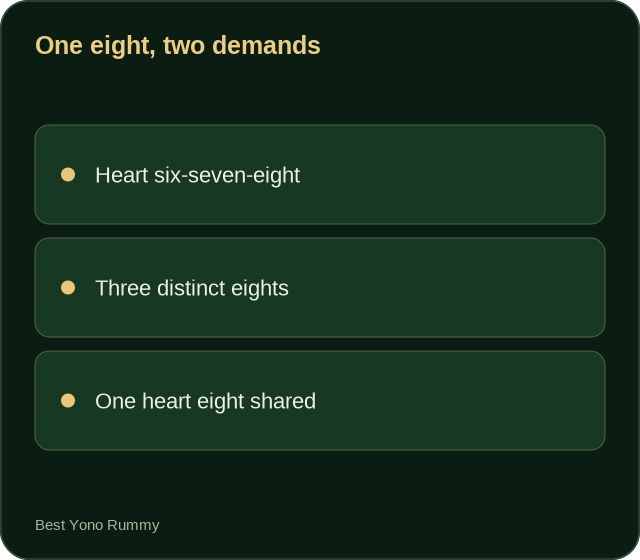
Take the six, seven and eight of hearts together with the eights of clubs and diamonds. In the first arrangement, the heart eight finishes the run and leaves a pair of eights. In the second arrangement, all three eights make a set and the heart six and seven remain together as an unfinished pair. Neither arrangement uses all five cards in complete groups. The statement “I can see a run and a set” is true as a description of possibilities, yet false as a description of a completed partition.
Ask a second player to explain the problem without naming the concept of overlap. A plain answer might be that the eight of hearts has been promised to two different groups. That wording works particularly well with children or adults new to card notation. It also captures why a scoring screen cannot simply add the value of every group a player can see. The table needs one arrangement of actual cards, not a list of combinations a single card could hypothetically support.
Resolve the overlap with one addition
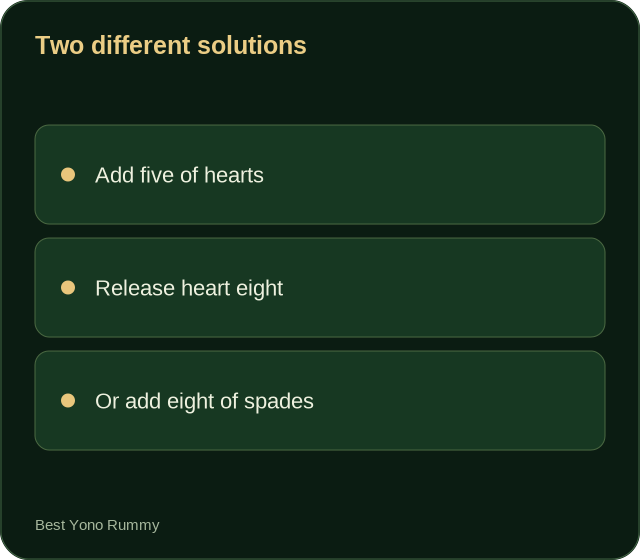
Add the five of hearts to the five-card puzzle. You now have the five, six and seven of hearts as a natural run and the three eights as a distinct-suit set. All six cards have a home and none is duplicated. The five solved the problem without matching the rank of the flexible card. It provided an alternative end for the run, releasing the eight of hearts to join the other two eights. That is more precise than saying the hand simply received another useful red card.
Try adding the nine of hearts instead of the five. A six, seven and eight run still uses the eight of hearts, and a seven, eight and nine run also uses it. There is a four-card run from six through nine, but the two other eights remain outside it. The new card has lengthened one possible group without separating the original overlap. The two added hearts both look promising at first sight. Comparing the remaining cards shows why they produce different solutions.
A second route using another suit
Reset to the original five cards and add the eight of spades. Keep the six, seven and eight of hearts together. The eight of clubs, eight of diamonds and eight of spades now form a set independently of the heart eight. All six cards can again be placed in two eligible groups. This solution leaves the original run intact, whereas the earlier addition of the five of hearts changed the run. Two different physical changes can resolve the same underlying competition.
For a useful stress test, add another eight of clubs from a second deck instead of the eight of spades. Under the ordinary distinct-suit set rule used here, clubs, diamonds and clubs do not make the needed three-suit set. The new rank appears right but the suit matters. Write down the suits explicitly when playing with more than one deck. A hand containing several physical copies of the same printed card requires especially careful tracking if each physical card is to appear in only one group.
Make the six-card solution part of thirteen
Use the version with the five of hearts. Set out the heart run from five through seven and the set of three eights in hearts, clubs and diamonds. Add a four-card run from two through five of spades and a three-card run from jack through king of clubs. Count three, three, four and three. The combined hand has thirteen cards, several natural sequences and one ordinary set. The resolution of the original overlap now sits inside a complete declaration.
Let one person cover the last two groups while another explains the six-card puzzle. Then reveal the remaining groups and ask a new question: does the entire hand meet the agreed declaration condition? Checking a local grouping and checking the complete hand are different tasks. If you removed the queen of clubs, the first six-card solution would remain perfectly good while the complete hand would cease to be the same declaration. This makes a useful distinction when evaluating a screenshot that only shows part of a player's arranged cards.
Two physical copies of the same printed card
A multi-deck hand may contain two cards that both look like the eight of hearts. Treat them as separate physical objects when checking a full layout. One could sit in a heart sequence and another in a set if the remaining cards and rules make both groups legal. In a notebook, label them heart eight A and heart eight B for the purpose of the example. The letters identify the two copies on the table; they have no special scoring value.
Now compare that situation with a screenshot in which the same single eight is highlighted twice as a possible move. Highlighting can describe alternatives without giving the player a second card. Count the total number of distinct held cards and inspect the actual grouped hand. An interface that suggests several options may be offering useful possibilities, while a final declaration still needs physical material for just one chosen arrangement. The two examples look similar on paper until you explicitly label the source of the second eight.
Reading game history without inventing a missing draw
If a relative sends you a picture taken after the hand changed, find out whether they drew, discarded or merely rearranged the display. Adding a five of hearts from the deck changes the actual cards in hand. Dragging the eight between two on-screen groups changes the proposed arrangement. Those actions can produce different replies to the same question about a run. Without the earlier state, describe the position you can see and leave the previous draw as unknown.
One useful method for a private practice record is to write a short line per action: a card entered, a card left, or an existing card moved to another group. Only the first two events change the held inventory. The last changes the explanation of that inventory. This method can be followed with a physical deck and pencil, so it does not rely on any saved history feature in JaiHo Rummy. It also avoids the temptation to interpret a nice arrangement on a screenshot as evidence about somebody's private account.
Keeping the family name with the product
JaiHo Rummy, JaiHo Win and JaiHo 91 are distinct catalogue names. A shared prefix helps browse related-looking words, but the suffix carries important information when you are matching a specific profile. Send a complete saved address or the full title rather than a message saying only JaiHo. If an old phone still has an icon, note whether the object is an installed application or a browser shortcut. A cropped image can hide exactly the word that distinguishes the entry you need.
The installation action on this profile takes you to the shared installation offer used throughout the directory. It does not verify a JaiHo Rummy Android package or demonstrate that other JaiHo names lead to the same publisher. The product name and conditions on the destination should be checked there. An app record can identify a catalogue subject, a package record can identify installed software, and a card exercise can explain an overlapping group. Keep those three findings distinct when helping another reader.
Give the puzzle a fair ending
To replay the lesson, write the starting five cards on a slip and put the two successful additions on separate slips. Ask a friend to choose one without being told how the solution works. If they choose the five of hearts, listen for an explanation of how it frees the eight. If they choose the eight of spades, listen for the additional set that no longer needs the heart card. The two explanations reach a valid result by different routes.
For a tougher final turn, offer the unsuccessful nine of hearts as well. A solver who points to the longer run has noticed a real property of the hand. Ask them where the two other eights will go before deciding that the whole puzzle is solved. That extra question is the point of the exercise. A locally attractive move must be evaluated against all of the cards it leaves behind. The same reasoning helps when checking a complete declaration with several visually plausible groupings.
Separate a hint from a solution
A good hint draws attention to the flexible card without telling the learner which group to choose. Saying that two groups both need an eight of hearts is useful. Saying exactly which card to add gives away the problem. If the solver is stuck, cover the flexible card and ask which natural sequences remain possible. Then uncover it and consider its other role. This small change of view lets the learner construct the solution rather than memorising a particular arrangement. Save their written explanation alongside the card list for a repeat session.
When revisiting the hand, reverse the exercise and ask the learner to remove a card so the overlap returns. Removing the added five or spade eight from the appropriate six-card solution reproduces the original puzzle. The ability to build and undo the solution shows that the learner understands its structure.
Questions about JaiHo Rummy
Why can the eight of hearts not complete both original groups?
The initial five-card puzzle contains only one physical heart eight. It can serve either the heart run or the set of eights in one arrangement, but not both.
How does adding the five of hearts release the eight?
The five, six and seven form their own three-card heart run. The heart eight is then free to join the eight of clubs and eight of diamonds.
Why does another eight of clubs fail as the alternative solution?
The proposed set would use clubs twice. The exercise uses the ordinary rule requiring different suits, so a spare eight of spades works where the duplicate club does not.
Source notes
Listing reference: app-name directory.