Ind Rummy and Indian rummy identify different subjects
Ind Rummy is the name of an app entry; Indian rummy is a family of card games. The first identifies a product name you can save or compare in this catalogue. The second identifies rules that people can use with an ordinary deck. LetsPlayYono styles the app name IND Rummy. Capitalising the three letters is a presentation difference. Expanding them to “Indian” changes the meaning of a search and may lead to introductions to card games rather than to the named app.
If a relative tells you “I played Indian rummy as a student”, that memory alone cannot identify which digital product, if any, they used. Ask whether they remember an icon labelled Ind Rummy or a game played around a table. A thirteen-card hand and the need for a pure sequence are clues about the game. A publisher record and an identified package are clues about a particular app. The distinction is practical even when both questions come up in the same conversation.
What thirteen cards change
In the familiar Indian format used here, a completed hand must account for all thirteen cards. It typically needs two sequences, one pure, and may use eligible sets for the remaining cards. A short exercise illustrates the scale of the task. Make a three-card sequence and a three-card set with six ordinary cards. Those are two complete combinations in isolation. Seven cards still remain to be assigned before you can describe a thirteen-card declaration. Counting only the combinations you already recognise can hide unfinished work.
A common two-player gin rummy game starts with ten cards per player and uses a different condition involving unmatched cards, often called deadwood. A ten-card layout that ends a gin rummy hand under the relevant rules cannot simply be presented as a thirteen-card Indian rummy declaration. Conversely, an Indian hand with two eligible runs may still leave the wrong number of cards for a gin example. Establish the variant before comparing examples; the fact that both games use runs and sets explains the resemblance but does not erase the difference.
Build an Indian rummy example from the middle ranks
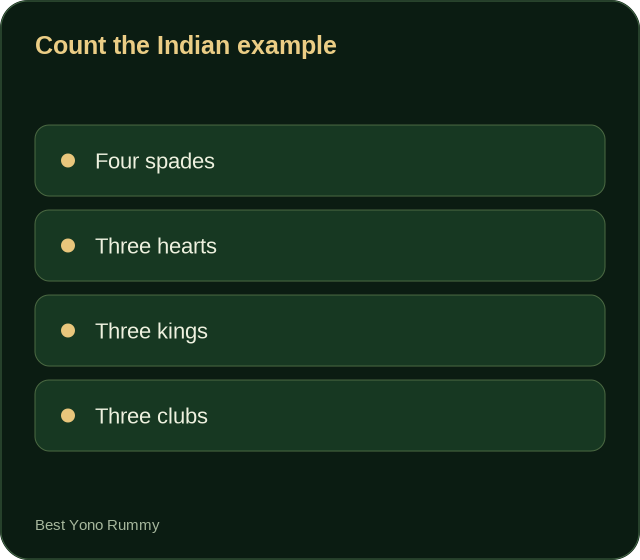
Lay out the five through eight of spades as a four-card run. Follow with the two, three and four of hearts. Add three kings in clubs, diamonds and spades. Place the nine, ten and jack of clubs last. You now have four groups, thirteen cards and three natural runs. The kings share a rank and have three different suits. There is no need to decide how a special joker works before checking this particular example because no joker appears anywhere in it.
Start the inspection with the middle of the long spade run. Its six and seven have a neighbour on each side. The five and eight each have only one neighbour inside that run. Removing a middle card breaks the run into fragments, while removing one end can leave a legal shorter sequence. That observation does not decide whether the complete hand stays valid; the removed card also needs a place. It simply identifies why two changes to the same apparently strong group can have different effects.
One alteration, two possible questions
Take the six of spades away and put the six of hearts in its place. The long spade sequence is broken, and the heart run still stops at four. The six of hearts cannot immediately extend it because the five of hearts is missing. The hand still contains thirteen cards after the substitution, but its original arrangement fails. This time the problem is not a duplicated card or a missing card. The ranks happen to fit a pattern while the suits do not.
Now imagine that the player's question was about a draw rather than a substitution. If the six of hearts was drawn as a fourteenth card, the original six of spades may still be present. Discarding the drawn card can leave the original full hand intact under a rule that permits that discard in the situation. Read the original description carefully: was a card replaced in the exercise, or was an extra card drawn during a turn? Getting that detail wrong can make two people give opposite answers while both understand sequences perfectly.
A ten-card gin example for comparison
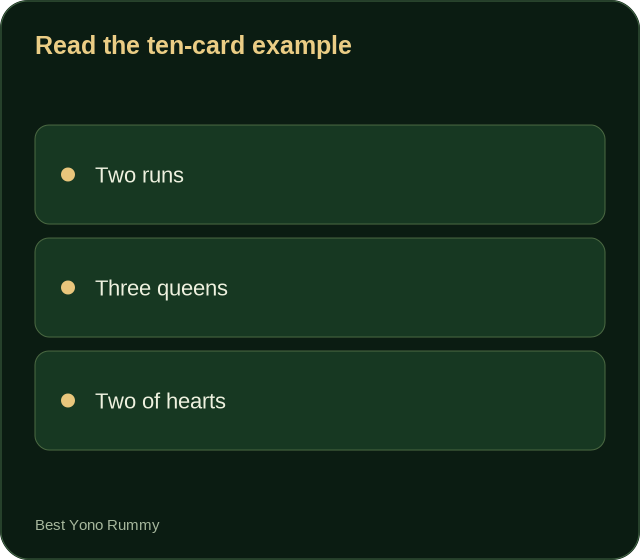
For a gin-style counting exercise, take the four, five and six of clubs; the seven, eight and nine of diamonds; three queens of different suits; and a single two of hearts. There are ten cards: nine in three complete combinations and one unmatched low card. In common gin scoring the two contributes two deadwood points. The example is about recognising unmatched value. It makes no claim about whether a specific knock would be permitted in a particular table or regional version.
Now place the same ten cards beside the thirteen-card example. A new player might point to the two runs and conclude that both are complete Indian declarations. Counting the cards prevents that conclusion. The two of hearts in the shorter hand is deliberately unmatched, while the longer hand accounts for every card. When a person asks why a short online example appears to allow spare cards, check whether it came from a gin rummy explanation. The governing question might be deadwood rather than a complete thirteen-card declaration.
A turn seen before and after the discard
Make two drawings of a tabletop, the first showing the player's hand before drawing and the second just before discarding. In the thirteen-card exercise the counts are thirteen and fourteen. In an ordinary ten-card gin exercise they are ten and eleven at comparable points. Thus a screenshot with eleven held cards need not show a broken ten-card interface. It may show the moment after a draw. The same timing explanation applies when fourteen cards temporarily appear together in thirteen-card play.
Include the discard pile separately in each drawing. A photographer standing at an angle can make the top discard look as though it belongs to the last group in hand. If somebody sends a picture to ask whether a declaration is correct, ask which card was discarded and whether the picture was taken before or after that action. Those facts help more than the app name for reconstructing the hand. The label Ind Rummy might identify a product; it cannot supply the missing moment in a captured turn.
Aces, jokers and the danger of a borrowed rule
Write down the ace rule before building a run around an ace. A table may permit ace next to two, ace next to king, or treat specific situations differently. A wraparound such as king, ace, two needs its own explicit rule and should not be assumed from the permissibility of the two ordinary ends. An example that avoids aces is easier for a first comparison between formats. The two exercises above deliberately used middle ranks to keep that variable out of the picture.
Treat jokers similarly. A printed joker in an Indian exercise can substitute for a missing card when the variant allows it. A standard gin rummy explanation normally uses a deck without jokers. Adding a joker to a gin illustration because another rummy exercise used one changes the game you are modelling. If your family uses a house variant, record it proudly as such. A named local rule can be explained and tested; an unnamed assumption may only surface after the players have already judged the same hand differently.
Reading the Ind Rummy name on Android
On a small screen, IND can look like a country label, part of a flag motif or the opening letters of a longer title. Include the heading and nearby words when recording a name. If possible, compare the browser's page title, the launcher label and the app information supplied by the system. Each records a different layer of the experience. A shortcut may carry a custom label even though it simply opens a website, whereas an installed package has additional identifying information in Android settings.
The directory's own Install action opens the same installation offer used across other profiles. Its placement next to the Ind Rummy name cannot establish the identity of a file on the next page or on an old device. Keep the app label and any verified publisher details together before comparing software versions. If it is the rules you need, the comparisons on this page and the linked rules sources are accessible without installing anything, opening an account or supplying an account identifier.
Choosing a format for a non-monetary practice session
With two players who want a short exercise, start by building the ten-card example face up. Ask one person to name the deadwood and the other to check the two runs. Then clear the table completely before setting out the thirteen-card example. Reusing the same deck is fine; mixing the leftover ten-card puzzle into the next exercise makes it harder to tell which rule caused a result. Give the second hand its own heading in the notebook and verify the final count.
If a player knows a different format well, let them state what would change if the two examples swapped rules. A gin player may immediately ask about the value of the unmatched two. A player familiar with declarations may first ask whether there are two sequences. Both are knowledgeable questions in the appropriate setting. Learning to name the format first lets family members with different backgrounds compare what they know instead of arguing about which use of the word rummy is the only correct one.
Save the reference that answers the original question
A person searching “Ind Rummy” may wish to remember an app profile for next week. The complete name and its saved catalogue address answer that task. A person comparing games may instead want the precise ten-card or thirteen-card layout. Preserve the rank, suit, grouping and variant with the example so it remains intelligible after the browser tab is closed. A note that says only “good rummy hand” leaves out the one detail that determines which rules to apply.
For a final test, offer an unlabeled hand of thirteen cards to a friend and ask what they can conclude from the number alone. They may infer that a familiar Indian format is plausible, but they cannot identify a publisher or know the house rule on jokers. Show the Ind Rummy profile and repeat the exercise. Now the app name is known, yet the detailed table settings are still unknown. Recognising exactly which new fact a piece of evidence supplies is the best way to use both a rules reference and an app directory.
A quick translation exercise for the table
Ask one reader to explain “pure sequence” without using the word pure. Ask a second to explain “deadwood” without using the word dead. Useful answers describe actual cards: three or more consecutive ranks in one suit with no substitute needed for the first expression, or cards left outside eligible combinations for the second. Translate the explanations into whichever language the players share and test each one on the worked hand. The cards themselves make it easier to notice when a translation has accidentally turned a sequence into a set.
Keeping the original English term beside a clear card example makes the note useful when somebody later encounters a differently translated rules panel.
Questions about Ind Rummy
Does Ind Rummy mean the same thing as Indian rummy?
Ind Rummy identifies the app record. Indian rummy is a family of card games with variants that can be played at a table without using any app.
Why can the ten-card gin hand contain an unmatched two?
The worked gin example measures deadwood. Its single unmatched two contributes two points; the example does not claim it meets the complete declaration condition of thirteen-card Indian rummy.
Why might a photograph show fourteen cards?
An Indian rummy player can briefly hold fourteen after the draw and before the discard. Identify the stage of the turn before deciding whether a captured hand has the wrong count.
Source notes
Listing reference: app-name directory.