
The rummy entry with the Diwa name
Diwa Rummy is the card-app name in this catalogue that begins with Diwa. LetsPlayYono describes it as a rummy-focused Diwa listing in an Android context. Related-looking names such as Diwa Slots and Diwa 777 appear in wider directories. Their shared beginning makes them useful search neighbours. It does not establish that they share accounts, Android packages, rules or a confirmed publisher. When one photograph shows only “Diwa”, the second word remains a genuine open question.
Look for that second word on a bookmark, in a message or as part of the full app heading. Pictures of playing cards may suggest that the Rummy entry is a candidate, but an umbrella game lobby can use the same imagery. A person interested mainly in what a wild card does can go straight to the tabletop exercises below. A person trying to identify a particular installation will instead need the whole display name and whatever package and publisher information the original device or source supplies.
Decide which meaning of joker applies
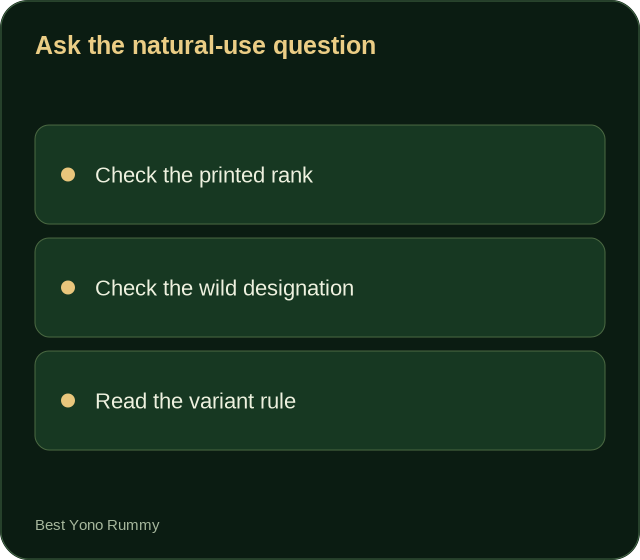
A printed joker is a special card that is recognisable from its own face. In some Indian rummy variants an ordinary rank is also designated as wild for a particular deal. That designation is a condition of the game or hand. It cannot be inferred from the fact that the natural card happens to be a five or a king. Before discussing an example, agree whether you mean the physical printed joker, a card made wild by the current rules, or a card being used naturally at its ordinary rank.
Put three labels on a table: printed identity, designated role and proposed use. A card's printed identity might be the five of clubs. The exercise might designate all fives wild. The player might propose using that five to stand for a missing nine of hearts. Those are three distinct statements. Changing the third leaves the first two untouched. This distinction also makes it easier to ask precise questions about a digital rules panel without assuming that every app carrying the same family word implements the same joker convention.
A printed joker between two natural cards
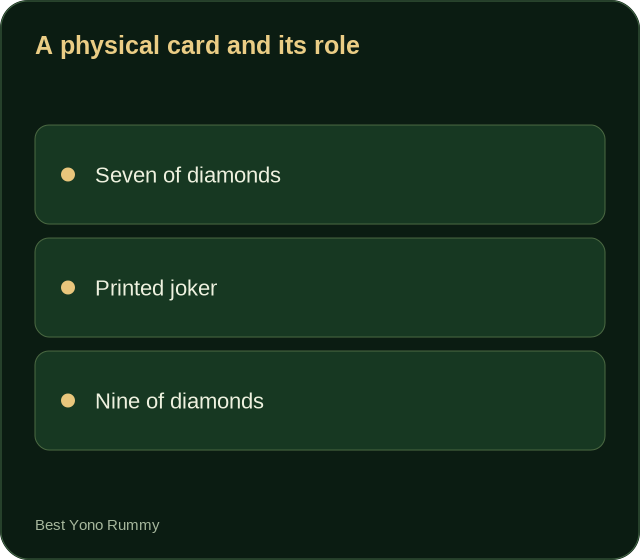
Place the seven and nine of diamonds on the table with a printed joker. For this exercise, allow a joker to represent a missing rank in a same-suit sequence. The middle rank must be the eight of diamonds. Write that on a slip of paper and place it below the printed joker. Keeping the two visible together explains both what the player holds and what the combination means. The presence of the substitute makes the group an impure sequence under the teaching convention.
Now take away the nine of diamonds and replace it with the nine of clubs. The missing eight is no longer the whole problem. The two natural cards belong to different suits, so a single substitution cannot turn both into neighbours in a same-suit sequence. This small comparison is a useful first test because only one suit changed. The person explaining the result can point to the exact physical card that made the old reasoning fail instead of giving a vague answer about the joker losing its power.
Distinguish an open end from an inside gap
Start again with the seven and eight of diamonds plus the printed joker. The natural cards are adjacent. A six of diamonds below them or a nine of diamonds above them can complete a three-card run. In this isolated case the two placements are both plausible, subject to the stated rule. Ask a friend to name one use and then find the other. The same visible group can have more than one explanation even when each particular arrangement assigns the joker only one rank.
Move the eight to the ten of diamonds while keeping the seven and printed joker. There are now two intervening ranks, eight and nine. One joker covers only one missing place in the rules used here. Compare that with the earlier seven and nine, which had one missing rank, and the seven and eight, which had an open end. The three arrangements differ in the distance between the natural cards. Saying the ranks slowly is often enough to diagnose which type of gap you are looking at.
Use one designated wild card as a substitute
For a fresh family exercise, declare tens wild and set printed jokers aside. Choose the four and six of hearts and the ten of spades. If the agreed rules allow the wild ten to substitute for the missing five of hearts, the proposed group can form an impure sequence. The ten's actual face remains spades even though its assigned role is hearts. Someone recording the hand should write both pieces of information. Calling it merely a five of hearts would conceal the use of a substitution.
Change the exercise before changing the physical cards. Announce that the table recognises only printed jokers, with no designated wild ranks in this round. The ten of spades now has its ordinary identity and cannot bridge the heart gap. This is a different kind of failure from swapping a diamond for a club. Here the visible hand has stayed the same while the rules have changed. A screen capture showing the cards without the joker indicator cannot settle the original dispute if the decisive condition was omitted from the picture.
What counts as natural in the example
A plain sequence with no substitution is the least ambiguous place to start. Lay out the two, three and four of clubs with no wild rank in effect. They are uninterrupted consecutive ranks in one suit. If you designate every three as wild and still leave the three of clubs in its printed place, ask a new question: does that particular variant count it as being used naturally? The answer can depend on the stated rules. The word wild alone does not settle that use case.
For a beginner lesson, choose a natural run whose ranks do not include the designated wild value. That removes an avoidable argument while still teaching the difference between a pure group and one using a substitute. For an experienced group, keep the ambiguous example and compare the written rules for two variants. Record the exact condition each uses. A difference in definition can explain why two competent players classify an otherwise identical sequence differently without anyone having misread the ranks or suits.
Fit the substitutions into a complete hand
Use the two through five of clubs as a four-card natural run. Make a second group from the seven of diamonds, a printed joker and the nine of diamonds. Add a set of queens in hearts, clubs and spades. Finish with the four, five and six of spades. Count the groups in order: four, three, three and three. The complete hand contains thirteen cards and has natural runs in clubs and spades as well as the substituted diamond run.
Try removing the printed joker and replacing it with the eight of diamonds. The arrangement still has thirteen cards and the second group becomes natural. Now keep that change and turn the five of clubs into the five of hearts. The four-card club run has lost its upper end but the two, three and four of clubs remain a natural sequence. The new five of hearts must still find an eligible place. This demonstrates why checking a group's classification and accounting for every remaining card are separate stages of checking a full hand.
Record a joker disagreement from a digital table
When describing an unclear interface, separate what appeared on the card from what a badge or rule indicator may have added. Was the word joker printed on a separate card? Was there a highlighted rank beside the closed deck? Did a group receive a marker after you arranged it? These are observations another person can discuss. “The app cheated” offers no card information to reconstruct. A careful written description may reveal a simple difference in the interpretation of one label.
Make a private copy of any image you legitimately have and cover account details before sharing the card question. Keep the variant and current joker indication visible. It can also help to record whether the screenshot shows a proposed group before confirmation or the final arrangement after a player's discard. If the picture lacks the indicator, say so. An independent app listing can provide the Diwa Rummy name but cannot infer an omitted wild rank, inspect a player's account or reproduce the conditions of an unknown round.
Identify the Android edition separately
The name under an Android icon can be short and can change between editions. A browser shortcut can also display a familiar logo. The system's app information screen, where available, gives more context about an installed package. Compare the complete title, source and any publisher-confirmed identifier before treating two installations as equivalent. The source directory may describe Diwa Rummy while a file forwarded in a chat uses a similar family name. Those two observations do not establish that the file belongs to the product.
The Install button on this profile opens a shared installation offer rather than identifying a distinct Diwa Rummy package. Read the actual destination's product description if you use that action. It supplies no evidence about which wild-card variant an app implements. For a rules question, start with the specific game help and the complete hand. For a catalogue question, start with the complete name Diwa Rummy. Keeping the starting points distinct avoids transferring features from another app simply because its title also begins with Diwa.
Turn the rules into a repeatable card experiment
Give one player control over the physical cards and another control over a small written rule card. In the first round the cards stay fixed and the written rule changes. In the second round the rule stays fixed and one natural card changes suit. Ask an observer to explain which change caused each result. Keeping one variable fixed makes it obvious whether the problem concerns the identity of a card or the meaning assigned to it by the exercise.
End with a record somebody else could use without opening an app. Write the natural run, the wild designation, the physical substitute and the exact rank it represents. Add whether the proposed groups account for all thirteen cards. For the diamond example above that means recording a printed joker used as the eight of diamonds between the seven and nine. The note will still make sense months later even if a digital interface has changed. Save the Diwa Rummy app entry alongside it only if you also want to remember the original listing.
Another way to check the same group
Let the reader hide the substitute and predict what must go in the empty place. With the seven and nine of diamonds there is one answer in the agreed three-card sequence. With the seven and eight there are two possible end positions. Writing down both answers before revealing the joker encourages the reader to explain the alternative roles properly. When the cards and their order are visible again, compare those predictions with the rules you wrote at the beginning of the exercise.
Keep the joker visible beside both answer slips so nobody confuses a possible represented card with an extra physical card.
Questions about Diwa Rummy
How many ranks can bridge the seven and nine of diamonds?
In a three-card same-suit run, only the eight of diamonds fills that inside gap. A printed joker can represent it if the chosen variant permits substitution.
Can a designated wild rank count naturally?
That depends on the particular rules. Record both the card’s printed rank and its proposed use, then compare them with the condition for a pure sequence.
Does the Diwa name verify a shared Android package?
No. Diwa Rummy is the listing name. Other products with the same initial word may have different publishers and package identities, which need separate evidence.
Source notes
Listing reference: app-name directory.