Recognising the Boss Rummy name
Boss Rummy is the rummy-app listing whose distinguishing word is Boss. LetsPlayYono also publishes a Boss Rummy page in an Android context. If you found the name beside pictures of playing cards, that source helps identify the kind of entry you saw. It does not tell you which Android package ended up on your phone. A search for the name can be completed in the app catalogue; investigating a specific installed copy requires device and publisher information.
The word Boss can look like a rank, a level or a label for somebody running a table. On this page it forms part of the app name. Keep it with Rummy when sharing a bookmark. In a game of cards the person declaring a hand has to show a valid arrangement regardless of who dealt or who was leading. The following declaration workshop gives the reader a specific job: examine the proposed arrangement as if someone at a family table had asked for a second opinion.
Before accepting a declaration
Agree on the rules for the exercise first. Use thirteen cards, at least two sequences and at least one sequence without a substitute joker. Each remaining card must belong to an eligible group. In the examples an ordinary set contains cards of equal rank in different suits. These assumptions describe a familiar Indian rummy format. They avoid an argument in which two people give different answers because one is thinking of a different variant. None is a claim about settings in a particular Boss Rummy installation.
Then decide what evidence would settle the question. Seeing one beautiful sequence is insufficient if three other cards still lie ungrouped. The player should be able to lay out all thirteen once, with a visible gap separating each group. The person checking should count the cards before rearranging anything. Otherwise a perfectly reasonable suggestion about moving a card may accidentally turn the original question about a declaration into a new question about how to fix the hand.
Record the hand exactly as offered
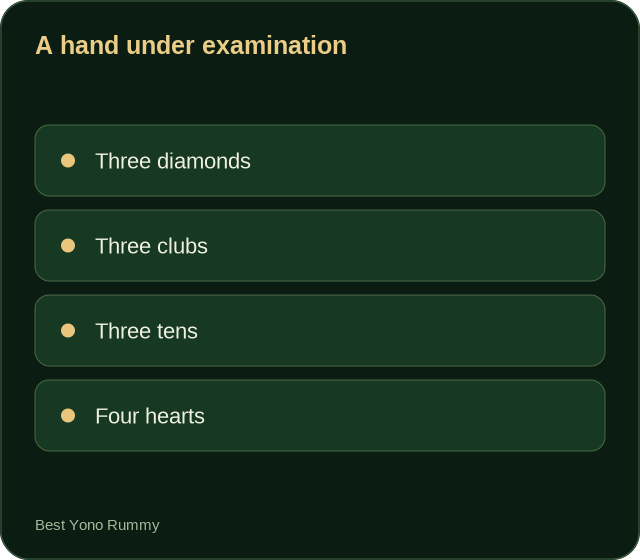
Start with the three, four and five of diamonds. The next group contains the six, seven and eight of clubs. A third group contains the tens of spades, hearts and diamonds. The final group contains the jack, queen, king and ace of hearts. Write these four groups on four separate lines. Three plus three plus three plus four gives thirteen cards. In this example the rules allow an ace at the high end of a sequence, so the last group is an eligible high run.
A written hand exposes a common memory error. After looking away, someone may remember “three tens and a heart sequence” but fail to recall whether the ten of hearts sat in the set or in the run. The written version assigns it to the set. The heart sequence starts at the jack and needs no ten. That detail is important because a card cannot do two jobs at once. Ask the checker to point to the exact written position of each card before proposing changes.
The incomplete declaration that looks tidy
Take the four of diamonds out and give the player the four of spades instead. In the same position and with the same rank, it looks like the middle of the diamond run. The group now mixes suits and fails the sequence condition. The other groups remain eligible. A simple answer of “three runs and a set” misses the defect because it describes the player's intended structure, rather than the thirteen physical cards the player actually presented.
For a useful second inspection, look for another arrangement that could absorb the four of spades without inventing extra cards. In this hand there is no neighbouring spade run and no set of fours ready to receive it. The tidy group layout cannot settle its value. Return to the unchanged written list and mark only the altered card in a different colour. This makes the lesson easy to recover later: a rank can appear in the right place while its suit still makes the declaration incomplete.
Test the high ace before changing the hand
The last group raised a rule question before it raised a strategy question. Some house rules accept an ace beside the king at the upper end, while other rules may describe its role differently. For this exercise the high ace was explicitly permitted. Now imagine that the table uses aces only at the low end. The same jack, queen, king and ace no longer make the declared four-card run under that instruction. The remaining three court cards can form a run but the ace still needs a place.
Notice how this failure differs from the earlier wrong-suit example. No card has changed and nothing was misread. A condition of the exercise has changed. Write the changed condition above the hand when asking someone to check it. A person looking only at the familiar court-card sequence might give the original answer in good faith. Restating which ace rule is in force allows both people to discuss the same hand without trying to resolve a difference between two distinct variants by majority vote.
One printed joker and one missing rank
Restore the original high-ace rule and all the original suits. Replace the seven of clubs with a printed joker. The six and eight of clubs identify the substitution precisely. The player still has a natural diamond run, a natural heart run and the set of tens. Under the rules chosen for the workshop, the club group is an impure sequence and the full hand can still meet the declaration condition. Mentioning the joker's exact job is more informative than merely saying the player has a wild card.
For a harder question, change the eight of clubs to the eight of diamonds. The two natural cards around the printed joker now have different suits. Filling a rank gap cannot change the suit of either natural card. The former explanation therefore stops working. Ask the checker which of the two conditions failed first: rank order or suit agreement. The answer reveals what they actually inspected and helps a learner avoid treating a joker as an unlimited licence to combine three unrelated cards.
Count without counting any card twice
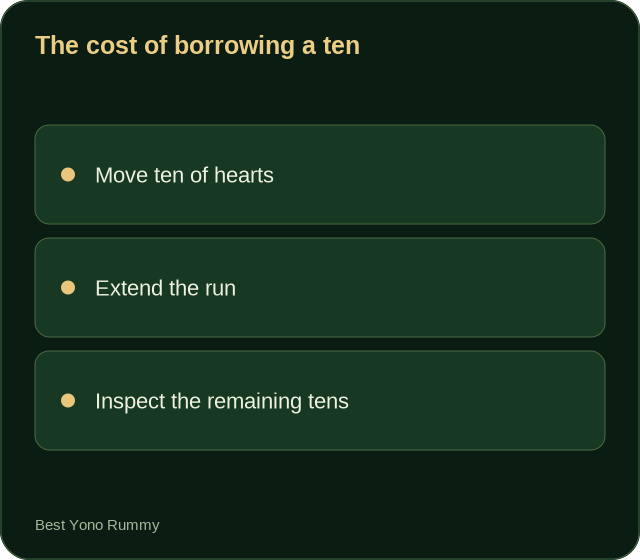
Return to the three tens and suppose somebody tries to extend the heart run downwards by borrowing the ten of hearts. From ten through ace the heart sequence is now five cards long. Only the ten of spades and the ten of diamonds remain in the old set. Unless another eligible card is available to complete that group, the apparent improvement has created an unresolved pair. The original thirteen cards and their suits have stayed the same; the proposed partition has changed.
One way to demonstrate this on a small table is to place one blank counter beside each card. Move the card and its counter together whenever it changes group. An overlapping declaration then becomes visibly impossible: the same physical counter cannot sit in two places. On a digital screen, a list of possible combinations sometimes gives the impression that all of them can be used simultaneously. A declaration requires a single arrangement of the complete hand, so the tabletop exercise provides a useful check against that impression.
Reading a declaration shown in a phone picture
Begin with the edges of the picture. A cropped image may omit the last card in a row or the discarded card at the side of the table. Before deciding that a hand has fourteen cards, look for the distinction between the player's held cards and an open discard pile. Similarly, a printed joker may be identified by a tiny mark that is difficult to distinguish when a screenshot is forwarded several times. Ask for the original image if the answer depends on that mark.
Describe what you can see without identifying the player. The useful features are the variant, suits, ranks, joker designation and intended groups. A phone number, account balance or full name contributes nothing to the card exercise. If the question concerns the app identity instead, a cropped image of only the playing area may leave the app name unknown. Keep the two conclusions separate. It is possible to recognise an invalid declaration with confidence while having no reliable basis for saying which app displayed it.
Interpreting a Boss Rummy installation offer
The catalogue gives Boss Rummy its own profile because it is a distinct name. The active Install control opens the directory's shared installation offer. That destination is used with other names too, so the button cannot authenticate a Boss Rummy APK or identify the publisher of a file sent by somebody else. If your aim is to identify an existing Android installation, the version and package information shown by your phone are more useful details to compare with a publisher record.
Keep the evidence with the question it answers. The source listing records where the name appeared. The app information screen describes the installed software on a particular device. A current publisher page could establish what release that publisher distributes. Finally, a screenshot of a declaration shows a set of cards in a particular state. Combining those records can be helpful if they genuinely match. Treating any one of them as proof of the others is how a familiar name can turn into an inaccurate claim.
Try the workshop with another player
Make two copies of the initial hand on paper. Leave one copy untouched. On the second, change exactly one thing without telling the other player whether you changed a card, a grouping or a house rule. Ask for a precise explanation of the result. A good answer identifies the affected group, names the condition that matters and accounts for the remaining cards. If the checker cannot see a change, let them compare the two written hands rather than announcing the answer immediately.
After three rounds, exchange roles. The person making the puzzle often learns as much as the person solving it because a fair puzzle must have a clear rule and an unambiguous card list. A final question worth trying is whether two different complete arrangements can satisfy the same rule. If both genuinely use all thirteen cards once and include the required sequences, both may be valid. Save the rule and the arrangement together, and keep the Boss Rummy bookmark for the separate task of identifying the app name.
Summarise a disputed result in one note
Write the result in the order somebody new to the table would need to hear it. Start with the fact that the group used the high-ace rule. Describe which of the four original groups was changed, then state whether every card still has one eligible home. The conclusion now follows from the details in the note. Without those first two facts, even an experienced reader may apply a different ace rule and give a different answer.
For a family game, make the corrected hand the first puzzle of the next session. Deal it openly and ask the youngest or least experienced player to explain the three tens. Completing one clearly defined group is an accessible way to participate. Once that group is accounted for, the rest of the table can take responsibility for the other ten cards.
Questions about Boss Rummy
Why does borrowing the ten of hearts break the proposed declaration?
The ten extends the heart sequence but leaves only two tens in the old set. A valid declaration must account for every physical card in exactly one eligible group.
What does the printed joker represent in the club group?
In the worked hand it stands for the seven of clubs between the six and eight of clubs. Changing the eight to a diamond removes the shared suit.
Does the workshop establish rules for a Boss Rummy installation?
The exercise states its own thirteen-card rules, including a high ace. A particular app edition or table could apply different conditions and requires its own rule sheet.
Source notes
Listing reference: app-name directory.