
Read the initials before the number
YN 777 uses two letters followed by three digits. One cited source writes YN777 without a space. The directory displays YN 777 so the prefix and number are easy to read on a small card. Yono 777 contains the full word Yono and has its own entry. An abbreviation that feels plausible to a reader is not evidence that two separately listed products share an operator, login or installation file.
One source places the product at an address ending in yn777, while another uses yn-777. That gives a concrete reason for recording a compact form and a spaced display name on the same directory profile. Neither address spells the prefix as Yono. A person who types “YN” from memory may indeed have meant the two-letter product. Giving them an explicit choice between the visible names is a better first step than expanding the letters on their behalf.
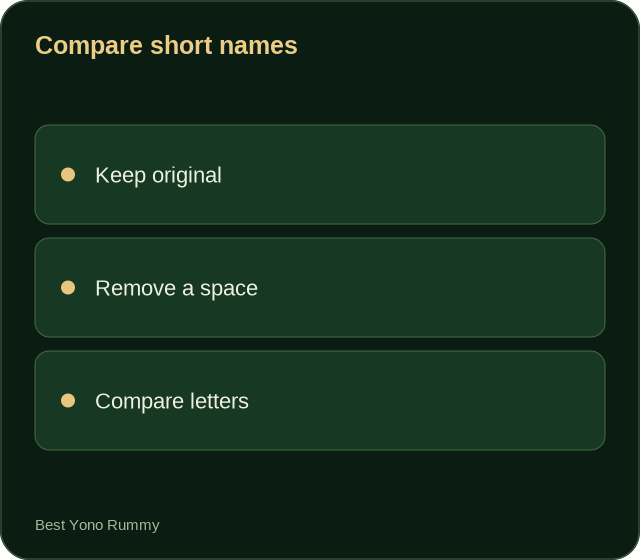
What removing a space changes
Removing the space changes the written string from six characters to five when the original contains exactly one space. It keeps the sequence of the letters and digits. That makes a useful spelling comparison for a search box. Replacing YN with Yono is a different operation: it adds letters. When teaching a friend to search for an app, it helps to describe precisely which change you are trying.
Write YN 777, YN777, YN-777 and Yono 777 on four index cards. Compare each to the first string character by character. The second removes a space, the third replaces the space with a hyphen, and the fourth changes the letter sequence before the space. A reader can observe those changes without knowing anything about app ownership. Deciding whether a software publisher considers two strings interchangeable is a further question that may require a current attributable source.
A literal search and a forgiving search can legitimately return different sets of entries. In a literal exercise, the string YN777 has no space and therefore differs from YN 777. In a second exercise, remove spaces and hyphens from every candidate before comparing, keeping the original title in a separate display column. The two strings now match the same normalised key. The original labels should still be retained so a reader can see exactly what each cited source printed.
Distinguish display name, address and file name
A display name may include spaces and capitals. A web address frequently uses lowercase letters or hyphens. A file name can include a version label or a suffix appended by the browser. All three can refer to related material while looking different. A file named with three sevens alone supplies very little identifying information. The source page on which the name was found gives that string some context.
Now give the first card three different labels: page heading, saved bookmark title and typed search query. A bookmark can inherit a heading or be renamed by its user. A query can contain a typo. A page heading documents what that particular page displayed. Identical text in these three places therefore has different evidential weight. If you are explaining why the catalogue uses YN 777, the actual source heading carries more weight than the name someone assigned to a bookmark after the visit.
A cropped picture of a download list supplies another useful test. It may show a file called 777 followed by a numeric suffix in brackets. Some browsers add a suffix when a file with the same name already exists locally. That local naming choice cannot establish a publisher, an edition or an update date. Keep file labels in their own column so you do not accidentally treat a device's local naming history as product information.
Make a small evidence card
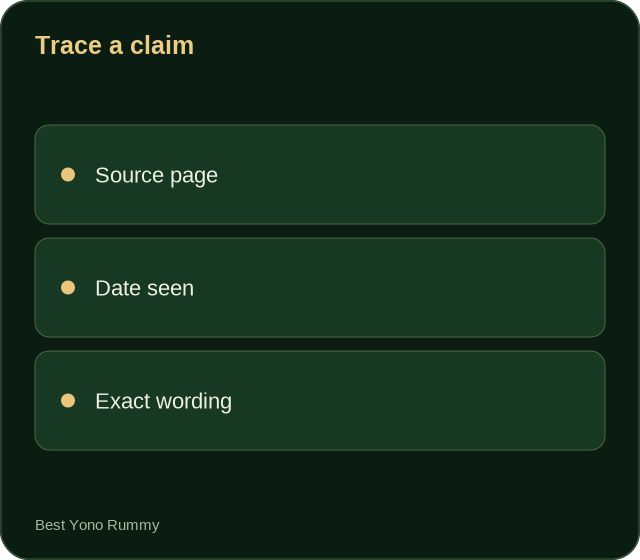
A useful evidence card contains the exact displayed name, the page address, the date it was seen and one short observation. For YN 777 an observation could say that one directory uses a space and another omits it. Keep an inference in a separate field. Calling two records the same publisher goes beyond a spacing observation and would require a reliable publisher reference for both.
For an example evidence card, put “source A displayed YN777” on the observation line and “might be the name I remember” on the interpretation line. Add a second observation only after consulting a second source. If a later discovery contradicts the interpretation, the observation can stand untouched. This makes a small research notebook surprisingly robust. Correcting a conclusion does not require rewriting what a cited page actually said.
Keep the source date as well as the date of your own note. A directory record observed on a Thursday could quote a promotion checked earlier in the week or month. Those two dates answer different questions. The first tells a reader when you saw the record; the second identifies the period attached to the quoted detail. Neither date is automatically the app's launch date or the age of the three-digit brand name.
This two-column approach is useful when anonymising a help request. You can say “the public profile heading reads YN777” without including a personal account name, phone number or identifying transaction. If the person helping you needs more context, provide the source page and the part of the public title causing the confusion. A full screenshot of a login page usually contains more private detail and less relevant evidence than a clear transcription of the two compared names.
Compare by reading characters aloud
Try spelling a short name letter by letter before reading the number as a group. Saying “Y, N, three sevens” is clearer than pronouncing the letters as an unfamiliar word. If another person hears Yono, write down both possibilities rather than silently replacing one. In a phone search, compare the complete result caption after typing the letters. Autocomplete suggestions reflect possible strings and do not verify identity.
Try dictating the short name to someone looking at a blank sheet. First say it naturally, then spell Y and N and say “seven, seven, seven”. Compare their first attempt with the spelling. If they initially wrote “why in”, that transcription records a sound, not a new product. If they wrote Yono, the discrepancy is a word-length change. This is a useful way to diagnose the ambiguity of a voice query without inventing an extra app entry.
Understand a source disagreement
Two sources can disagree because they use different spacing, because one is older or because they describe different products. Begin by recording what the sources actually show. If the difference is only a hyphen in a web address, a visual match of the written app name may be enough for a directory citation. If the product name and publisher both differ, preserve two records until better evidence becomes available.
Suppose the first source calls an item YN777 and the second uses YN 777, while both display a similar number-led icon. That supports a cautious note about a probable spelling variant in a directory. Now suppose the second source also names a different provider and describes a wholly different game. The evidence no longer supports merging the two on spacing alone. A good comparison states which fields agree and which require a current product reference.
A mismatch can remain unresolved without making the entry useless. You can still provide two accurate source links, quote the two spellings and explain the question they leave open. A label such as “source B uses a space” gives the next reader a check they can repeat. A label such as “definitely the same app” closes the question without exposing the evidence behind it.
A second test for an apparent match is to record one observation that would change your mind. For example, a verifiable official publisher statement explicitly distinguishing two products would outweigh a matching icon on two directory pages. Conversely, a change in the capitalisation of the same public URL is weak evidence for a new product. Stating the test in advance helps avoid treating every subsequent search result as confirmation of an assumption you made from the number alone.
Find where a claim originated
For a dated source figure, the relevant question is which page displayed it and under which label. A later directory might repeat the same number without independently verifying it. Write the first source you actually examined beside the quotation. Linking a chain of pages that all repeat one claim does not provide the same confidence as finding a current, explicit statement from the product responsible for it.
For this YN 777 profile the third-party record showed ₹271 under the signup label and ₹100 under the minimum withdrawal label. These numbers belong to the observed listing and its date. If a second page repeats the same figures word for word, the repetition may be a copy, not an independent confirmation. A fully attributable, current product statement would be the more relevant evidence for someone deciding whether a condition currently applies.
Store a name without extending it
The Saved feature keeps the chosen YN 777 directory card in the current browser. It does not expand the initials, certify a file or link an external account. A saved page can be shared as a normal web address if someone else wants to compare it. Include the title in the message so the receiver can recognise the intended result even if a messaging app shortens the link preview.
Imagine saving YN 777 today and opening an old message tomorrow that points to Yono 777. Open the original saved profile and compare the first word on both pages. The two labels remain distinct even if the browser groups the tabs together or the messaging app generates very similar previews. That short visual comparison can prevent someone from removing the wrong saved item or asking a support question about the wrong product.
Read the next destination afresh
An active installation link continues to an external offer shared by the project. Read the destination name as carefully as the directory name. If a longer spelling appears there, the visible text documents what you reached; it does not repair a mismatch by itself. For a question about the catalogue, return to the source pair on this page. For a question about software identity, look for a verifiable publisher listing.
If you need one concise note to pass along, try spelling plus purpose. “I am looking for the app listed as YN777, with the two letters Y and N. I have the directory source but still need the publisher.” This tells another reader exactly what is known and what evidence would move the search forward. It is more productive than repeating the number several times or assuming that a product reached through a shared external installation offer must resolve the uncertainty.
Read the final note from the perspective of a person who has never seen either page. Could they tell which two letters are present, which part of the name varies and where the observation can be checked? If so, the note serves its purpose. A detailed but unsupported description of a publisher or a bonus programme would make the message longer while leaving its central identity question unanswered.
Questions about YN 777
Is YN777 written with or without a space?
The catalogue displays YN 777, and a cited source uses YN777. Keep both original spellings in a comparison while preserving the two-letter prefix.
Can I expand YN into Yono when searching for this app?
Treat Yono 777 as a separate named listing. Adding letters is a different change from removing a space or hyphen, and matching digits do not establish common ownership.
Which details should I keep with a YN 777 source note?
Record the exact heading, page address, date and observation. A statement about what a source displayed should stay separate from any inference about the publisher.
Source notes
Listing reference: app-name directory.