The name is Yoyo Slots
Yoyo Slots has a second y in the first word. Yono Slots has an n in the corresponding position. Both are distinct entries in the catalogue. Where an icon is small or a result is spoken aloud, that single letter can be lost. This page keeps the Yoyo spelling used by its cited directory source. Preserve the exact spelling in a bookmark or message when you need to distinguish the names later.
Write the two names in separate rows in a plain typeface. Yoyo Slots and Yono Slots share the first two letters, the final o and the complete word Slots. Only the third letter of the first word differs. A fast visual scan which checks only the beginning and end will therefore miss exactly the part that matters. Read the third letter in context before opening a profile from a crowded set of search results.
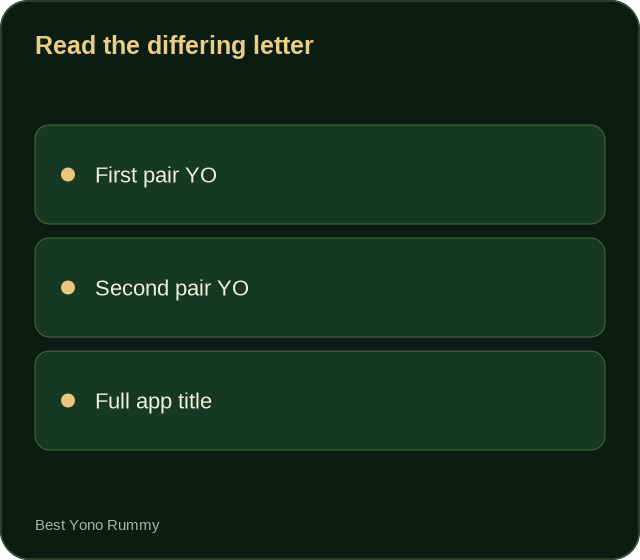
Read a word as two syllables
The first word of Yoyo can be written as yo followed by yo. The corresponding split in Yono is yo followed by no. Looking at the second pair of letters can be easier than trying to compare both full headings at once. On a phone with narrow cards, open the detail page if the word has been clipped. The full caption carries information an isolated thumbnail may never display.
A messaging app can truncate a preview so that a recipient sees “Yo… Slots”. That partial string fits both names. It is worth telling the recipient explicitly that the intended title repeats yo. If the full linked page then reads Yono instead, keep the mismatch visible in the conversation. Auto-correcting the message to whichever version you expected would destroy the evidence that two sources might have been mixed up.
Try the same comparison with spoken words. Say yo-yo slowly, then yo-no, then give the two written spellings. A person unfamiliar with the products can now repeat the distinction accurately. That does not certify the provenance of any particular app. It gives you a dependable label to use while comparing sources. Accurate spelling is a starting point for verification, not a substitute for it.
A missing field is useful information
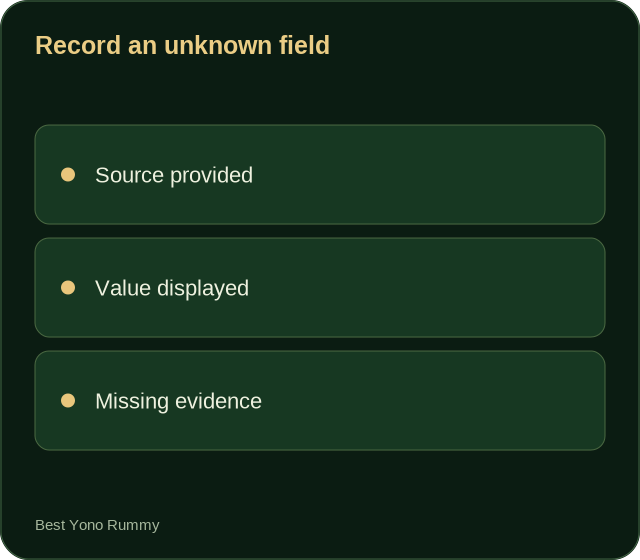
The source set for this profile provides no confirmed bonus or minimum withdrawal amount. The directory therefore displays Not listed for those fields. Zero would mean that a source explicitly gave zero as a value. A blank in a cropped image could mean the right-hand column was missing. These three situations should remain distinct when writing down a comparison. Borrowing a number from Yono Slots would merge two separate records.
Imagine three directory rows. The first quotes a signup amount of zero rupees in explicit written terms. The second has a dash under signup with a legend saying “not supplied”. The third is a screenshot cropped just before the amount. Only the first establishes a zero. The second records an absent source value. The third does not even show whether the original page included a value. These distinctions are useful whenever a small-screen capture is the starting evidence for a comparison.
Suppose the second row is the one being entered into a spreadsheet. A text value such as “not listed” or a genuinely empty field with a documented reason preserves the uncertainty. Replacing it with numeric zero will change a future average and may lead a reader to believe a condition was explicitly stated. Data quality starts at this small decision. The Yoyo Slots profile uses the missing-data language rather than converting silence into a number.
Consider what happens if a comparison uses a list of amounts to calculate an average. Suppose two confirmed values are ten and twenty and a third value is missing. The average of the two known values is fifteen. Entering zero for the missing amount would produce an average of ten over three entries, making an observation you never had influence the result. The arithmetic is simple; the hard part is deciding which values are actually known. A clear missing-data label makes that decision visible.
Compare two records one field at a time
Make a table with fields for title, source page, amount label and observation date. Fill only the cells for which you have evidence. If the title differs, preserve the two records even where other fields resemble each other. A human reader can return to the source later. A merged record may hide the original difference and make it much harder to work out where an unsupported value came from.
Prepare two rows headed Yoyo Slots and Yono Slots. In the first row record the linked app name source and the absence of confirmed figures in the available record. In the second, the separate Yono Slots source has a signup amount of ₹50 and a minimum withdrawal of ₹100 on the observation date. Transfer neither value to the first row. The exercise is useful precisely because those nearby names have different source coverage; an apparently complete table filled by copying would be less accurate.
Add an extra column called question still open. For the first entry this might ask whether a current publisher listing can be located. For the second it might ask when the cited promotional figure was last independently checked. This lets an incomplete record remain useful. It tells the next reader which piece of evidence would improve the entry instead of forcing them to rediscover why a field is blank.
Missing evidence is specific to a field. Having a source for the spelling Yoyo Slots does not suddenly provide a source for a financial figure, but an unconfirmed figure does not erase the documented spelling either. Write the two claims in separate sentences. A fellow reader can check the first immediately and see exactly what would be needed for the second. This approach is particularly valuable for short, similar names where a search result can look persuasive at a glance.
Recover the details from a thumbnail
A thumbnail can provide a first clue about the theme of an individual game. It may show a character, a logo or lettering. It is usually a weak source for the exact edition or publisher. Start by recording only plainly visible text, keeping uncertain letters in brackets on your own note. Then compare that transcription with the full game title and studio listing, rather than searching for an app based entirely on its colour.
A thumbnail showing a red character and a gold title might suggest a broad theme. Write down the characters you can actually read rather than expanding a three-letter fragment into a familiar title from memory. Then look for two independent features: another distinctive word and an attributable studio name. If both are unavailable, retain several candidates. A colour match across two catalogues can be a useful lead, but it does not resolve a one-letter name difference.
A comparison of cover art can still be useful when handled carefully. Look at the arrangement of the title letters, a distinctive subtitle and any visible studio credit. If only one of these appears, record it as a clue. If two sources use different crops of the same image, the common artwork is one piece of evidence reproduced twice. If the written names differ in that critical third letter, return to the source headings before deciding whether the visual similarity settles anything.
Read a source date as a timestamp
A date attached to a directory's observation identifies when that source record was checked. It does not by itself identify when software launched, when a publisher last updated an app or when an offer ended. Those events require their own evidence. A small table with separate columns for source seen and official update makes the distinction visible even when the second column must remain empty.
Suppose a saved note reads “checked 26 November” while the screenshot itself displays an app update dated several weeks earlier. Those two dates can coexist. The first refers to research activity. The second, if clearly attributed, might refer to a software version. A third date attached to a promotion could have yet another purpose. Label all dates with the event they describe; never infer that the app came out on the day someone saved a directory page.
Compare slots as individual games
A game with a name, a studio and a readable legend can be compared with another game on common descriptive fields. A brand-level app profile belongs in a different row of your notes. Keep the game's own label for any feature you observe. Words such as reels, bonus and ways can mean different things across titles. The Yoyo Slots name provides a place to start asking which game a reader means.
When a particular slot game is the object of the search, prepare a fresh row with the complete game title, studio and relevant rules page. Do not insert a generic app-level label in the studio field. If a screenshot captures a game but omits its title, write that limitation in the row. Empty evidence can later be supplemented by an attributable source. An invented title makes it harder to recognise the correct evidence if it appears.
Use the source trail when a match is uncertain
For this entry the available catalogue source gives the spelling Yoyo Slots. It does not provide a basis here for declaring a common account with Yono Slots, an operating licence, the publisher of an APK or the identity of a live payment service. If a comparison reaches one of those questions, describe which evidence is missing. A narrow factual statement is more useful than a confident reconstruction of a name from memory.
A responsible comparison can stop at a narrow answer. For example: “I can identify the Yoyo spelling in the cited app directory. I do not have a source confirming the bonus figure shown in the other screenshot for this name.” The first sentence preserves the observation and the second explains the limit. It is more useful than guessing a range based on unrelated names or presenting a copied figure with the word approximately.
Save the page that matches your spelling
Use the directory's Saved control to keep the exact Yoyo Slots profile in this browser. A note reading Yoyo with a second y can help someone else find the same result quickly. If you continue through the common external installation offer, read the product name at its destination. Its availability and current terms are distinct from the source record used for this catalogue page.
The final check before circularly confirming a name is to ask where each apparent corroboration came from. A bookmark generated from a directory, a screenshot of the same directory and a message copying its words are three artefacts but one underlying source. A genuinely separate, current publisher listing would add different evidence. Keeping that distinction in mind makes the Yoyo Slots page useful even when another source for an incomplete field is still to be found.
For a friend who is unfamiliar with the search, a small spelling mnemonic can finish the explanation: Yoyo repeats its opening pair of letters, while Yono changes the second pair. Follow that with the direct page address. That is usually enough to find the intended catalogue entry; uncertain financial or ownership claims add little to a simple, well-defined identification task.
Questions about Yoyo Slots
How can I tell Yoyo Slots from Yono Slots?
Read the third letter of the first word. Yoyo repeats the pair yo; Yono ends in no. Open the full profile if a small tile truncates the name.
Does Not listed mean the Yoyo Slots bonus is zero?
Not listed means this directory has no confirmed figure for that field. Zero would be a specific numerical value requiring a source that explicitly states it.
Can I use the amount from Yono Slots for Yoyo Slots?
Keep the records separate. Similar spelling supplies no evidence that an amount reported for Yono Slots also applies to the differently named Yoyo Slots entry.
Source notes
Listing reference: app-name directory.