What the Spin Crush title identifies
Spin Crush is a named app in the Spin collection. The two words together distinguish it from Spin Gold, Spin Winner and other nearby profiles. The source lists slots alongside several other game types. The word Crush may remind a reader of a puzzle that removes groups of tiles, but a familiar word in an app title does not establish a feature in every game. Start by identifying which individual game screen prompted the question.
A person who types Spin Crush may be looking for the app they saw in a directory, while another may remember a moving puzzle board. Ask for one more detail: the words beneath the icon or a symbol that changed after a group was removed. These clues point towards different evidence. The directory source can answer the spelling question. A rulebook or a complete sequence of board states is the right material for the puzzle question.
What a cascade looks like on paper
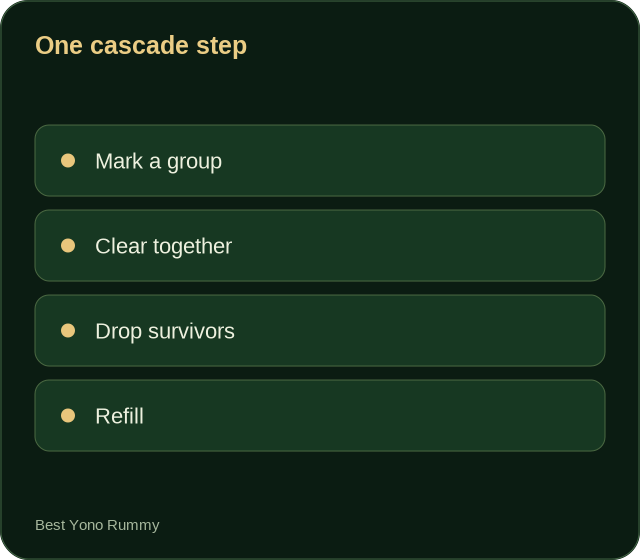
A cascade is a sequence of board changes following an initial arrangement. For our exercise a matching group disappears, the symbols above the gaps move down, and new symbols enter from the top. Each step produces a new board state. The entire chain can belong to one starting action. Calling every state an independent spin would hide how the second arrangement was obtained from the first.
Draw a three-column paper board with rows read from top to bottom. The top row is leaf, star, lamp; the middle row is leaf, leaf, star; the bottom is bell, lamp, bell. Make your demonstration rule explicit: a group of at least three equal shapes touching along shared sides is removed. The leaves at top left, middle left and middle centre form one qualifying L-shaped group. The two bells at the bottom corners are separated by a lamp and do not form such a group.
Decide which neighbours touch
Before looking for a group, define adjacency. On a square grid, an exercise may allow a connection across a shared side and ignore diagonal contact. Two hearts in opposite corners of a little square can appear close together without qualifying as neighbours under that rule. Circle the edges allowed by the exercise before counting the size of the group. A different game might define a line or a different kind of connection.
To confirm the leaf group, start at top left. It touches middle left directly below it. Middle left touches middle centre to its right. Top left and middle centre meet only diagonally, but they still belong to the same connected group through the intermediate leaf. A group under this rule requires a route between members, not that every member touches every other. This small distinction explains how an L shape can qualify under a shared-side rule.
Try a second starting picture with identical leaves only at the top-left, centre and bottom-right positions. Under shared-side adjacency these three leaves are isolated from one another if every other position contains a different shape. Under a rule allowing diagonal contact they form a connected group. Nothing about the drawings changed. The difference was the relation used to decide which cells are neighbours. This is why the word touching in a brief caption may need the fuller definition from the rule page.
Remove a group simultaneously
Mark all cells in the chosen group before clearing any of them. If you erase the first symbol and immediately drop its column, the positions of the remaining cells change. A group which once touched might disappear from your drawing before you finish processing it. Simultaneous marking solves that bookkeeping problem. It mirrors the distinction between deciding which symbols qualify and drawing the board after those symbols have gone.
Circle all three leaves on a copy. Clearing them leaves two gaps in the first column, one gap in the second and none in the third. If you count four gaps, find the extra erased square before moving on. The number of blanks should equal the number of removed symbols for this step. It is a useful invariant, a quantity that must agree across two descriptions of the same operation. It lets you diagnose a copying mistake before it propagates to the refill.
A careful annotation can use a number for each stage. Stage zero is the untouched board. Stage one is the marked group before removal. Stage two is the board after gravity has acted but before the refill. Keeping the empty squares visible at stage two helps another reader determine exactly where the replacement symbols entered. If stage one is missing, they might mistake a falling symbol for a newly generated one. The two operations can look similar in a short animation while having different causes.
Apply gravity within each column
A gap in the first column affects the symbols above it in that column. It does not ask a symbol in the next column to slide sideways in this paper model. Work from the bottom up, preserving the vertical order of every symbol that survives. A diagram before and after the move makes mistakes obvious: a pair of survivors that swap places during a straight downward fall signals a transcription error.
Work through the second column first. It began with star, leaf, lamp from top to bottom. After removing the middle leaf, the star drops into the middle and the lamp stays on the bottom. The empty space is now at the top. In the first column the surviving bell is already on the bottom, so the two empty positions stay above it. The entire third column remains lamp, star, bell. Writing these three columns separately makes the falling stage easy to inspect.
To verify gravity without tracking every colour, number the surviving symbols in one column from bottom upward. After a straight fall they should remain in the same relative order, even if their absolute row numbers change. In a column with a lamp at the bottom and a star at the top separated by a cleared cell, the lamp remains below the star. If a later frame places the star below the lamp, either a different movement rule was in effect or the diagram was copied incorrectly.
A fresh symbol is new information
After the fall, empty spaces may need replacement symbols. An exercise can give an explicit supply sequence instead of relying on chance. Write the next shape above the relevant column and cross it off the supply once used. If new symbols create another qualifying group, repeat the check on that new state. The initial grid alone cannot predict later boards unless their replacement sequence is known.
Specify the refill cells explicitly for this puzzle. Place a bell at top left, a star at middle left and a star at top centre. The middle row now contains star, star, star. A second clear is possible. At this point the example has used one initial board, three new symbols and two qualifying groups in succession. A different refill could have stopped the cascade after the first group. The two possibilities share the same starting picture and first clear.
Before marking the second clear, check for additional stars touching that middle row. The newly placed star at top centre touches the centre star, making the connected star group larger than the three visible across the row. The rule asks for a group, not a line. If you had crossed off only the middle three, one participating star would have been left behind. This is exactly the sort of detail a frame-by-frame drawing makes easier to discuss.
Keep an action count separate from a chain count
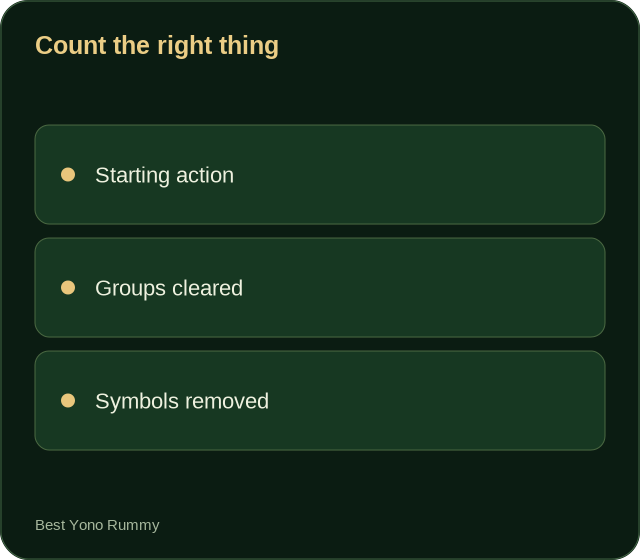
One initiating action can produce several successive clears in this model. A counter showing how many groups were removed has a different unit from a counter showing how many actions began. A result note can record one action, two clears and several removed cells without contradiction. State the unit beside each figure. This also helps when comparing a short animation with a log that shows only the end state.
The first clear removed three leaves. The next qualified group includes the three stars in the middle row and the star at top centre. Record four stars for that step. Seven cells have now been selected for removal across the two steps. They need not be seven different physical positions: cells can refill between steps. A count of removals over time and a count of locations on the grid answer different questions.
End the exercise before generating a second refill. The proper result is “two clears observed so far,” because the next state is unspecified. Writing that the chain must end at two would add a fact that the rules and drawings do not determine. This convention is helpful when reading an interrupted animation as well; a paused image can document completed states while leaving the remainder unresolved.
Compare the app page with a game page
The Spin Crush profile makes the app name searchable and gives its cited sources. A game-specific paytable or puzzle description is the right place to establish actual matching conditions. If a destination contains card games as well as reels, the relevant rulebook depends on the tile you select inside it. Do not transfer the cascade conditions of a familiar puzzle to a different game just because its app icon has similar artwork.
The source record for Spin Crush lists a ₹131 signup figure and ₹100 minimum withdrawal. Neither value is the size of a group or the number of possible cascade stages. Their headings belong with the citation and the date. The directory does not convert the seven removed paper shapes into any amount. If you need the conditions associated with a named product, use its own current terms rather than inferring them from the illustrative puzzle.
Carry the example to a smaller screen
On a phone, two before-and-after grids may stack vertically. Keep their column labels visible and read a single column through both diagrams before moving to the next. If you are looking for the app again, save its directory card so the exercise and the app name remain easy to find. Any active installation button opens a common offer whose own product name and conditions should be read at the destination.
A useful account of the puzzle can be only four lines long: the original board, the group rule, the positions of the refill and the point at which observation stopped. An account of the app's identity can be shorter still, consisting of the full product name and the source page. Sending one when the recipient asked for the other is a common source of confusion. Decide whether the conversation concerns the changing grid or the named catalogue entry before collecting more screenshots.
Give one reader the starting board with the refill cells omitted and another the complete sequence. The first can verify the initial three-leaf clear, including the two gaps in column one. Only the second can verify the later star group. A difference in what they can prove is the expected result of having different information. It does not tell you anything about the actual feature list of Spin Crush beyond the material its own sources document.
Questions about Spin Crush
Does the Spin Crush title establish a cascade feature?
The title identifies the app. Check the rules of the individual game before assuming it has cascading symbols. Our grid is a separate paper demonstration.
Can two diagonally touching leaves count as a group?
In the shared-side exercise, a purely diagonal connection is insufficient. The two leaves can belong to the same group if other matching leaves connect them through shared sides.
How many starting actions does the two-clear puzzle use?
One starting board leads to two observed clears after an explicitly supplied refill. The action count, the number of groups and the total cells removed are different quantities.
Source notes
Listing reference: app-name directory.