
What Club INR means in this catalogue
Club INR is a named multi-game app entry. The project files it under More apps and LetsPlayYono describes a club-style mixed lobby in an Android context. The letters INR also identify Indian rupees in monetary contexts. Here they are part of a name. A person looking at a bank statement or a price in an app store may see the same three letters without seeing any reference to Club INR. Look for the complete pair of words before treating a screenshot as evidence about the brand.
That distinction makes this a useful entry for anyone tracing an old message. If the message said simply “amount in INR”, it was probably specifying a unit. If it included an icon under the heading Club INR, it may have been identifying this app name. A subject line saying “Club balance” can still leave both the product and the unit unknown. Work from the labels that are actually visible. Guessing a missing product name from a currency code can attach a private payment to a service that had nothing to do with it.
Reading Indian digit grouping accurately
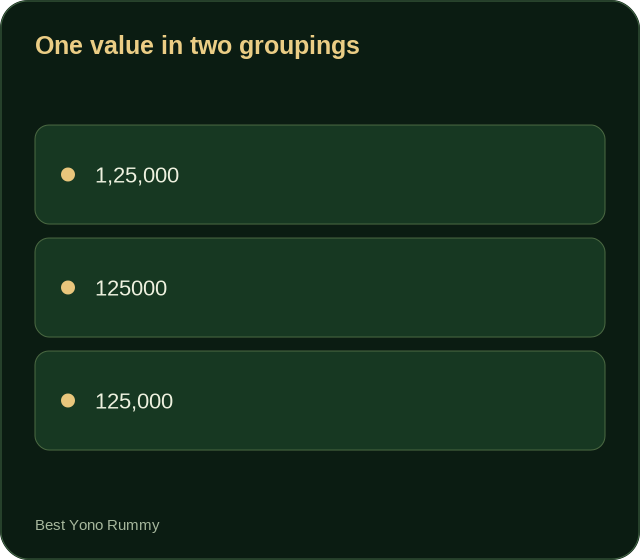
Consider the written number 1,25,000. In the Indian grouping convention the rightmost group has three digits and earlier groups commonly have two. The number is one lakh twenty-five thousand. In a convention grouping digits in threes it appears as 125,000. The digits and value are unchanged. This is an exercise in reading a number accurately, independent of any Club INR account. A person comparing two receipts can mistakenly see different figures when only the comma positions differ.
Try another example, 12,50,000. Read it as twelve lakh fifty thousand and write the digits without punctuation: 1250000. Now group them in threes from the right, giving 1,250,000. Checking the digit string first can settle a disagreement without asking someone to repeat a long number aloud. A misleading comparison arises when an amount written as 1.25 lakh is paired with 1,250 simply because the early digits resemble each other. Write the unit and the complete numerical value on each line before comparing them.
Rupees, paise and an example amount
One rupee contains one hundred paise. A practice entry of ₹125.50 therefore represents 125 rupees and 50 paise, or 12,550 paise. The decimal point separates rupees from their fractional part. It does not do the job of a thousands separator. Reading the digits as 12,550 rupees changes the value by a factor of one hundred. Keep the currency sign and the decimal point visible when copying a receipt into a notebook. This example is arithmetic and describes no fee or offer for Club INR.
Now imagine comparing two entries labelled 125.5 and 125.50 with the same currency code. The trailing zero changes the displayed precision, not the amount. A line showing 12550 without a unit is a different problem. It might represent rupees, paise, points or a reference number. It needs its heading before it can be interpreted. An app name containing the letters INR cannot provide that missing heading for every number on a screen. Read the local caption wherever the value appears.
Points, coins and balances on a picture
A decorative gold coin can make a game score look like money. The caption determines whether the value is measured in points, tokens, an example unit or a currency. Suppose a picture has a badge reading 240 points under a club emblem and a second field reading ₹24.00. The first is a points quantity and the second is a currency-denominated figure. Their numerical resemblance supplies no exchange rate. A stated conversion rule would be needed before converting one into the other.
Another picture might show the words maximum or up to next to a promotional number. That describes the nature of the claim, not a payment someone has received. If a source is quoting an old campaign, retain the campaign date alongside the amount. Changing the currency symbol or rounding a displayed value can distort the original statement. The dated figures in this directory are attributed where present. Inferring conditions, account eligibility or present availability from a card's artwork would go beyond what a dated directory listing establishes.
A reconciliation exercise without any payment
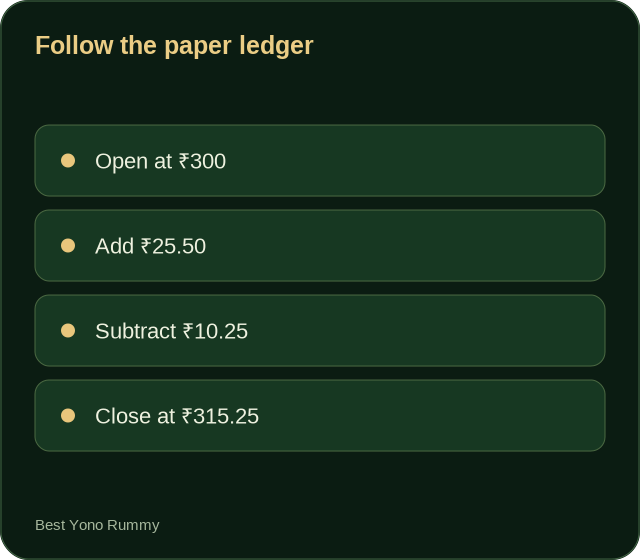
On paper, start an imaginary ledger at 300 rupees. Add a credit of 25.50 and then a debit of 10.25. The arithmetic closes at 315.25. Label each line with its direction before trying to add the values. If the second line were a reversal of the 25.50 credit rather than a new debit of 10.25, the result would be completely different. The exercise trains the reader to distinguish what a figure means from its appearance on the screen. No transaction is needed to try it.
For a second check, hand the ledger to someone else without the closing value. Ask them to reconstruct it from the opening entry and the two movements. If they treat the debit as a credit they will get 335.75. Comparing their steps reveals the exact mistake. That is more informative than asking them to keep rechecking the digits. In a real dispute, a platform's on-screen number and a bank's transaction record are different records with different issuers. The arithmetic exercise helps explain them; it cannot establish what happened to an actual account.
App name, merchant name and payment reference
A brand on an app icon, the merchant description on an account statement and the reference for an individual transfer serve three different purposes. They can occasionally contain some of the same letters. For example, seeing INR on a statement can tell you the transaction currency without identifying the app that prompted it. A payment reference may consist entirely of digits and still have no relationship to the monetary value. Keep the name, unit, amount and reference in distinct fields when organising your personal records.
If somebody asks for help identifying a payment, direct them first to the bank or provider that issued the statement through a contact route they already know. Public forums need no account number, payment PIN or one-time password. A catalogue can clarify how the complete Club INR name appeared in a directory. It has no transaction ledger or ability to adjudicate a refund. Giving the right party a precise existing reference is much more useful than trying to derive a merchant identity from a broadly used currency code.
Comparing a mixed lobby with one game
A club-style lobby can be remembered for a particular activity, yet the object being named is still the surrounding app. Describe the action you remember. A player arranging cards into runs may be describing rummy. Someone watching pictures settle into a grid may be recalling a reel game. A screenshot featuring both could be a lobby with multiple tiles rather than evidence that one game combines those rules. A title on the game screen and an app name beneath a phone icon identify different things.
Suppose a relative says Club INR showed a game with a temple scene. Several different games can use similar scenery. Ask for the printed title or the studio mark on the game's information screen rather than assuming the scene is unique. If the title can be recovered, keep it with a note about where it was seen. If the app name is the only firm clue, this profile can preserve that clue without inventing a list of titles currently available to a particular player.
Device details that help identify an installation
Check what the existing handset says before treating a download result as the product previously used. A browser may have added a home-screen shortcut that opens a website, while Android's installed apps list describes applications managed by the system. Both can display rounded icons labelled with a short name. The old browser history, a publisher listing saved by the owner or a system app information page can therefore answer different identity questions. An image sent in a chat rarely contains all those details.
When making a note, record only the identification information you need. The device model, displayed version and relevant public listing can be enough to explain why two screenshots look different. Personal contact lists and payment details are irrelevant to a comparison of app versions. Club INR is an independently listed name in this directory. The shared installation offer reached from its Install action must be identified on the destination page; the action supplies no proof of a Club INR package, publisher or verified Indian payment facility.
Preserving punctuation on a small screen
Small numbers grow ambiguous when a screenshot is resized. Zooming a copy can help distinguish a decimal point from a comma, but enlargement cannot reconstruct a character that was missing from the original. If a family member can still open the original document, ask them to read both the value and the label aloud. Have another person write it back in words. “Twelve thousand five hundred rupees” leaves much less room for a punctuation misunderstanding than a bare string of six characters read in a hurry.
Make a private transcription and keep the original alongside it. An OCR tool can turn the rupee sign into a letter or drop punctuation, and a messaging app may substitute a different symbol when text is pasted. If a digit remains uncertain, mark the uncertainty explicitly. An honest question about one decimal place can usually be settled by the issuer of a document. A confidently copied number may travel through several conversations before anyone remembers that the decimal place was never visible.
Keeping the brand and its numbers separate
For future reference, write a short heading with the complete product name and then a separate line for the item you want to identify. That item might be an app listing, a screenshot, a support message or a payment record. Add its date and origin. An app name stored on its own is useful for returning to the catalogue; a dated number remains interpretable only if its unit and context stay attached. This approach is especially useful where a currency abbreviation also appears inside the name itself.
Finish the paper exercise by writing three versions of the closing value: 315 rupees and 25 paise, ₹315.25, and 31,525 paise. Check that all three express the same amount. Now label a fourth line 315 points and explain why it cannot be merged into the first three. The difference is the unit, even when most of the digits are the same. Carrying that distinction back to a mobile screen makes the name Club INR easier to recognise and financial records less likely to be misread.
Compare two captions before comparing their values
Read “up to 500” beside “closing balance 500” and imagine the currency is specified in both. The first caption describes an outer limit in a claim. The second purports to describe a balance at a particular moment. Treating the two as equivalent would be wrong even if the currency and digits matched perfectly. Write one short sentence saying what each caption would allow you to conclude and what extra evidence you would need to check it. When the app and the unit share letters, a precise caption is worth more than a familiar-looking icon.
Preserve both captions when asking somebody else to compare the figures.
Questions about Club INR
What is 1,25,000 written without Indian digit grouping?
The digit string is 125000. Grouped in threes, it reads 125,000. Both notations represent one lakh twenty-five thousand units of the currency identified beside the amount.
How are ₹315.25 and 31,525 paise related?
One rupee is one hundred paise, so the two figures express the same amount. A figure labelled points still needs a separately stated conversion before it can be compared.
Does an INR line on my statement identify Club INR?
INR is a currency code. Check the merchant description and payment reference with the statement issuer before connecting any entry with a particular app or website.
Source notes
Listing reference: app-name directory.